
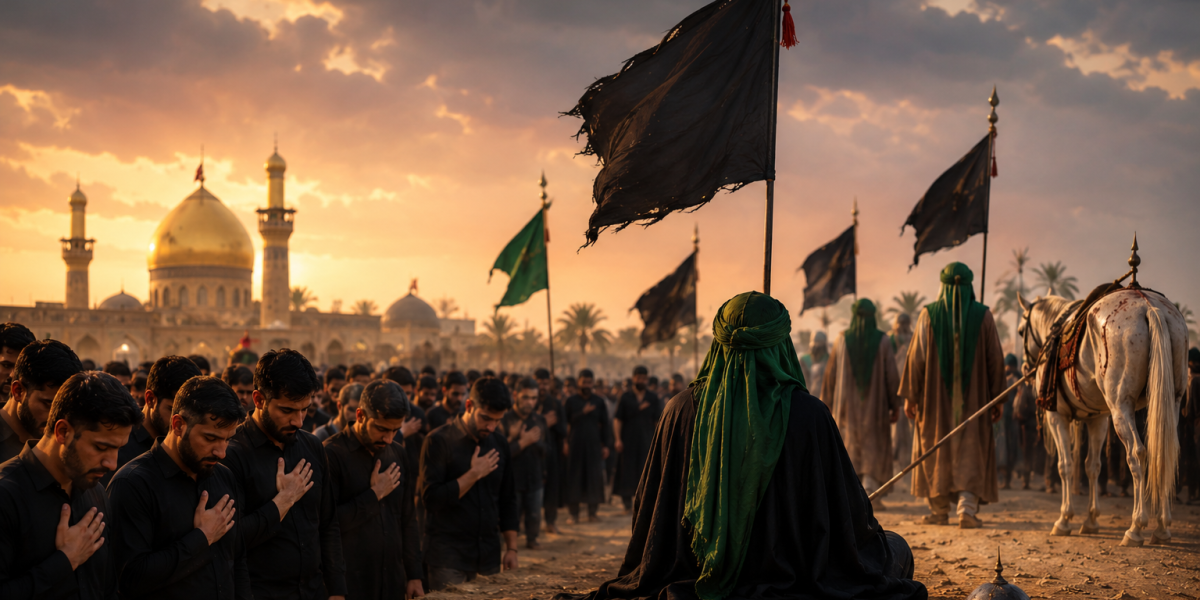
Muharram is the first month of the Islamic (Hijri) calendar and one of the four sacred months in Islam. The word “Muharram” comes from the Arabic root meaning “forbidden” or “sacred,” referring to the ancient prohibition on warfare during this month — a practice that predates Islam and was later affirmed by the Quran (Surah At-Tawbah, 9:36). While Muharram marks the beginning of the Islamic New Year, it is not a month of celebration. For Muslims around the world, it is a time of deep spiritual reflection, remembrance, and devotion. For the Shia Muslim community in particular, Muharram is a period of mourning that honours the sacrifice of Imam Hussain ibn Ali, the grandson of Prophet Muhammad (peace be upon him), at the Battle of Karbala.
The events of Muharram — especially the tragedy of Karbala and the spiritual significance of the Day of Ashura — continue to inspire millions with their message of justice, moral courage, and unwavering faith. This article explains why Muharram is observed, what happened at Karbala, how Ashura is understood differently across Muslim communities, and how Muharram is practised in India and around the world.
Key Takeaways
- Muharram is the first month of the Islamic calendar and one of four sacred months designated in the Quran (9:36).
- Prophet Muhammad (PBUH) called it “the Month of Allah” — no other month carries this title (Sahih Muslim 1163).
- The 10th of Muharram, called Ashura, is the most significant day of this month.
- For Shia Muslims, Ashura marks the martyrdom of Imam Hussain at Karbala in 680 CE.
- For Sunni Muslims, Ashura commemorates the day Allah saved Prophet Musa (Moses) and the Israelites from Pharaoh.
- Fasting on Ashura is a recommended Sunnah for Sunni Muslims, with the reward of expiating the sins of the previous year.
- Muharram is a gazetted public holiday in India, observed with processions, majlis gatherings, and community charity.
Why Is Muharram Sacred in Islam?
Muharram holds a unique position among the twelve months of the Islamic calendar. The Quran explicitly designates four months as sacred — Dhul Qi’dah, Dhul Hijjah, Muharram, and Rajab — and instructs Muslims not to wrong themselves during these months (Surah At-Tawbah, 9:36). Of these, Muharram stands apart because Prophet Muhammad (PBUH) himself gave it a title reserved for no other month: “the Month of Allah” (Shahr Allah al-Muharram).
The significance of this designation is reflected in the Prophet’s own practice. According to a hadith narrated by Abu Hurairah, the Prophet said: “The best fasting after the month of Ramadan is the month of Allah, al-Muharram, and the best prayer is prayer at night” (Sahih Muslim 1163, Sunan an-Nasa’i 1613). This places voluntary fasting during Muharram second only to the obligatory fast of Ramadan in spiritual merit.
Even before Islam, the Arabs of the pre-Islamic period (Jahiliyyah) regarded Muharram as a time when hostilities and bloodshed were forbidden. The Quran confirmed and elevated this practice, making the sanctity of Muharram part of divine law rather than merely tribal custom.
Therefore, Muharram is sacred not for a single reason but for a convergence of factors: its Quranic designation, the Prophet’s personal devotion to it, its role as the opening month of the Islamic calendar, and its association with some of the most defining events in Islamic history.
The Historical Event of Karbala: Why It Defines Muharram
The significance of Muharram is inseparable from the Battle of Karbala, which took place on the 10th of Muharram, 61 AH (10 October 680 CE) in present-day Iraq. This event is one of the most consequential moments in all of Islamic history, and its impact shaped the religious, political, and cultural identity of millions of Muslims.
The Background
After the death of Muawiyah ibn Abi Sufyan, the first Umayyad caliph, his son Yazid ibn Muawiyah assumed power. Yazid demanded allegiance from all prominent Muslim leaders, including Imam Hussain ibn Ali — the grandson of Prophet Muhammad through his daughter Fatimah and his son-in-law Ali ibn Abi Talib. Imam Hussain refused to pledge allegiance. He believed that Yazid’s rule was unjust and that accepting it would compromise the core principles of Islam.
Imam Hussain left Madinah for Kufa (in present-day Iraq) after receiving letters of support from the people of that city. However, before he could reach Kufa, his small caravan — comprising about 72 family members and companions, including women and children — was intercepted by the Umayyad army at Karbala. For several days, Hussain’s camp was besieged and cut off from the waters of the nearby Euphrates River. Despite negotiations, the Umayyad commander Umar ibn Sa’d was ordered to force Hussain’s submission or attack.
The Day of Ashura
On the 10th of Muharram, Imam Hussain and his companions were killed in a battle against a vastly outnumbered Umayyad force. Among the martyrs were Hussain’s infant son Ali al-Asghar, his brother Abbas ibn Ali (known for his loyalty and bravery), and many of Hussain’s relatives. After the battle, the women and children of Hussain’s camp — including his sister Zaynab bint Ali — were taken prisoner and marched to the Umayyad capital Damascus.
Why Karbala Matters Beyond Sectarian Lines
The tragedy of Karbala is not simply a historical event. It became a moral and spiritual reference point for concepts of justice, resistance to tyranny, and sacrifice for principle. In Shia Islam, Karbala symbolises the eternal struggle between good and evil — Hussain’s refusal to compromise his principles in the face of certain death represents the highest form of moral courage.
However, the significance of Karbala is not limited to Shia Muslims. Sunni Muslims also recognise Imam Hussain’s sacrifice and honour his memory, although their observance practices differ. Across cultures, religions, and centuries, figures from Mahatma Gandhi to Charles Dickens have cited the story of Karbala as an example of principled resistance against oppression.
What Is Ashura? Meaning and Significance for Sunni and Shia Muslims
Ashura (Arabic: عاشوراء, meaning “the tenth”) falls on the 10th day of Muharram and is one of the most important dates in the entire Islamic calendar. However, Sunni and Shia Muslims understand and observe Ashura in distinctly different ways — both rooted in authentic Islamic tradition but emphasising different historical events.
Ashura in Sunni Islam: A Day of Gratitude and Fasting
For many Sunni Muslims, Ashura is a day of thanksgiving associated with divine deliverance. According to a hadith narrated by Ibn Abbas, when the Prophet Muhammad arrived in Madinah, he found the Jewish community fasting on the 10th of Muharram. When he asked the reason, they explained that it was the day on which Allah saved Prophet Musa (Moses) and the Israelites from Pharaoh by parting the Red Sea. The Prophet responded: “We have more right to Musa than they do,” and he fasted on that day and encouraged Muslims to do the same (Sahih al-Bukhari 2004, Sahih Muslim 1130).
In broader Sunni tradition, Ashura is also associated with several other auspicious events: the day God forgave Prophet Adam, the day Prophet Nuh (Noah) disembarked from the Ark, and the day Prophet Yusuf (Joseph) was released from prison. These associations reinforce Ashura as a day of divine mercy and gratitude across many prophetic traditions.
Fasting on Ashura is voluntary (nafl) but strongly recommended. The Prophet said: “Fasting the Day of Ashura, I hope from Allah, will expiate the sins of the previous year” (Sahih Muslim 1162). To distinguish the Muslim fast from the Jewish observance, the Prophet also recommended fasting an additional day — either the 9th (Tasu’a) or the 11th of Muharram — alongside the 10th.
Ashura in Shia Islam: A Day of Mourning
For Shia Muslims, Ashura is defined by the martyrdom of Imam Hussain at Karbala. It is a day of intense mourning, not celebration. The grief is not merely historical — it is an annual re-engagement with the values Hussain stood for and a collective renewal of the commitment to justice.
Mourning traditions include majlis gatherings (religious assemblies) where scholars narrate the events of Karbala, recitations of marsiyas (elegies) and nauhas (mourning poetry), and processions through the streets. Participants often wear black as a symbol of grief. In some communities, matam (chest-beating) is practised as a physical expression of sorrow.
It is important to note that the Shia mourning of Muharram does not end on Ashura. The period of remembrance extends through the month of Safar and concludes on the 8th of Rabi al-Awwal — spanning approximately 68 days — reflecting the belief that the suffering of Hussain’s family continued well beyond the battlefield.
How Do Shia and Sunni Muslims Observe Muharram Differently?
One of the most common questions about Muharram concerns the differences between how the two largest branches of Islam observe this month. While both Sunni and Shia Muslims regard Muharram as sacred, the emphasis, rituals, and emotional tone differ significantly.
| Aspect | Shia Observance | Sunni Observance |
|---|---|---|
| Primary focus | Mourning the martyrdom of Imam Hussain at Karbala | Gratitude for divine deliverance of Prophet Musa |
| Emotional tone | Solemn, grief-centred | Reverent, devotional |
| Fasting on Ashura | Generally discouraged or avoided; some scholars consider it impermissible due to Umayyad-era associations | Strongly recommended Sunnah; expiates the previous year’s sins |
| Key rituals | Majlis, marsiya recitation, nauha, mourning processions, taziya, matam | Voluntary fasting, increased prayer, charity, Quran recitation |
| Duration | First 10 days intensely, then through Safar and into Rabi al-Awwal (~68 days total) | Primarily Ashura (10th), with optional fasting on 9th or 11th |
| Dress | Black clothing as a sign of mourning | No specific dress code |
| Public expression | Processions (juloos), taziya carrying, public gatherings | Private worship, mosque gatherings |
| View of Karbala | Central to faith; foundational to Shia identity | Recognised and deeply respected, but not the central observance |
| Arbaeen pilgrimage | Major observance — millions walk from Najaf to Karbala 40 days after Ashura | Not widely observed |
Despite these differences, both communities share a deep respect for Imam Hussain and regard Muharram as one of the holiest periods in the Islamic year.
The Arbaeen Pilgrimage: The World’s Largest Annual Gathering
One of the most remarkable extensions of Muharram observance is the Arbaeen pilgrimage, which takes place 40 days after Ashura on the 20th of Safar. This annual pilgrimage to the shrine of Imam Hussain in Karbala, Iraq, has grown into the world’s largest annual peaceful gathering — surpassing the Hajj in total attendance, though the Hajj remains the obligatory pilgrimage for Muslims.
In 2025, an estimated 25 million pilgrims participated in the Arbaeen pilgrimage. Most walk the roughly 80-kilometre route from Najaf to Karbala over two to three days, often in extreme heat. Along the route, volunteers and local families set up thousands of mawkabs (service stations) providing free food, water, medical care, and rest facilities to all pilgrims regardless of faith or nationality.
In 2019, UNESCO added the provision of services and hospitality during Arbaeen to its Representative List of the Intangible Cultural Heritage of Humanity, recognising the extraordinary scale of collective generosity that characterises this event.
The Arbaeen pilgrimage is not exclusively Shia. Sunni Muslims, Christians, Yazidis, and people of other faiths also participate. Indian pilgrims are among those who travel to Karbala annually, with groups like Karwan-e-Hind providing organised services for Indian devotees.
How Is Muharram Observed in India?
India is home to over 200 million Muslims — the third-largest Muslim population in the world — and Muharram is one of the most widely observed Islamic occasions in the country. Approximately one-quarter of Indian Muslims follow Shia Islam, and Muharram observances in India blend religious devotion with deeply rooted cultural traditions.
Major Observance Traditions in India
Majlis Gatherings: Religious assemblies called majlis are held throughout the first ten days of Muharram in homes, mosques, and dedicated buildings called imambaras (also called ashurkhanas). Scholars narrate the events of Karbala, and attendees participate in mourning through listening, weeping, and recitation of elegies.
Taziya Processions: One of the most visually distinctive traditions in Indian Muharram observance is the carrying of taziyas — ornate replicas of Imam Hussain’s shrine — through the streets. These bamboo-and-paper structures are often elaborately decorated and can be several feet tall. The taziya procession tradition is especially prominent in Lucknow, Hyderabad, and parts of Bihar and Uttar Pradesh.
Sabeel and Niyaz: Many families and community groups distribute free food and water (sabeel) to the public during Muharram, symbolising the suffering of Hussain’s camp when they were denied water at Karbala. This practice of niyaz (food offering) is open to people of all faiths and is a hallmark of communal generosity during the month.
Cross-Faith Participation: Muharram in India has a unique interfaith dimension. In many regions, Hindus participate in building taziyas, offering water to mourners, and playing traditional drums during processions. This cross-community participation reflects centuries of shared cultural heritage, particularly in cities like Lucknow, Hyderabad, Kolkata, Srinagar, and parts of Kerala and Karnataka.
Cities Known for Muharram Observance
Lucknow is widely regarded as the centre of Muharram observance in India. The city’s historic imambaras — especially the Bara Imambara and Chhota Imambara — host elaborate azadari (mourning) rituals featuring soul-stirring nauhas and marsiyas. Hyderabad’s Old City witnesses significant processions, particularly the historic “Bibi ka Alam” procession. In Kerala, the Mappila Muslim community observes Muharram with public mourning and chest-beating processions in areas like Calicut and Malappuram.
Public Holiday Status
The 10th of Muharram (Ashura) is a gazetted public holiday in India. Government offices, post offices, banks, and most schools remain closed. In areas with significant Muslim populations, large processions may cause local traffic disruptions.
Lessons from the Story of Karbala
The tragedy of Karbala is remembered not simply as a historical event but as a timeless moral parable. Its enduring power lies in the universal nature of its themes, which transcend sectarian, religious, and cultural boundaries.
Standing against injustice even when outnumbered: Imam Hussain chose to confront an unjust ruler with just 72 companions against an army of thousands. His decision was not strategic — it was principled. This teaches that the moral weight of an action does not depend on its probability of worldly success.
Faithfulness to one’s principles under pressure: Hussain was offered multiple compromises and safe passages if he would simply accept Yazid’s authority. He refused, not out of stubbornness, but because he believed that silence in the face of injustice is itself a form of complicity.
The role of women in preserving the message: Zaynab bint Ali, Hussain’s sister, played a crucial role after Karbala. Taken captive and brought to Damascus, she delivered powerful sermons in the court of Yazid that exposed the injustice of Karbala and ensured that Hussain’s sacrifice would not be forgotten. Many historians regard Zaynab’s role as essential to the survival of the Karbala narrative.
Sacrifice for a purpose beyond oneself: Hussain’s sacrifice was not for personal gain or political power. He explicitly stated his goal as reforming the Ummah (community) of his grandfather, the Prophet Muhammad. This selfless motivation is what elevates the event from political conflict to spiritual exemplar.
Patience in suffering: The deprivation of food and water endured by Hussain’s camp for days before the battle — including the suffering of women and children — is a profound lesson in patience (sabr), one of the most valued qualities in Islamic ethics.
Practical Observance: How to Honour Muharram
How You Can Observe Muharram
- Fast on Ashura (Sunni practice): Fast the 10th of Muharram, preferably with the 9th or 11th, following the Sunnah of the Prophet.
- Increase voluntary fasting throughout Muharram: The Prophet identified this month as the best for voluntary fasting after Ramadan.
- Give charity: Acts of generosity during Muharram — especially on Ashura — are considered highly meritorious. Many communities organise food distribution as a reflection of Hussain’s spirit of selflessness.
- Attend majlis or educational gatherings: Learning about the events of Karbala and their moral implications is a core practice, especially for Shia Muslims.
- Reflect and set spiritual intentions: As the first month of the Islamic year, Muharram is a natural time for self-assessment, repentance (tawbah), and setting new spiritual goals.
- Increase Quran recitation and dhikr: Scholars across traditions recommend devoting additional time to worship during this sacred month.
Conclusion
Muharram is far more than the beginning of a new Islamic year. It is a sacred month that carries the weight of Quranic designation, Prophetic devotion, and some of the most defining events in Islamic history. The sacrifice of Imam Hussain at Karbala remains a powerful symbol of justice, courage, faith, and resistance against oppression — a story that has inspired not only Muslims but people of conscience across cultures and centuries.
Whether observed through mourning processions and majlis gatherings, or through fasting and increased worship, Muharram calls every Muslim to pause, reflect, and recommit to the values of truth, patience, generosity, and moral courage. The message of Karbala is ultimately simple and universal: stand for what is right, even when it costs everything.
References & Source Notes
Quran, Surah At-Tawbah (9:36): Designates four sacred months, including Muharram, and instructs Muslims not to wrong themselves during these months.
Sahih Muslim 1163 / Sunan an-Nasa’i 1613: Hadith of Abu Hurairah — “The best fasting after Ramadan is in the month of Allah, al-Muharram.”
Sahih al-Bukhari 2004 / Sahih Muslim 1130: Hadith of Ibn Abbas — Prophet’s instruction to fast on Ashura after learning of the Jewish observance in Madinah.
Sahih Muslim 1162: Hadith on the expiation of previous year’s sins through fasting on Ashura.
Historical sources on Karbala: The Battle of Karbala (10 Muharram 61 AH / 10 October 680 CE) is documented across classical Islamic historiography, including works by al-Tabari and Ibn Kathir.
UNESCO Intangible Cultural Heritage (2019): Recognition of the provision of services and hospitality during the Arbaeen pilgrimage in Karbala, Iraq.
Frequently Asked Questions (FAQ)
Why is Muharram observed?
Muharram is observed because it is one of the four sacred months designated in the Quran (9:36) and because Prophet Muhammad (PBUH) called it “the Month of Allah.” For Shia Muslims, it is primarily a period of mourning for the martyrdom of Imam Hussain at Karbala in 680 CE. For Sunni Muslims, it is a blessed month associated with the fasting of Ashura, which commemorates the day Allah saved Prophet Musa from Pharaoh.
What is Ashura and why is it important?
Ashura is the 10th day of Muharram. For Shia Muslims, it marks the day Imam Hussain was martyred at the Battle of Karbala. For Sunni Muslims, it commemorates the day Allah parted the Red Sea to save Prophet Musa and the Israelites. Fasting on Ashura is a recommended Sunnah in Sunni Islam, with the Prophet stating that it expiates the sins of the previous year (Sahih Muslim 1162).
Is Muharram a public holiday in India?
Yes, the 10th of Muharram (Ashura) is a gazetted public holiday in India. Government offices, banks, post offices, and most schools are closed. Large processions and prayer gatherings are held across the country, particularly in cities like Lucknow, Hyderabad, Kolkata, and Srinagar.
What is the difference between Shia and Sunni observance of Muharram?
Shia Muslims observe Muharram primarily as a period of mourning for Imam Hussain, with rituals including majlis gatherings, marsiya recitations, mourning processions, and wearing black. Sunni Muslims observe the month with voluntary fasting (especially on Ashura), increased prayer, and charity. Sunnis recognise and respect Hussain’s sacrifice but do not generally observe specific mourning rituals.
What is the Arbaeen pilgrimage?
Arbaeen takes place 40 days after Ashura, on the 20th of Safar. It is an annual pilgrimage to the shrine of Imam Hussain in Karbala, Iraq, and is considered the world’s largest annual peaceful gathering, with over 20 million participants in recent years. Pilgrims walk approximately 80 kilometres from Najaf to Karbala, and volunteers provide free food, water, and rest facilities along the route. UNESCO recognised the hospitality traditions of Arbaeen as Intangible Cultural Heritage in 2019.
Can non-Muslims participate in Muharram observances?
Yes. In India and many other countries, people of different faiths participate in Muharram processions, help build taziyas, distribute food, and attend educational gatherings. The Arbaeen pilgrimage in Iraq also welcomes participants of all faiths. Muharram’s themes of justice, sacrifice, and compassion resonate across religious boundaries.
Is fasting on Ashura obligatory?
No, fasting on Ashura is not obligatory. It is a highly recommended voluntary fast in Sunni Islam. The Prophet recommended fasting the 9th and 10th, or the 10th and 11th of Muharram. In Shia Islam, fasting on Ashura is generally discouraged or avoided.

Editorial Review Note
Written by Religion World — Bhavya Srivastava is the founder of Religion World and a veteran journalist with over 18 years of experience across broadcast, print, and digital media. A founding member of the International Association of Religion Journalists (IARJ), he has spent much of his career reporting on and producing content about religion, faith, and spirituality. View full profile →.
Religion World provides information on all religions and presents it impartially. You can send us information, news, updates, opinions, and suggestions at religionworldin@gmail.com. You can also follow us on X (Twitter), Facebook, and YouTube.