

Key Takeaways
- Haridwar Ardh Kumbh 2027 dates: 14 January – 20 April 2027 (97 days)
- 10 official Snan (bathing) dates, not 9 — Nav Samvatsar on 7 April is part of the list but frequently missed by other articles
- The government has renamed “Shahi Snan” to “Amrit Snan” for 2027, the first such change in Haridwar Kumbh history
- Three dates are confirmed as Amrit Snan (main royal bathing) days: 6 March, 8 March, 14 April 2027; some reports also count 20 April as a fourth — this is not yet uniformly confirmed
- 8–10 crore pilgrims are expected across the mela period
Haridwar Ardh Kumbh 2027: Full Bathing Date List
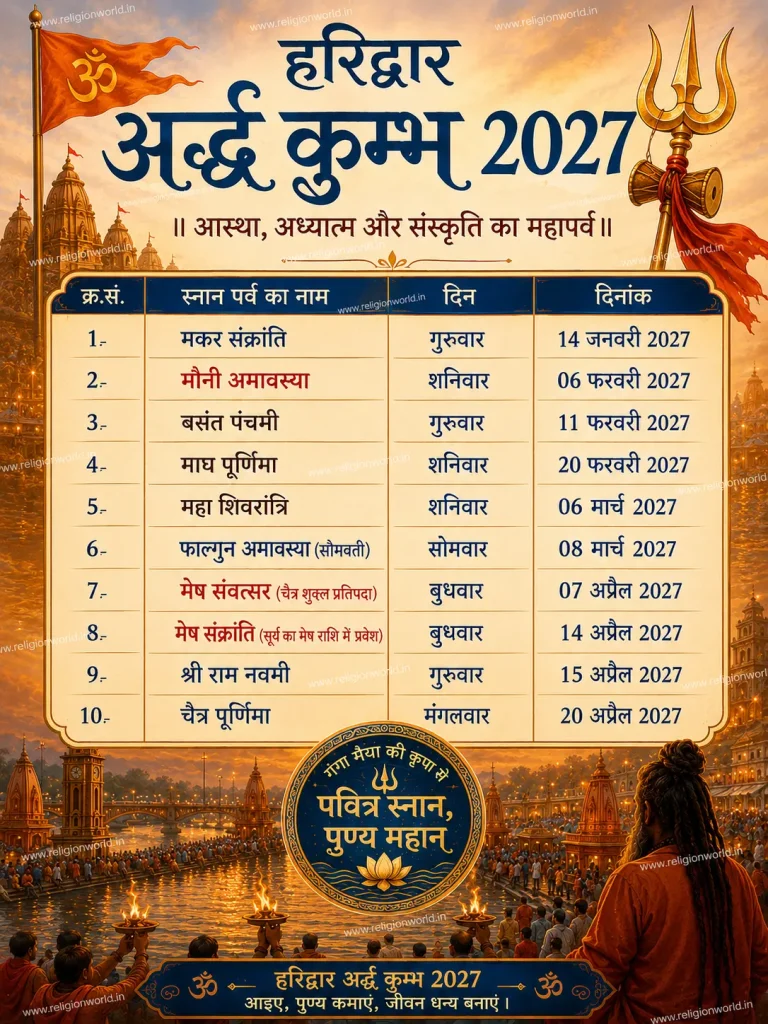
The Ardh Kumbh is held once every six years in Haridwar, midway between two full Kumbh Melas. For 2027, it follows the Prayagraj Maha Kumbh of 2025 and precedes the next Haridwar Kumbh in 2037. The dates below were finalised at a meeting between Uttarakhand Chief Minister Pushkar Singh Dhami and representatives of all 13 Akharas, led by Akhara Parishad president Mahant Ravindra Puri.
| Date | Occasion | Significance |
|---|---|---|
| 14 January 2027 | Makar Sankranti | Opening Snan of the mela |
| 6 February 2027 | Mauni Amavasya | Traditionally the most crowded non-Amrit Snan day |
| 11 February 2027 | Basant Panchami | Spring festival bathing day |
| 20 February 2027 | Magh Purnima | Full moon bathing day |
| 6 March 2027 | Maha Shivratri | 1st Amrit Snan (main Akhara procession day) |
| 8 March 2027 | Phalgun / Somvati Amavasya | 2nd Amrit Snan |
| 7 April 2027 | Nav Samvatsar (Chaitra Pratipada) | Hindu New Year Snan |
| 14 April 2027 | Mesh Sankranti (Baisakhi) | 3rd and largest Amrit Snan of the mela |
| 15 April 2027 | Ram Navami | Bathing day |
| 20 April 2027 | Chaitra Purnima | Closing Snan; 4th Amrit Snan |
All 13 Akharas have agreed on this schedule. That said, as of writing, no independent primary source — such as a formal Uttarakhand Mela Administration notification — has been published online; every report traces back to statements made at the same Akhara Parishad–government meeting. Treat the dates as reliable but not yet gazette-final, and check for an official update closer to the event.
Why “Shahi Snan” Is Now Called “Amrit Snan”
For the first time in Haridwar’s Kumbh history, the government has replaced the term “Shahi Snan” (Royal Bath) with “Amrit Snan” (Nectar Bath). The word “Shahi” has Persian/Urdu roots and referred to the royal procession style of the Akharas. “Amrit” is Sanskrit and ties the bathing ritual directly to the Samudra Manthan legend — the churning of the cosmic ocean — where a drop of the nectar of immortality is believed to have fallen at Har Ki Pauri. The change was announced by CM Dhami in consultation with the 13 Akharas and is now used in official signage and administrative documents for the 2027 mela.
Functionally, an Amrit Snan day works the same way a Shahi Snan always has: Akharas process to the ghats in a fixed order, Naga Sadhus bathe first, and general pilgrim access is restricted or staggered around the procession window. If you are avoiding crowds, treat 6 March, 8 March, and 14 April as the three days to plan around — 20 April is the safer bet if you want a Purnima bath without the same scale of procession, though even that may see heavier footfall as the mela’s closing date.
Is Haridwar Ardh Kumbh 2027 a Public Holiday?
The Ardh Kumbh itself is not a nationwide public holiday. However, the Uttarakhand state government typically declares local holidays and restricted-movement zones in Haridwar district on the major Amrit Snan dates, and schools in the district often see closures around peak Snan days. Banks and central government offices follow the standard Reserve Bank of India and state holiday calendars, which are published closer to the year — this is a good one to update once RBI’s 2027 calendar is out, since it hasn’t been released as of writing.
How Haridwar Ardh Kumbh Differs From Prayagraj and Nashik
2027 is unusual because it hosts two Kumbh-cycle events in the same year: the Ardh Kumbh in Haridwar (14 Jan–20 Apr) and the Simhastha Kumbh in Nashik (July–August 2027). According to Hindu tradition, whenever Haridwar holds its Ardh Kumbh, Nashik or Ujjain hosts a Simhastha in parallel, since both trace back to the same Samudra Manthan legend. Haridwar’s Ardh Kumbh is a six-year cycle event; the full Maha Kumbh at Prayagraj (most recently 2025) follows a twelve-year cycle. Spiritually, Hindu tradition treats the Ardh Kumbh’s merit as equal to a full Kumbh — “Ardh” (half) refers to the cycle position, not a reduced significance.
Practical Takeaways for Pilgrims
- Avoiding crowds: visit in late January or early February, before Mauni Amavasya (6 Feb), or after Ram Navami (15 Apr) but before Chaitra Purnima (20 Apr).
- For the fullest ritual experience: plan around 14 April (Baisakhi), the largest of the three confirmed Amrit Snan days.
- Book accommodation early for any date within 3 days of 6 March, 8 March, or 14 April — hotels and dharamshalas near Har Ki Pauri fill months in advance for Amrit Snan windows.
- Check for updated advisories in late 2026, when the Uttarakhand Mela Administration is expected to publish a formal notification confirming (or correcting) this schedule.
Frequently Asked Questions
What are the official Haridwar Ardh Kumbh 2027 dates?
The mela runs from 14 January 2027 (Makar Sankranti) to 20 April 2027 (Chaitra Purnima), a total of 97 days, with 10 official bathing dates in between.
How many bathing dates are there in Ardh Kumbh 2027?
Ten official Snan dates have been announced, including three confirmed Amrit Snan (main royal bathing) days on 6 March, 8 March, and 14 April 2027.
What is the first Amrit Snan date in 2027?
The first Amrit Snan falls on 6 March 2027, coinciding with Maha Shivratri.
Why is it called Amrit Snan instead of Shahi Snan in 2027?
The Uttarakhand government, in consultation with the 13 Akharas, renamed “Shahi Snan” to “Amrit Snan” for 2027 to align the term with the Sanskrit origins of the Kumbh legend rather than its Persian-origin predecessor. The ritual itself is unchanged.
Is Chaitra Purnima on 20 April 2027 an Amrit Snan?
This is reported inconsistently. Most sources describe only three Amrit Snan dates (6 March, 8 March, 14 April) and list 20 April as the closing Snan; at least one report describes it as a fourth Amrit Snan. Confirm closer to the date if this distinction matters for your travel plans.
Is Ardh Kumbh 2027 a government holiday in Haridwar?
It is not a nationwide holiday, but Uttarakhand typically declares local restrictions and district-level closures around the major Amrit Snan dates. Check the state government’s calendar closer to the event for confirmed local holiday declarations.
What is the difference between Ardh Kumbh and Maha Kumbh?
Ardh Kumbh (“half Kumbh”) occurs every six years at Haridwar and Prayagraj; Maha Kumbh occurs every twelve years at the same sites. Spiritually, Hindu tradition holds that the merit of bathing during Ardh Kumbh is equal to that of a full Kumbh.
References / Source Notes
Dates cross-verified across three independent reports of the 28 November 2025 meeting between Uttarakhand CM Pushkar Singh Dhami and the Akhil Bharatiya Akhara Parishad: India TV News, Daily Jagran (JND), and Ardh Kumbh info portal coverage citing the Uttarakhand Mela Administration. No primary government notification was located as of the last research pass — update this section once an official state government or Mela Administration source is published.

Editorial Review Note
Written by Religion World — Bhavya Srivastava is the founder of Religion World and a veteran journalist with over 18 years of experience across broadcast, print, and digital media. A founding member of the International Association of Religion Journalists (IARJ), he has spent much of his career reporting on and producing content about religion, faith, and spirituality. View full profile →.
Religion World provides information on all religions and presents it impartially. You can send us information, news, updates, opinions, and suggestions at religionworldin@gmail.com. You can also follow us on X (Twitter), Facebook, and YouTube.