Kartik Purnima is one of the most sacred full-moon days in the Hindu calendar, observed on the Shukla Paksha Purnima (full moon) of the holy month of Kartik. Falling roughly fifteen days after Diwali, it marks the culmination of a month of fasting, pilgrimage and lamp-lighting. The day carries layered meaning across traditions — it commemorates Lord Shiva’s victory over the demon Tripurasura, celebrates Lord Vishnu’s Matsya avatar, and is honoured by Hindus, Sikhs and Jains alike.
Kartik Purnima falls on the full-moon day of the Kartik month (November–December). In 2026, it is observed on Tuesday, 24 November. Because the Purnima tithi and moonrise vary by city, always confirm with your local panchang before scheduling rituals.
The Significance of Kartik Purnima
The Kartik month is considered deeply auspicious for spiritual growth, and its full-moon day is regarded as one of the most opportune occasions of the year for sacred rituals. On this day, Lord Shiva is believed to have slain Tripurasura, the demon who had conquered the gods and built three fortress-cities (Tripura). For this reason, the day is also known as Tripuri Purnima or Tripurari Purnima. It is also believed that Lord Vishnu incarnated as Matsya (the fish) on this day.
According to scripture, performing the Kartik Snan (holy bath) and offering prayers to Lord Vishnu on this day blesses devotees with great merit — the ritual bath is said to carry the spiritual weight of many yagyas, and a dip in the Ganga on Kartik Purnima is held to grant liberation.
The Five-Day Festival Cluster
Kartik Purnima is not a single day but the finale of a five-day sequence that begins on Prabodhini (Devuthani) Ekadashi, the eleventh day, and ends on the Purnima, the fifteenth. These days include several important observances:
Tulsi Vivah
Tulsi Vivah usually begins on Prabodhini Ekadashi and concludes on Kartik Purnima. Devotees perform the ceremonial wedding of Tulsi Mata to Lord Shaligram (a form of Lord Vishnu). As per the scriptures, it may be observed on any convenient day between Ekadashi and Kartik Purnima.
Bhishma Panchak
The Bhishma Panchak fast also begins on Prabodhini Ekadashi and ends on Kartik Purnima. In the Vaishnava tradition, this five-day fast observed during the last days of the month is considered highly significant.
Vaikuntha Chaturdashi
Observed a day before Kartik Purnima, on Chaturdashi. It is believed that Lord Vishnu worshipped Lord Shiva on this day, offering one thousand lotus flowers. Many Shiva temples hold special pujas in which Vishnu and Shiva are worshipped together — a rare occasion honouring both deities.
Dev Diwali
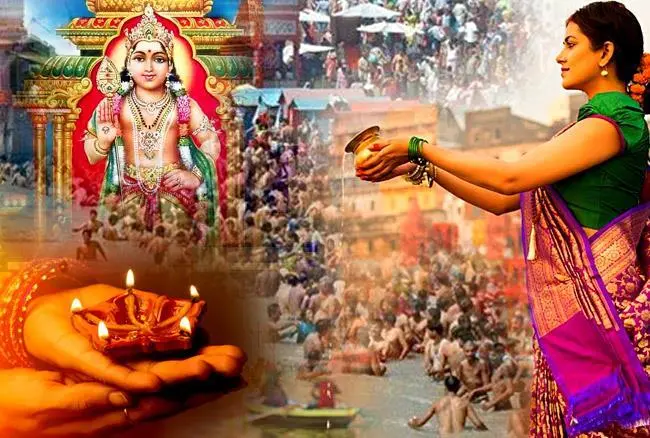
Dev Diwali — the “Diwali of the Gods” — coincides with Kartik Purnima. After Shiva vanquished Tripurasura, the gods are said to have celebrated by lighting lamps in the heavens; the day is therefore marked much like Diwali. The spectacle is at its most breathtaking in Varanasi, where thousands of earthen lamps illuminate the river ghats and temples along the Ganga.
Other Observances on This Day
Kartik Purnima is shared across communities. It is celebrated by Sikhs as Guru Nanak Jayanti (the birth anniversary of Guru Nanak), and is a major pilgrimage day for Jains. In Hindu tradition, it is also remembered as the birth day of Kartikeya, the son of Lord Shiva, and of Vrinda (Tulsi) and the Matsya avatar.
Rituals of Kartik Purnima
- Kartik Snan: Take a holy bath at a river or pilgrimage site before sunrise. This sacred bath is the central ritual of the day.
- Worship Lord Vishnu: Offer flowers, light diyas and incense, and pray for prosperity and wellbeing.
- Fast and katha: Observe a day-long fast, perform Rudrabhishek, and read the Satyanarayan Katha.
- Light lamps: Illuminate the home, temple and (where possible) riverbanks in the evening for Dev Diwali.
- Kartik Purnima Mela: The famous fair at Pushkar concludes on this day, when devotees take a sacred dip in the Pushkar Lake.
The Story of Kartik Purnima
The legend centres on Tripurasura, a demon who had defeated the gods and seized control of the three worlds. He built three great cities in the sky, collectively called Tripura, protected by a boon that they could be destroyed only when perfectly aligned — an alignment that occurred just once in a thousand years — and only by a single arrow. Lord Shiva waited for that precise moment and, when the three cities aligned, released one fiery arrow that destroyed them all, freeing the gods. In their joy, the deities lit lamps to celebrate — the origin of Dev Diwali. It is said that observing the Kartik Purnima fast and rituals opens the path to Dharma, Artha, Kama and Moksha.
Note: The information in this article is based on Hindu scriptures, traditions and local beliefs. Ritual dates and timings vary by region and panchang; please confirm with your local calendar before observing.
Frequently Asked Questions
What is the significance of Kartik Purnima?
Why is Kartik Purnima also called Dev Diwali?
What is Kartik Snan?
Which festivals fall in the Kartik Purnima cluster?
What rituals are performed on Kartik Purnima?

Editorial Review Note
Written by Religion World — Bhavya Srivastava is the founder of Religion World and a veteran journalist with over 18 years of experience across broadcast, print, and digital media. A founding member of the International Association of Religion Journalists (IARJ), he has spent much of his career reporting on and producing content about religion, faith, and spirituality. View full profile →.
Religion World provides information on all religions and presents it impartially. You can send us information, news, updates, opinions, and suggestions at religionworldin@gmail.com. You can also follow us on X (Twitter), Facebook, and YouTube.