
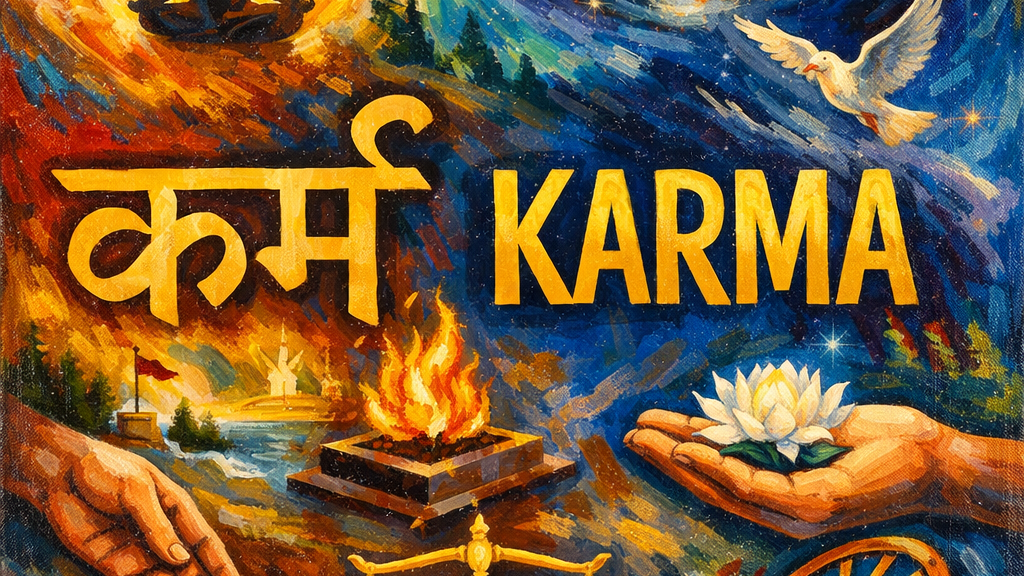
Karma Meaning in Today’s Language
Karma meaning carries a slightly different flavour in English. When we hear karm (कर्म), it feels pure — something that must be done rightly. In contrast, karma today lives in our collective mind more as a concept.
People casually say: karma returns, karma has memory, karma comes back. As a result, these lines now float around us like everyday idioms.
And yet, the kind of knowledge needed to truly understand karma — beyond the intellect — is slowly disappearing.
Why the Connection Between Knowledge and Karma Feels Broken
Between good karma, bad karma, right karma, and wrong karma, so many new behaviours and old thresholds have entered our lives that even after crossing them, we still fail to understand the happiness and sorrow unfolding in our own existence. Therefore, the connection between knowledge and karma often feels broken.
Moreover, the behaviour of the wise and the powerful sometimes looks the same now. Their comfort also appears driven more by influence and shortcuts than by karma itself.
Still, let’s step above surface-level observations and try to understand karma with patience.
Karma as the Clock of Every Moment
Karma is the clock of every moment — ticking and moving the hands toward the next phase. Between daylight and the darkness of night, karma stays bound to every cry rising from the human heart and every urge forming in the mind.
For those who believe in karma, it can feel like a double-edged sword. For those who don’t, life often becomes a kind of intoxication.
Intoxication, Awareness, and Consequence
Just as a drunk wants only to live under the influence — to shout, to fight, to lash out — we too live intoxicated: speaking, performing, pretending. Later, when awareness returns, the drunk may look calm and restless at the same time. However, he continues unburdened by consequence — until one day the liver fails or the heart stops.
Unfortunately, intoxication rarely allows him to think of that future result.
In the same way, we are all intoxicated in some form. We speak, we perform, we pretend — yet how many of us are truly awake, we don’t really know.
Karma Is Not Simple
Karma is not simple. In Hindu thought, karma also carries the quota of past lives and destiny (prārabdha). Only the detached and the awakened prepare the next compartment of existence; the rest of us are still dressing up for this life — swinging between bridegroom and dowry.
Why Karma Feels Like “Speed Post”
Like a wedding where emotions, expenses, relationships, dishes, and decorations gather in one place, our urge to break every speed limit of life has turned karma’s principles into a kind of speed-post service — fast in name, but with a delivery time known only when the letter finally arrives.
Meanwhile, between the simplest and the most complex interpretations of karma, the train of human desires, words, advice, and love runs without whistle or destination. Consequently, many people believe in karma — yet do something entirely different.
Karma in the Vedas, Upanishads, and the Gita
In the Rigveda and Yajurveda, karma is primarily linked to yajna (sacrifice), āhuti (offering), duty, and ṛta (cosmic order). The Upanishads say: Yathā karma yathā śrutam — as a person acts, so they become.
The Bhagavad Gita divides karma into two layers:
-
Sakāma karma — action done with desire for results, which creates bondage.
-
Niṣkāma karma — action done as duty, without attachment to results, which opens the path to liberation.
Therefore, the scriptures remind us: karma itself is not bondage — attachment is.
Vedanta summarizes it beautifully: Karma purifies, knowledge liberates, devotion completes. Read that once more — slowly.
Understanding Karma Beyond “Good” and “Bad”
Understanding karma is both simple and not simple. To act is movement; yet not acting can also be a higher movement. To bear karma is life, whereas to renounce it is penance.
Karma as action is process; karma as sequence is expression. From karma comes work; from karma comes fruit. Refining karma is wisdom; and sweeping karma away is intellect.
Karma that is, is not.
Karma that will be, never truly is.
A Closing Thought
My karma, your karma, everyone’s karma, the world’s karma — all exist together, moving together.
So walk — carrying karma, doing karma, thinking karma, binding karma, holding karma, gathering karma, sharing karma, releasing karma.
Karma is fun to understand. I haven’t understood it fully. If you have, please leave a comment.
I find clarity in movement, joy in stillness — happiness in connection, experience in breaking apart; thought in living, liberation in death.
Life flows like water between two riverbanks — day and night. Some stones, some flowers, some moss make the river beautiful in places. But if you try to understand its habit of flowing — that is karma meaning.
— Bhavya, Founder, Religion World
Karma Meaning: FAQs

Editorial Review Note
Written by Religion World — Bhavya Srivastava is the founder of Religion World and a veteran journalist with over 18 years of experience across broadcast, print, and digital media. A founding member of the International Association of Religion Journalists (IARJ), he has spent much of his career reporting on and producing content about religion, faith, and spirituality. View full profile →.
Religion World provides information on all religions and presents it impartially. You can send us information, news, updates, opinions, and suggestions at religionworldin@gmail.com. You can also follow us on X (Twitter), Facebook, and YouTube.