
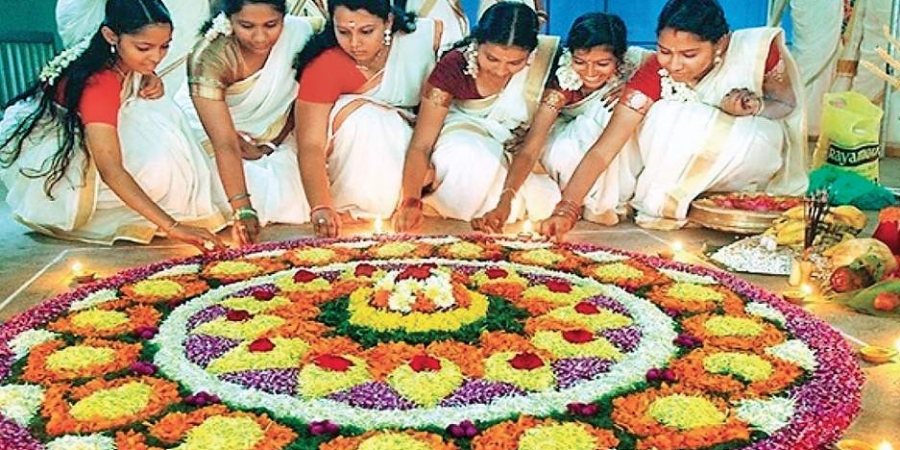
Onam is Kerala’s ten-day harvest festival, celebrated in the Malayalam month of Chingam, which typically overlaps with August–September on the Gregorian calendar. Each of the 10 days of Onam — from Atham to Thiruvonam — carries its own ritual meaning, building toward the festival’s climax. This guide explains what each day represents, why the Pookalam grows the way it does, and what actually happens at every stage of the celebration.
Quick Facts:
- Onam is celebrated over 10 days, starting with Atham and ending with Thiruvonam
- It falls in the Malayalam month of Chingam (roughly August–September)
- The Pookalam (floral carpet) grows by roughly one ring each day, from Atham to Thiruvonam
- The festival commemorates the mythical homecoming of King Mahabali
- Onam is Kerala’s official state festival, celebrated across Hindu, Christian and Muslim households alike
Looking for this year’s exact dates? See our Onam 2026 calendar and Thiruvonam date guide →
In this article:
How the 10 Days Are Structured
Onam follows the Malayalam solar calendar, and each of its ten days is named after the nakshatra (lunar mansion) ruling that day — not a fixed numbered date. That’s why the exact Gregorian dates shift every year, even though the sequence of days and their meaning never changes. The two most significant days are the first — Atham, when the celebrations formally begin — and the last — Thiruvonam, the grand finale.
Each Day of Onam, Explained
Day 1 — Atham
Atham marks the day King Mahabali is believed to begin his journey from Pathala (the netherworld) back to Kerala to visit his people. Families sweep and wash the courtyard at dawn and lay the first Pookalam — a floral carpet using only yellow flowers, usually marigold or thumba, kept deliberately to a single ring. The restraint is intentional: the design is meant to visibly grow over the coming nine days. In Thripunithura near Kochi, the Athachamayam procession — with caparisoned elephants and traditional art forms — formally opens the festival.
Day 2 — Chithira
Households add a second ring to the Pookalam and begin a deeper home cleaning than a normal weekly routine — brass lamps are polished, old items cleared, and in many families this is when the Onam grocery list is finalized.
Day 3 — Chodhi
Onam shopping begins in earnest: new clothes (Onakkodi — traditionally cream Kerala kasavu with a gold border), gifts, and jewelry. Markets stay open later than usual, and this is typically the first noticeably crowded day of the festival period.
Day 4 — Vishakam
Historically the most important commercial day of the ten: markets held their harvest sale on Vishakam, and preparation for the Onam Sadya begins — raw plantain, yam, ash gourd, jackfruit, and coconut are bought in bulk for the feast still days away.
Day 5 — Anizham
Anizham belongs to the water. Vallamkali (snake boat race) crews hold their final practice runs along Kerala’s backwaters — often more atmospheric to watch than the main race itself, since crowds haven’t gathered yet.
Day 6 — Thriketta
The homecoming day: Malayalis working outside Kerala travel back for the festival. The Pookalam grows to five or six flower varieties, and Onakkalikal (traditional games) begin in earnest.
Day 7 — Moolam
Temples begin serving smaller versions of the Onam Sadya as a rehearsal for Thiruvonam. Traditional dance forms including Kaikottikali (Thiruvathirakali) and Pulikali (tiger dance) troupes start rehearsals, and some families decorate a swing with flowers to welcome the returning king.
Day 8 — Pooradam
Clay or laterite idols of Mahabali and Vamana — called Onathappan — are placed at the center of the Pookalam and offered flowers each morning. This is arguably the ritual core of the entire ten days: it’s the physical reason the Pookalam exists, since the flower carpet is built as a welcome mat for these very figures.
Day 9 — Uthradam (First Onam)
Kerala’s single busiest retail day of the year. Markets stay open past midnight for last-minute banana leaves, plantains, and payasam ingredients. Mahabali is believed to arrive on the evening of Uthradam, so households avoid leaving the home empty.
Day 10 — Thiruvonam
The main event. The day opens with an oil bath before sunrise, new Onakkodi is worn, and the Pookalam reaches its full size — often ten or more concentric rings. The extended family gathers for the Onam Sadya at midday, and the afternoon is given to Onakkalikal games and Kaikottikali performances.
What’s in the Onam Sadya?
The Onam Sadya is a vegetarian feast of 24–28 dishes served on a banana leaf, laid tip-to-the-left, eaten by hand in a fixed order — the sequence isn’t decorative, it controls how flavors combine as the meal progresses.
| Course | Examples |
|---|---|
| Crisps & pickles | Banana chips, Sarkara Varatti, Inji Puli, Manga Achar |
| Thoran (dry veg) | Cabbage thoran, carrot-beans thoran |
| Curries | Avial, Olan, Erissery, Kalan |
| Rice course | Matta rice with Parippu, Sambar, Pulissery, Rasam |
| Payasam | Ada Pradhaman, Parippu Payasam, Palada |
Common Misconceptions About Onam
- “Onam is a single-day festival.” Thiruvonam gets all the attention, but the rituals genuinely build across all ten days — missing the earlier days means missing why the Pookalam and Sadya look the way they do by day ten.
- “Onam is only a Hindu festival.” Onam is Kerala’s harvest festival first and a religious observance second — it’s celebrated across Hindu, Christian, and Muslim households in Kerala, and by the Malayali diaspora worldwide regardless of faith.
Onam Beyond Kerala
Onam is marked wherever the Malayali diaspora has settled in significant numbers — notably in the UAE, USA, and Singapore — with community Sadya events and Pookalam competitions replicating the Kerala celebration abroad.
Practical Takeaways:
- If you want to experience the full arc of Onam rather than just Thiruvonam, plan to be in Kerala from Atham onward — the Pookalam’s growth is genuinely worth watching day by day
- The Onam Sadya is one of the few Indian festival meals with a fixed eating order — ask a local host about the sequence rather than eating dishes in the order they’re placed
- If you’re not Hindu but live in or near a Malayali community, Onam celebrations are broadly inclusive — it’s one of the more accessible festivals to join as an outsider
Frequently Asked Questions
What are the 10 days of Onam in order?
Atham, Chithira, Chodhi, Vishakam, Anizham, Thriketta, Moolam, Pooradam, Uthradam, and Thiruvonam — each named after the nakshatra ruling that day, with Thiruvonam as the grand finale.
Why does Onam fall on different dates every year?
Onam follows the Malayalam solar calendar, and the date depends on when the Thiruvonam nakshatra falls within the Chingam month. Since nakshatras shift relative to the Gregorian calendar each year, Onam’s dates move slightly within the August–September window annually.
What is the significance of the Pookalam?
The Pookalam is a floral carpet laid at the entrance to welcome King Mahabali home. It starts on Atham as a single ring of yellow flowers and grows by roughly one layer each day, reaching ten or more concentric rings by Thiruvonam.
Is Onam celebrated only by Hindus?
No. Onam is Kerala’s official harvest festival and is celebrated across Hindu, Christian, and Muslim households in the state, as well as by the Malayali diaspora worldwide.
What is the most important day of Onam?
Thiruvonam, the tenth and final day, is considered the most important — it’s when the Pookalam reaches full size, the grand Onam Sadya is served, and King Mahabali is believed to visit every Malayali home.

Editorial Review Note
Written by Religion World — Bhavya Srivastava is the founder of Religion World and a veteran journalist with over 18 years of experience across broadcast, print, and digital media. A founding member of the International Association of Religion Journalists (IARJ), he has spent much of his career reporting on and producing content about religion, faith, and spirituality. View full profile →.
Reviewed by Bhavya Srivasava on August 24, 2026.
Religion World provides information on all religions and presents it impartially. You can send us information, news, updates, opinions, and suggestions at religionworldin@gmail.com. You can also follow us on X (Twitter), Facebook, and YouTube.