
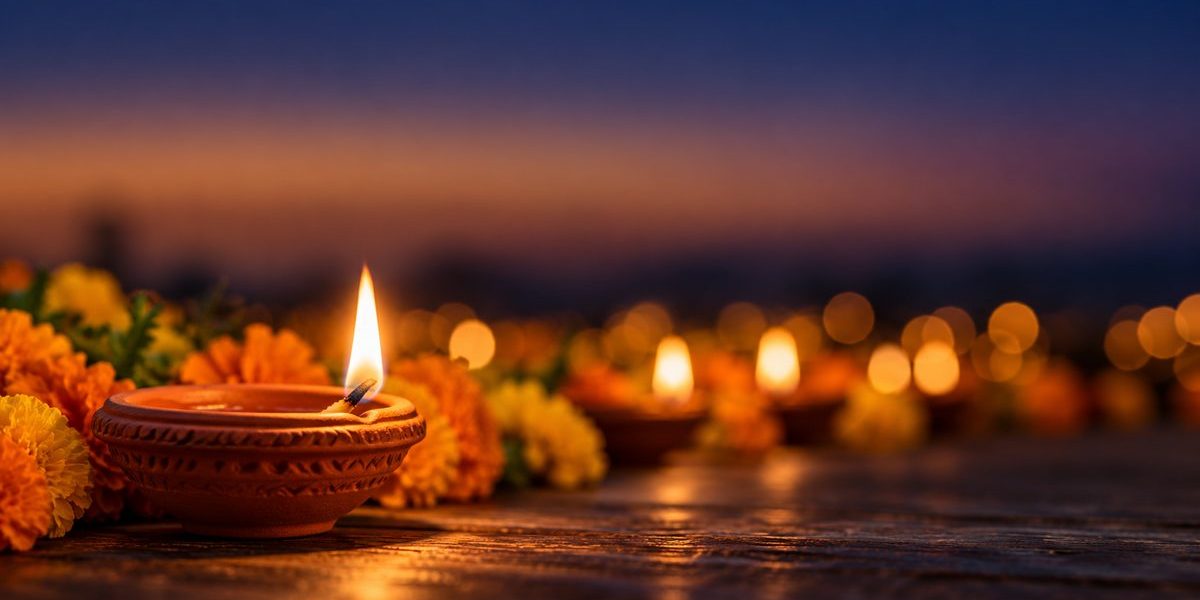
Last year, Diwali was over by 20 October. This year the lamps will not be lit until Sunday, 8 November 2026 — nineteen days later. If the festival feels unusually late, that impression is correct, and the reason is not arbitrary.
An extra lunar month was inserted into the Hindu calendar in mid-2026, and every festival after it moved. That month is called Adhik Maas. Understanding it explains not only this year’s date, but why Diwali swings across a four-week window from one year to the next while fixed-date holidays do not.
Diwali 2026: the complete five-day calendar
Dates below follow tithi calculations published by Drik Panchang for New Delhi.
| Day | Date | Observance | Tithi (Kartika) |
|---|---|---|---|
| 1 | Friday, 6 November 2026 | Dhanteras / Dhantrayodashi | Krishna Trayodashi |
| 2 | Saturday, 7 November 2026 | Kali Chaudas | Krishna Chaturdashi |
| 3 | Sunday, 8 November 2026 | Diwali · Lakshmi Puja · Narak Chaturdashi | Krishna Amavasya |
| — | Monday, 9 November 2026 | no main observance — see below | Amavasya until 12:31 PM |
| 4 | Tuesday, 10 November 2026 | Govardhan Puja / Annakut / Bali Pratipada | Shukla Pratipada |
| 5 | Wednesday, 11 November 2026 | Bhai Dooj / Yama Dwitiya | Shukla Dwitiya |
Narak Chaturdashi and Lakshmi Puja both fall on 8 November this year, while Kali Chaudas is marked on 7 November. This compression is normal when the Chaturdashi and Amavasya tithis share a single sunrise.
Diwali is observed beyond Hinduism. Jain communities mark the day as the attainment of nirvana by Mahavira, and Sikhs observe Bandi Chhor Divas, commemorating the release of Guru Hargobind from imprisonment at Gwalior.
Lakshmi Puja timings on 8 November
The Amavasya tithi begins at 11:27 AM on 8 November and ends at 12:31 PM on 9 November. Lakshmi Puja is traditionally performed during Pradosh Kaal, the period following sunset, and preferably while a sthir lagna — a fixed ascendant, usually Vrishabha — prevails.
Muhurat windows published by Drik Panchang for 8 November 2026, in each city’s local time:
| City | Lakshmi Puja Muhurat |
|---|---|
| Ahmedabad | 06:22 PM – 08:20 PM |
| Mumbai | 06:27 PM – 08:27 PM |
| Pune | 06:24 PM – 08:24 PM |
| New Delhi | 05:54 PM – 07:50 PM |
| Jaipur | 06:03 PM – 07:59 PM |
| Kolkata | 05:20 PM – 07:18 PM |
| Chennai | 06:07 PM – 08:09 PM |
| Hyderabad | 06:07 PM – 08:08 PM |
| Bengaluru | 06:17 PM – 08:20 PM |
For New Delhi, Pradosh Kaal runs from 05:31 PM to 08:09 PM.
These windows are derived from local sunset. Readers outside India — in North America, the United Kingdom, the Gulf, Southeast Asia, Australia, East Africa, the Caribbean or Fiji — should not apply an Indian timing. Because the tithi is calculated against local time, the observance day itself can shift by a calendar day in the western hemisphere. Consult a panchang set to your own city, or ask your local temple.
Why the date moves at all
The Gregorian calendar is purely solar. A purely lunar calendar, such as the Islamic Hijri calendar, drifts backwards through the seasons by roughly eleven days a year, which is why Ramadan migrates across summer and winter over time.
The Hindu calendar is neither. It is lunisolar — months are counted by the moon, but the year is anchored to the sun so that festivals stay in their proper season. Diwali belongs to autumn; Holi belongs to spring. The calendar is engineered to keep it that way.
The arithmetic creates a problem. Twelve lunar months run to about 354 days. A solar year runs to about 365. Left uncorrected, the lunar months would slide backwards by about eleven days annually, and within sixteen years Diwali would land in the monsoon.
The correction: Adhik Maas, the thirteenth month
Rather than adjusting gradually, the Hindu calendar banks the shortfall and repays it in a single instalment. Roughly every 32 to 33 months, an entire additional lunar month is inserted. It is known as Adhik Maas, and also as Purushottam Maas or Mal Maas.
The rule identifying it is astronomical rather than arbitrary. Each solar month is marked by a sankranti, the sun’s entry into a new zodiac sign. Ordinarily every lunar month contains one. When a lunar month elapses with no sankranti falling inside it, that month is designated Adhik, and the month following it repeats the same name. The year then holds thirteen months instead of twelve.
In 2026 that month was Adhik Jyeshtha Maas, observed from 17 May to 15 June. Its presence is visible in the panchang itself: Drik Panchang lists Padmini Ekadashi on 27 May 2026 and Jyeshtha Adhika Purnima on 31 May 2026. Padmini and Parama Ekadashi occur only within an Adhik Maas — they are the leap month’s own fortnightly markers. Jyeshtha then ran a second time, giving 2026 a double Jyeshtha.
The consequence follows directly. Every lunar month after June 2026 was displaced roughly thirty days later than it would otherwise have fallen. Navratri, Dussehra, Diwali, Chhath and Kartika Purnima all shifted together. Diwali moved from 20 October in 2025 to 8 November in 2026 — the usual eleven-day backward drift cancelled out, and then some, by the inserted month.
According to tradition, Adhik Maas is dedicated to Vishnu in his Purushottam aspect, and is regarded as suited to fasting, recitation and charity rather than to new worldly undertakings such as weddings or property purchases. Observance of these customs varies considerably between regions and communities.
Why 9 November is a blank day
This is where published calendars disagree, and the disagreement has a precise cause.
Diwali falls on Amavasya. Govardhan Puja falls on Pratipada, the first day of the bright fortnight. Normally these are consecutive days. In 2026 they are not.
The Amavasya tithi ends at 12:31 PM on 9 November, and Pratipada begins at that same moment, running until 2:00 PM on 10 November. Because a Hindu day is reckoned from sunrise, 9 November begins under Amavasya rather than Pratipada. The day that begins under Pratipada is 10 November — which is why Govardhan Puja and Annakut fall on Tuesday, 10 November 2026, with the Pratahkala muhurat running from 06:40 AM to 08:50 AM.
A number of websites list 9 November. Readers encountering both dates are not simply looking at an error on one side; they are seeing two different conventions for assigning a tithi to a calendar day, compounded by genuine variation between Smarta and Vaishnava practice. Devotees should follow the panchang observed by their own tradition or temple.
In Maharashtra the same day is kept as Bali Pratipada, commemorating Vamana’s victory over King Bali. Kartika Shukla Pratipada is also when the Gujarati New Year, Bestu Varas, is marked; Gujarati families and businesses should confirm against a Gujarati panchang, as the two observances can occasionally fall a day apart.
The pattern across years
Viewed over a decade, the apparent randomness resolves into a clear shape. Diwali dates, per Drik Panchang:
| Year | Diwali date |
|---|---|
| 2023 | 12 November |
| 2024 | 1 November |
| 2025 | 20 October |
| 2026 | 8 November |
| 2027 | 29 October |
| 2028 | 17 October |
| 2029 | 5 November |
The date walks backwards by roughly eleven days each year — 12 November, 1 November, 20 October — then snaps forward when a leap month intervenes. 2026 is a snap-forward year. 2027 and 2028 resume the backward walk. 2029 snaps forward again.
What this means in practice
Diwali 2026 is Sunday, 8 November, with the festival period running from 6 to 11 November. The late date is not an anomaly, nor a dispute among astrologers. It is the Hindu calendar performing exactly the task it was built for — spending a leap month in order to keep the festival of lights in autumn, where it belongs.
For anyone comparing dates across websites this season, one practical test applies. Check whether the source states the tithi and its start and end times, not merely a date. A calendar telling you that Diwali falls on Amavasya, that Amavasya begins at 11:27 AM on 8 November and ends at 12:31 PM on 9 November, is offering something you can verify. A calendar giving only a date is asking you to take it on trust.
Frequently Asked Questions
What is the Diwali 2026 date?
Diwali 2026 falls on Sunday, 8 November 2026, on Kartika Krishna Amavasya. The Amavasya tithi begins at 11:27 AM on 8 November and ends at 12:31 PM on 9 November.
Why is Diwali so late in 2026?
Because 2026 contained an Adhik Maas — an extra lunar month, Adhik Jyeshtha, observed from 17 May to 15 June 2026. The Hindu calendar inserts this thirteenth month roughly every 32 to 33 months to keep lunar months aligned with the solar year. Every festival after June 2026 shifted roughly one month later as a result.
What are the five days of Diwali 2026?
Dhanteras on 6 November, Kali Chaudas on 7 November, Diwali and Lakshmi Puja on 8 November, Govardhan Puja on 10 November, and Bhai Dooj on 11 November.
Is Govardhan Puja 2026 on 9 or 10 November?
Drik Panchang places Govardhan Puja on Tuesday, 10 November 2026, because the Pratipada tithi does not begin until 12:31 PM on 9 November, meaning 9 November begins under Amavasya. Some regional calendars and traditions observe it on 9 November. Devotees should follow the panchang used by their own tradition or temple.
What is the Lakshmi Puja muhurat on Diwali 2026?
For New Delhi, 05:54 PM to 07:50 PM; for Ahmedabad, 06:22 PM to 08:20 PM; for Mumbai, 06:27 PM to 08:27 PM. Timings are calculated from local sunset and vary by city, so readers elsewhere should consult a panchang set to their own location.
What is Adhik Maas and how is it determined?
Adhik Maas, also called Purushottam Maas or Mal Maas, is an extra lunar month added to the Hindu calendar. A lunar month in which no solar sankranti occurs is designated Adhik, and the following month repeats the same name, giving that year thirteen lunar months instead of twelve.
Do Jains and Sikhs also observe Diwali?
Yes, with their own significance. Jain communities mark the day as the attainment of nirvana by Mahavira. Sikhs observe Bandi Chhor Divas, commemorating the release of Guru Hargobind from imprisonment at Gwalior.
All dates and timings verified on 21 October 2026. Muhurat timings are location-specific; readers outside the listed cities should consult a panchang for their own location.

Editorial Review Note
Written by Religion World — Bhavya Srivastava is the founder of Religion World and a veteran journalist with over 18 years of experience across broadcast, print, and digital media. A founding member of the International Association of Religion Journalists (IARJ), he has spent much of his career reporting on and producing content about religion, faith, and spirituality. View full profile →.
Religion World provides information on all religions and presents it impartially. You can send us information, news, updates, opinions, and suggestions at religionworldin@gmail.com. You can also follow us on X (Twitter), Facebook, and YouTube.