
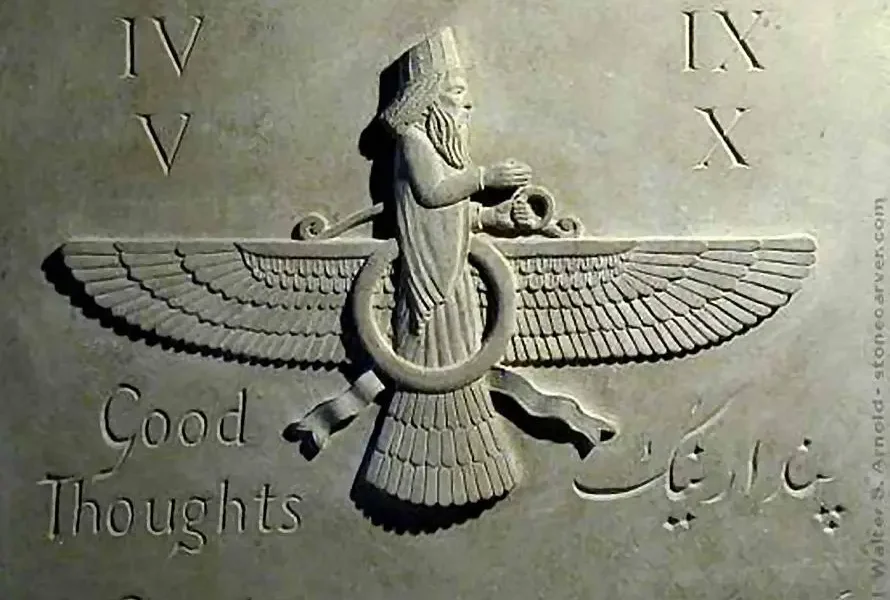
Zoroastrians are followers of Zoroastrianism, one of the world’s oldest continuously practiced religions, founded on the teachings of the Iranian prophet Zarathushtra (better known in the West as Zoroaster). At the center of the faith is the worship of a single, uncreated supreme god, Ahura Mazda, and a lifelong moral choice between Asha (truth and order) and Druj (falsehood and chaos). Zoroastrianism began in ancient Persia and today survives mainly among small communities in Iran and the larger Parsi community of India. This article explains who the Zoroastrians are, what they believe, where the faith began, how it may have influenced later religions, and how the community lives today.
- Zoroastrians follow Zoroastrianism, founded by the prophet Zarathushtra in ancient Persia (present-day Iran).
- Scholars do not agree on an exact date for Zarathushtra. Estimates range from roughly 1500–1000 BCE (based on the archaic language of his hymns) to “before the 6th century BCE” (the traditional dating cited by Britannica). Older dates found in some esoteric or traditional literature are not part of mainstream historical consensus.
- Core belief: one uncreated god, Ahura Mazda, and a moral universe shaped by the struggle between Asha (truth) and Druj (falsehood).
- Sacred texts: the Avesta, with the Gathas — hymns attributed directly to Zarathushtra — at its core.
- After the Arab conquest of Persia in the 7th century CE, many Zoroastrians migrated to Gujarat, India, where their descendants are known as Parsis.
- The global Zoroastrian population today is estimated at roughly 100,000–200,000, concentrated in India, Iran, and diaspora communities.
Who Founded Zoroastrianism? Zarathushtra and Ahura Mazda
Zoroastrianism traces back to Zarathushtra Spitama, an Iranian priest and religious reformer. He taught that there was one supreme, uncreated god — Ahura Mazda, “Lord of Wisdom” — rather than the many gods worshipped by earlier Iranian polytheism. This makes Zoroastrianism one of the earliest clearly monotheistic (or strongly monotheistic-leaning) faiths in recorded history.
Dating Zarathushtra precisely is genuinely difficult, and it’s worth being honest about why: his teachings were transmitted orally in verse for centuries before being written down, and the only internal evidence is the archaic form of Avestan used in his hymns, the Gathas. Linguists who compare that Avestan to Vedic Sanskrit — its closest linguistic relative — place the Gathas somewhere in the range of 1500–1000 BCE. Britannica takes a more conservative traditional position, dating him simply to “before the 6th century BCE.” You may also encounter far older dates (as early as 6000–8000 BCE) in theosophical and some traditional Zoroastrian sources; these reflect religious or esoteric tradition rather than mainstream historical or linguistic scholarship, and it’s worth knowing the difference before citing either figure as fact.
Core Beliefs of Zoroastrianism
Zoroastrian theology centers on a handful of ideas that recur throughout the Gathas:
- Ahura Mazda — the uncreated, all-wise creator god.
- Asha vs. Druj — truth, order, and cosmic progress opposed by chaos, distortion, and falsehood. In the oldest hymns this conflict is primarily ethical and psychological — a choice each person makes — rather than a cosmic war between two equal gods.
- Free will — Zoroastrianism explicitly rejects predestination. Every being, human or divine, is understood to choose between Asha and Druj.
- Judgment after death — the soul is said to cross the Chinvat Bridge; a righteous life allows safe passage, while a life given to Druj does not.
- Frashokereti — a final renewal of the world in which good ultimately prevails.
In practice, most Zoroastrians summarize their ethics in three phrases: Humata, Hukhta, Hvarshta — Good Thoughts, Good Words, Good Deeds.
Sacred Texts: The Avesta and the Gathas
The central scripture of Zoroastrianism is the Avesta, a collection of religious texts in the Avestan language. Its oldest and most sacred portion is the Gathas — 17 hymns attributed directly to Zarathushtra. Avestan belongs to the Indo-Iranian branch of the Indo-European language family, making it a close linguistic sibling of Vedic Sanskrit specifically; it is related to Greek and Latin only in the much broader, more distant sense that all of them ultimately descend from Proto-Indo-European.
Zoroastrianism’s Influence on Judaism, Christianity, and Islam
Britannica and other reference sources note that Zoroastrianism “likely influenced” the development of Judaism, and through it, Christianity and Islam. During the Achaemenid Persian period, Judea came under Persian rule, and the Persian king Cyrus the Great — remembered in the Book of Isaiah as the Lord’s “anointed” — freed the Jewish exiles in Babylon and permitted the rebuilding of the Temple in Jerusalem. This extended period of contact is the basis for the scholarly hypothesis that ideas such as a structured angelic hierarchy, a cosmic struggle between good and evil, a coming savior figure, and a final resurrection and judgment entered Jewish thought partly through Zoroastrian influence, later carrying into Christian theology.
It’s important to be precise about how strong this claim actually is: this is a widely held scholarly hypothesis, not a proven chain of direct textual borrowing. Some historians argue for substantial Zoroastrian influence; others argue the ideas developed independently or through a mix of Babylonian, Jewish, and Persian sources that can’t be neatly separated. The honest framing is “many scholars believe Zoroastrianism influenced” these traditions — not that it caused or single-handedly produced them.
From Persia to India: History and the Parsi Migration
Zoroastrianism was the dominant religion of Persia through the Achaemenid, Parthian, and Sasanian empires, roughly spanning the 6th century BCE to the 7th century CE. Following the Arab conquest of Persia in the 7th century CE, Islam gradually became the region’s dominant religion, and Zoroastrians faced increasing pressure and, at times, persecution. Between the 8th and 10th centuries CE, groups of Zoroastrians sailed from Iran and settled on the west coast of India, primarily in present-day Gujarat. Their descendants are known as Parsis (from “Pars,” referring to Persia). A smaller number of Zoroastrians remained in Iran, particularly around Yazd and Kerman, and continue to practice the faith there today.
Zoroastrian Practices and Symbols
- Fire temples — Zoroastrians maintain a sacred fire as a visible symbol of Ahura Mazda and of truth and purity; the fire itself is not worshipped as a god but venerated as a symbol.
- Sudreh and kusti — the sacred white shirt and cord that initiated Zoroastrians wear, given during the Navjote (initiation) ceremony.
- Towers of Silence (dokhma) — the traditional practice of exposing the dead to open air rather than burial or cremation, to avoid contaminating earth or fire. This practice has become increasingly controversial and is in decline, particularly outside India, due to vulture population collapse and legal restrictions.
- Festivals — including Nowruz (Persian New Year) and various seasonal Gahambars.
Zoroastrians Today: Population and Communities
Zoroastrianism is a small but living faith. Global estimates generally place the worldwide Zoroastrian population between roughly 100,000 and 200,000, with the largest single community being the Parsis of India, concentrated around Mumbai and Gujarat. A smaller Zoroastrian community remains in Iran, and diaspora communities exist in the UK, US, Canada, and Australia. The community faces well-documented demographic decline, driven by low birth rates, an aging population, and ongoing debate within the community over intermarriage and conversion.
Writer and Zoroastrian Porus Homi Havewala describes growing up within the tradition: keeping the sacred fire fed with sandalwood and cedar, reciting the ancient Avestan Mathras (prayers), wearing the sacred girdle (Aiwiyaonghanem) and white Sudreh, and carrying a traditional Avestan name paired with his father’s, in the old custom. This kind of first-hand account — the sensory and lived experience of the ritual, rather than just a description of it — is something a purely academic summary can’t offer. Note that some of the historical claims discussed elsewhere by Havewala, such as a Zoroaster birth date around 8000 BCE or specific parallels drawn to Germanic mythology, reflect personal and traditional readings of the faith’s history rather than mainstream academic consensus, and are presented here as perspective, not settled fact.
Common Misconceptions About Zoroastrians
- “Zoroastrians worship fire.” Fire is venerated as a sacred symbol of Ahura Mazda and truth, not worshipped as a deity in itself.
- “Zoroastrianism is an extinct religion.” It is a small but actively practiced living faith, with functioning fire temples, clergy, and communities today.
- “Parsi and Zoroastrian mean the same thing everywhere.” Parsi specifically refers to the Indian-descended Zoroastrian community; Iranian Zoroastrians are a distinct community with some differing customs.
Practical Takeaways
- If you’re researching Zoroastrianism for religious comparison, focus on its likely influence on afterlife and angelology concepts — but cite it as scholarly hypothesis, not proven fact.
- If you’re engaging with a Zoroastrian or Parsi community member, avoid assuming fire worship; ask about the fire’s symbolic role instead.
- If you’re researching Zoroaster’s dates for academic or reference use, cite a range (roughly 1500 BCE–6th century BCE) rather than a single fixed date.
Conclusion
Zoroastrians are the followers of one of humanity’s oldest surviving monotheistic traditions — a faith built on the choice between truth and falsehood, carried from ancient Persia to modern India by the Parsi migration, and still practiced today by a small but resilient global community. Understanding who they are means holding two things at once: genuine, well-supported scholarly influence on later religious thought, and a living, lived tradition that resists being reduced to a single ancient date or a single sweeping claim.
Frequently Asked Questions
Who are the Zoroastrians?
Zoroastrians are followers of Zoroastrianism, a religion founded by the Iranian prophet Zarathushtra (Zoroaster) in ancient Persia, centered on the worship of one god, Ahura Mazda, and the moral choice between truth and falsehood.
What do Zoroastrians believe?
Zoroastrians believe in one uncreated, all-wise god, Ahura Mazda, and in a moral universe shaped by the ongoing choice between Asha (truth and order) and Druj (falsehood and chaos). They emphasize free will, good thoughts, good words, and good deeds.
Is Zoroastrianism the oldest religion?
Zoroastrianism is widely regarded as one of the world’s oldest monotheistic religions, though its exact founding date is debated among scholars, ranging from roughly 1500 BCE to the 6th century BCE.
Who are the Parsis and how are they related to Zoroastrians?
Parsis are the descendants of Zoroastrians who migrated from Persia to Gujarat, India, between the 8th and 10th centuries CE to escape persecution following the Arab conquest. They remain one of the largest Zoroastrian communities in the world today.
What is the Zoroastrian holy book called?
The central Zoroastrian scripture is the Avesta. Its oldest and most sacred section, the Gathas, contains hymns attributed directly to Zarathushtra.
How many Zoroastrians are there today?
Estimates place the global Zoroastrian population at roughly 100,000 to 200,000, primarily among the Parsi community in India, a smaller community in Iran, and diaspora populations elsewhere.
Religion World is one and only indian website to give information of all religions. We are dedicated to present the religions. You can send any info, news, engagements and advice to us on – religionworldin@gmail.com – or you can WhatsApp on – 9717000666 – we are also on Twitter, Facebook and Youtube.

Editorial Review Note
Written by Religion World — Bhavya Srivastava is the founder of Religion World and a veteran journalist with over 18 years of experience across broadcast, print, and digital media. A founding member of the International Association of Religion Journalists (IARJ), he has spent much of his career reporting on and producing content about religion, faith, and spirituality. View full profile →.
Religion World provides information on all religions and presents it impartially. You can send us information, news, updates, opinions, and suggestions at religionworldin@gmail.com. You can also follow us on X (Twitter), Facebook, and YouTube.
Leave a Reply