
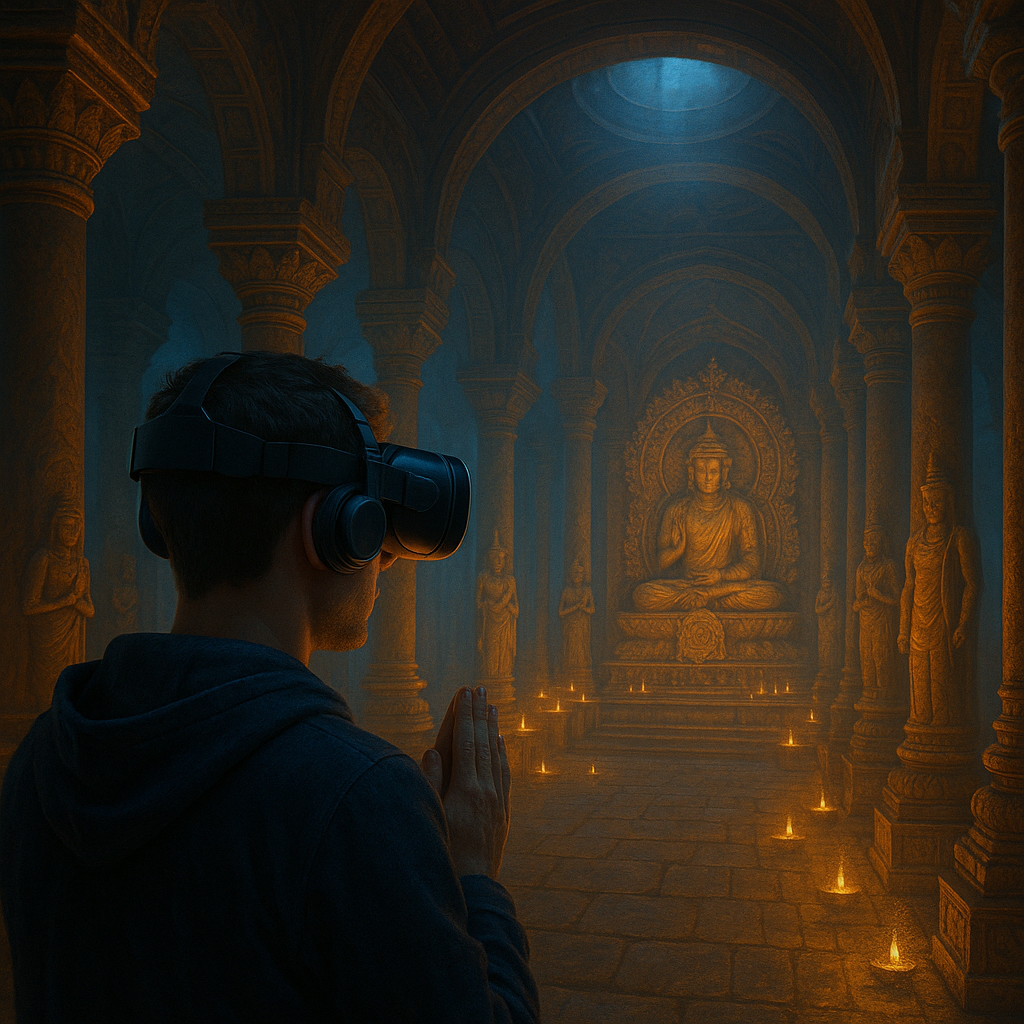
Virtual Reality Temples & Immersive Worship: Novelty or Meaningful?
As technology evolves, it continues to redefine how people experience faith and spirituality. In recent years, Virtual Reality (VR) temples and immersive worship experiences have emerged as a new way for devotees to connect with the divine. Wearing a headset, one can now “walk” into a virtual version of Kashi Vishwanath, Mecca, or the Vatican, perform rituals, and even participate in group prayers — all without leaving home. But this growing phenomenon raises a deeper question: is virtual worship a meaningful spiritual experience or just a modern novelty?
The Birth of Digital Devotion
The Covid-19 pandemic accelerated the shift toward online and digital faith practices. When temples, mosques, and churches closed, millions of devotees turned to screens for comfort. Live-streamed aartis, virtual darshans, and online satsangs became part of daily spiritual life. From there, technology took a leap forward — introducing Virtual Reality temples, where worshippers could not only see but also feel like they were present inside a sacred space.
Today, several tech-driven religious organizations have developed VR platforms that replicate real-world shrines. For example, devotees can now explore a 3D model of Tirupati Balaji or Bodh Gaya, move around the sanctum, light digital lamps, and even interact with other avatars performing rituals. What once seemed futuristic has now become a growing segment of spiritual tourism and worship.
The Experience: Presence Without Travel
VR temples promise one of humanity’s oldest desires — presence beyond distance. For elderly devotees, people with disabilities, or those living abroad, visiting physical temples can be difficult or impossible. Virtual Reality bridges that gap.
A devotee in London can experience the morning aarti of Kashi Vishwanath Temple in real-time, hearing the bells ring and chants echoing through surround sound. In this way, VR allows the faithful to transcend geographical barriers and time zones. For many, it’s a profound emotional experience — offering peace, nostalgia, and a renewed sense of connection to their roots.
Moreover, immersive worship is not limited to Hindu temples. Buddhist monasteries, Islamic heritage sites, and Christian cathedrals have all begun adopting digital recreations. The Vatican, for example, has launched a VR museum experience that allows visitors to explore sacred art and architecture interactively.
The Technology Behind the Sacred
Behind the scenes, the creation of a VR temple involves 3D mapping, photogrammetry, and AI-enhanced soundscapes to make every detail lifelike. Sensors recreate the echo of mantras, the flicker of diyas, and even the glow of incense smoke. Some platforms integrate haptic feedback — allowing users to feel subtle vibrations during bells or chants, enhancing emotional immersion.
Developers are also using augmented reality (AR) to blend the virtual and physical worlds. With AR-enabled apps, devotees can project sacred idols or mandalas into their living spaces during prayer, merging digital devotion with traditional practice.
This integration of technology and spirituality has given birth to what many call “Techno-Faith” — a new dimension where spiritual experience meets digital innovation.
The Debate: Real Connection or Virtual Illusion?
Despite its appeal, virtual worship raises philosophical and theological questions. Can a digitally simulated temple truly replace the sanctity of a real one? Is spiritual energy something that can be transmitted through pixels and code?
Critics argue that VR temples risk turning faith into entertainment, diluting the emotional depth of physical pilgrimage. The physical journey — walking barefoot on temple grounds, waiting in line for darshan, smelling incense in the air — carries a discipline and surrender that screens cannot replicate.
However, supporters believe that technology doesn’t diminish spirituality; it simply offers another form of access. Just as prayer can happen anywhere — in silence, at home, or in nature — VR temples are an extension of that same freedom. For many, especially the younger generation, virtual spaces feel natural and even more engaging than traditional rituals.
Inclusivity and Accessibility
One of the strongest arguments in favor of virtual temples is inclusivity. Technology allows people who are physically, financially, or geographically restricted to participate in worship. For the elderly, people with health challenges, or those living abroad, it opens a spiritual door that might otherwise remain closed.
It also encourages interfaith understanding. Anyone, regardless of religion, can explore different places of worship and learn about various traditions through VR. This educational aspect is helping foster global awareness and empathy — something that traditional pilgrimage alone might not achieve.
The Future of Immersive Worship
As VR and AI technology continue to evolve, the next stage of immersive worship could become even more interactive. Imagine participating in a global digital yagna, chanting along with thousands of devotees’ avatars, or receiving AI-guided teachings tailored to your spiritual growth.
Temples and religious institutions are already experimenting with metaverse shrines, where virtual donations, spiritual consultations, and group meditations take place. Some are even developing blockchain systems to authenticate digital offerings — ensuring that online rituals carry both symbolic and ethical value.
This digital shift doesn’t necessarily replace traditional worship but rather coexists with it, expanding how people can experience faith.
A New Dimension of Devotion
Virtual Reality temples and immersive worship mark a turning point in how humanity engages with the sacred. For some, they’re a fascinating novelty — a high-tech reflection of ancient traditions. For others, they’re deeply meaningful, offering spiritual solace in a modern world.
The truth lies somewhere in between. Technology cannot recreate the divine energy of a holy site, but it can help people connect, learn, and reflect in new ways. Whether one experiences God in a temple or through a headset, the essence remains the same — faith, devotion, and inner peace.
As the boundaries between the physical and digital continue to blur, the spiritual realm, too, is expanding — reminding us that divinity, like light, can shine through any medium.
~Religion World Bureau

Editorial Review Note
Written by Religion World — Bhavya Srivastava is the founder of Religion World and a veteran journalist with over 18 years of experience across broadcast, print, and digital media. A founding member of the International Association of Religion Journalists (IARJ), he has spent much of his career reporting on and producing content about religion, faith, and spirituality. View full profile →.
Religion World provides information on all religions and presents it impartially. You can send us information, news, updates, opinions, and suggestions at religionworldin@gmail.com. You can also follow us on X (Twitter), Facebook, and YouTube.