
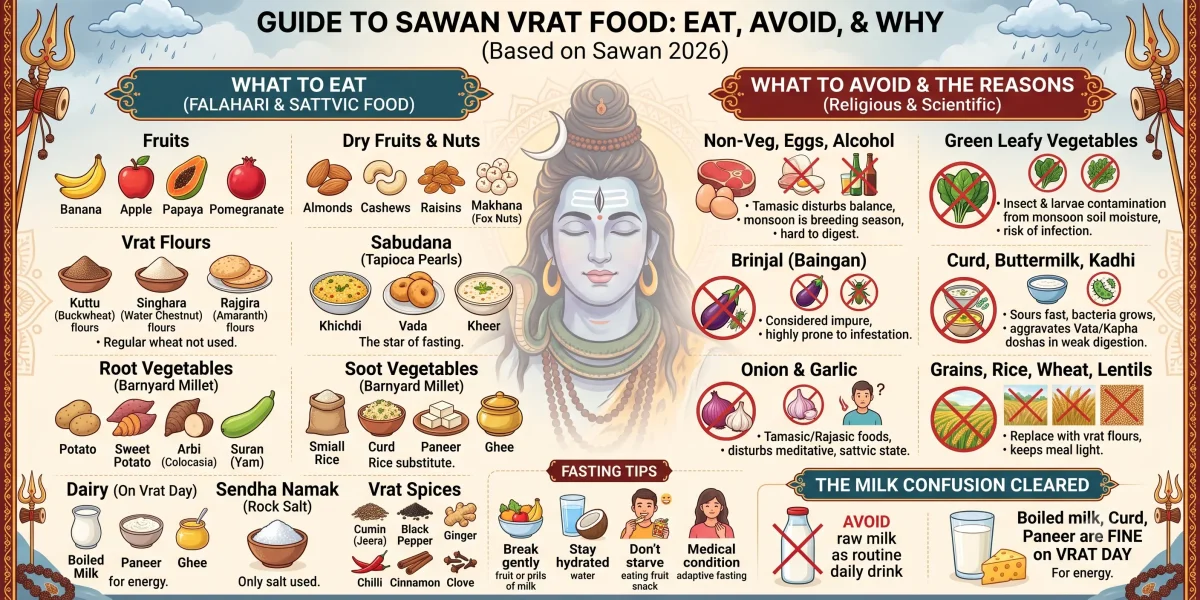
During the holy month of Sawan (Shravan), millions of devotees observe fasts for Lord Shiva — and knowing the right Sawan vrat food is what keeps that fast both spiritually pure and physically sustainable. Sawan fasting is not simply about going hungry. It is a shift to sattvic, easily digestible food that suits the humid monsoon season, paired with a deliberate list of foods to avoid. This guide covers exactly what to eat during a Sawan vrat, what to strictly avoid, and — unlike most lists — why each rule exists, drawing on both religious belief and the Ayurvedic and scientific logic behind it.
In 2026, Sawan runs from 30 July to 28 August in North India (Purnimanta calendar) and from 13 August to 11 September in Gujarat, Maharashtra and South India (Amanta calendar), with Sawan Somwar vrats falling on 3, 10, 17 and 24 August.
What to Eat During Sawan Vrat (Sawan Vrat Food List)
On fasting days, devotees eat falahari (fruit-based) sattvic food, usually a single meal in the evening after the Sandhya aarti. Here is what is traditionally allowed:
- Fruits: All seasonal fruits — banana, apple, papaya, pomegranate. Rich in fibre and energy, ideal for a day-long fast.
- Dry fruits & nuts: Almonds, cashews, raisins, and makhana (fox nuts) — eaten through the day to prevent exhaustion.
- Vrat flours: Kuttu (buckwheat), singhara (water chestnut), and rajgira (amaranth) flour for puris and rotis. Regular wheat flour is not used.
- Sabudana (tapioca pearls): The star of Sawan fasting — made into khichdi, vada, or kheer.
- Samak rice (barnyard millet): A rice substitute for pulao or kheer.
- Root vegetables: Potato, sweet potato, arbi (colocasia), suran (yam), and bottle gourd (lauki).
- Dairy (on vrat days): Milk, curd, paneer, and ghee are consumed as fasting food on the Monday vrat, for energy and to cool the body. (See the milk note below — there is an important distinction.)
- Sendha namak (rock salt): The only salt used during vrat. Regular iodised table salt is avoided.
- Vrat-friendly spices: Cumin (jeera), black pepper, green cardamom, cinnamon, cloves, fresh ginger and green chilli.
Foods to Avoid During Sawan — and the Reason Behind Each
This is where most guides stop at “just avoid it.” Here is the actual reasoning, which is a mix of scripture and seasonal Ayurvedic wisdom.
1. Non-vegetarian food, eggs & alcohol Religious: Sawan is a month of purity and devotion; tamasic foods disturb spiritual balance. Scientific: monsoon is the breeding season for fish, and meat digests poorly in humid weather, upsetting the stomach.
2. Green leafy vegetables (spinach, saag, fenugreek) Religious belief pairs with a genuine seasonal reason: the monsoon’s high soil moisture massively increases insect and larvae contamination on leafy greens, raising the risk of stomach and skin infection. This is why greens are set aside for the month.
3. Brinjal (baingan) Considered impure in scripture, and practically, brinjal is highly prone to insect infestation and infection during the rains — hence the avoidance.
4. Curd, buttermilk & kadhi (as everyday food) In the humid monsoon, curd sours fast and grows harmful bacteria, and in Ayurveda it aggravates Vata and Kapha doshas when digestion is already weak. Kadhi, being curd-based, is avoided for the same reason.
5. Onion & garlic Classic tamasic/rajasic foods believed to stimulate the baser instincts and disturb the meditative, sattvic state the fast is meant to cultivate.
6. Grains, rice, wheat & regular lentils (on vrat days) On the actual fasting day these are replaced by vrat flours and samak, keeping the meal light and falahari.
The Milk Confusion — Cleared Up
You will see two contradictory claims online: “avoid milk in Sawan” and “milk is a fasting food.” Both are correct in their own context, and the distinction matters:
- As a daily drink through the month: Many traditionally avoid raw milk, partly because milk is offered to the Shivling daily, and partly because monsoon-fed cattle and quick spoilage make raw milk less safe.
- As vrat food on the Monday fast: Boiled milk, curd and paneer are commonly eaten as the sattvic fasting meal for energy.
So: boiled milk on your vrat day is fine for most observers; the “avoid milk” rule refers to raw milk as a routine drink. Follow your family tradition where it differs.
Easy Sawan Vrat Recipes
You do not need to be a skilled cook to eat well during Sawan. A few dependable options:
- Sabudana khichdi — soaked sabudana with peanuts, potato, cumin and green chilli. Filling and classic.
- Kuttu ki puri with aloo jeera — crisp buckwheat puris with simple jeera-spiced potatoes.
- Samak rice pulao — barnyard millet with mild whole spices.
- Makhana kheer — roasted fox nuts simmered in milk with cardamom and dry fruits.
- Vrat ke pakode — singhara-flour fritters for a rainy evening.
Practical Fasting Tips
- Break your fast gently — start with fruit or a glass of milk, not a plate of fried food.
- Stay hydrated: water, milk and homemade juices, especially in humid weather.
- Don’t starve — snack on fruit and dry fruits every couple of hours to avoid weakness.
- If you have a medical condition (diabetes, low BP, pregnancy), adapt the fast to your health; devotion does not require harming the body.
Conclusion
Eating the right Sawan vrat food turns fasting from an ordeal into a genuinely restorative practice. The traditional rules — sattvic falahari food, sendha namak, no greens or tamasic items — are not arbitrary; they line up neatly with what the monsoon season demands of the body. Observe them with devotion and a little planning, and Sawan 2026 becomes a month of both spiritual and physical wellbeing. Har Har Mahadev.
Sawan Vrat Food — Frequently Asked Questions
What can I eat during Sawan vrat?
What foods should be avoided in Sawan?
Why are green vegetables not eaten in Sawan?
Can we drink milk during Sawan?
Which salt is used in Sawan vrat food?
Can I eat sabudana during Sawan fast?

Editorial Review Note
Written by Religion World — Bhavya Srivastava is the founder of Religion World and a veteran journalist with over 18 years of experience across broadcast, print, and digital media. A founding member of the International Association of Religion Journalists (IARJ), he has spent much of his career reporting on and producing content about religion, faith, and spirituality. View full profile →.
Religion World provides information on all religions and presents it impartially. You can send us information, news, updates, opinions, and suggestions at religionworldin@gmail.com. You can also follow us on X (Twitter), Facebook, and YouTube.