
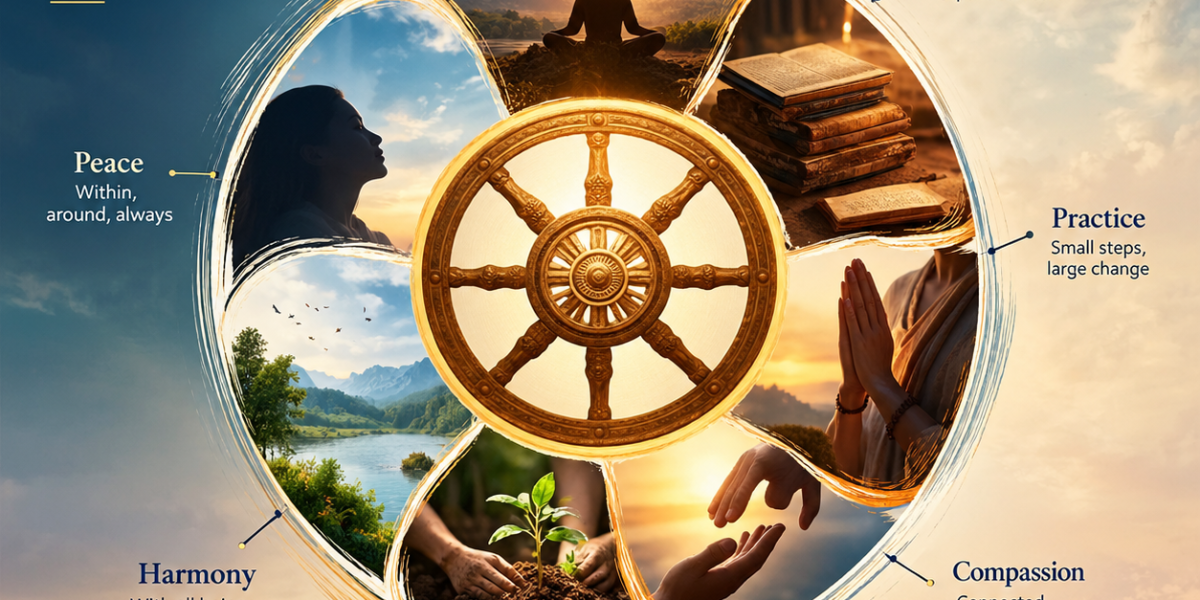
Then Dharma Cycle
In an intensely saturated atmosphere of Sanatan thought, when we find ourselves unable to bridge the gap between words and their meanings, we seem to drift into a state of overwhelmed contemplation—vibrating with countless religious voices and attachments, yet strangely pleased within that confusion. Religion appears everywhere around us.
Temples, pilgrimage sites, sacred towns, rivers, saints, gurus, astrologers, yogis, seekers, tantric, and experts of every obscure discipline—each place is crowded. Tourism is increasingly being presented in the garb of religion. People rush toward individuals they consider exceptionally knowledgeable. Everything begins to feel “right.” Even the Pandavas and Kauravas of this so-called religious age and its wars have already been identified.
Recently, a guru from Braj remarked that on Janmashtami, several temples in do not even have enough funds to change the deity’s garments. People have begun to treat circling around already famous places and personalities as religion itself. If there are no rooms in ashrams across the country, no one seems to care. The condition of many cow shelters is pitiable. Shiva temples are crowded on Mondays, while on other days people quietly endure their suffering.
Many observe Ekadashi fasts and insist on keeping Laddu Gopal with them, yet in the hundreds of old-age homes in Braj, longing eyes wait for devotion and compassion. There is a race to take selfies with famous gurus—so much so that the guru himself may start to feel like God. Social media is flooded with remedies, leaving lives confused and stagnant. Youth living around temples often indulge in worldly pleasures while outwardly performing religious rituals. When interest in Osho or ISKCON fades, the search for new gurus begins, with many eager to become the next Swami Vivekananda—sometimes leaving behind even a lonely mother.
Amid so many contradictions, what is truly new in religion? Many of these distortions arise when something new enters an old framework and when self-created rules are mistaken for religion itself.
The New Reality
The online marketplace now monetizes the merit of worship. YouTube has opened new commercial pathways in many religious domains. Astrology, Vastu, yoga, meditation, and even social service have found a powerful key in social media. Today’s religious influencers are highly cautious about what they present—their primary goal often being to go viral. With an abundance of self-proclaimed teachers, the distinction between truth and falsehood has blurred. Some who cannot even properly recite a single verse are leading large followings.
It is said that in Satya Yuga, Dharma stands on four pillars; in Treta Yuga, three; in Dvapara Yuga, two; and in Kali Yuga, only one. In Satya Yuga, Dharma is complete and fully established. With each succeeding age, one pillar weakens. Thus, in Treta there are three, in Dvapara two, and in Kali Yuga only one pillar of Dharma remains while three of Adharma prevail. The primary practice of each age also differs: austerity in Satya Yuga, knowledge in Treta, sacrifice (yajna) in Dvapara, and charity in Kali Yuga. Charity is certainly happening—but where, and for what purpose? That is the real question.
Dharma is both relative and absolute. Across time, its definition, movement, leadership, and structure have been shaped by people. In today’s world, popularity and scandal are two recurring truths in the lives of religious leaders. Yet in its absolute sense, Dharma is truth, conduct, character, and eternity itself. It can be attained through knowledge, devotion, surrender, simplicity, discipline, integrity, and heartfelt intention.
There are countless stories where both the ignorant and the learned became examples of Dharma. God sees only clarity of intention and stands with all. Whatever one’s actions, consequences will follow. It is said that even a sinner who uttered “Narayana” once attained heaven, and one who chanted Shiva’s name reached Shiva’s abode. The Divine may appear divided by form and name, but in essence, it is one in all beings.
Dharma continually renews itself.
What is needed is simply a fresh way of seeing it. If any religion has survived for thousands of years, it must possess an inherent capacity for renewal.
Author –
Bhavya Srivastava, Founder, Religion World (bhavya@religionworld.in)

Editorial Review Note
Written by Religion World — Bhavya Srivastava is the founder of Religion World and a veteran journalist with over 18 years of experience across broadcast, print, and digital media. A founding member of the International Association of Religion Journalists (IARJ), he has spent much of his career reporting on and producing content about religion, faith, and spirituality. View full profile →.
Religion World provides information on all religions and presents it impartially. You can send us information, news, updates, opinions, and suggestions at religionworldin@gmail.com. You can also follow us on X (Twitter), Facebook, and YouTube.