Hanukkah 2026: Why the Festival of Lights Begins on a Friday Night, and What That Changes
Hanukkah, also known as Chanukah, is one of the most widely recognised Jewish festivals and is popularly called the Festival of Lights. Celebrated for eight nights, it commemorates the rededication of the Second Temple in Jerusalem after the Jewish victory led by the Maccabees.
In 2026, Hanukkah begins at sundown on Friday, December 4, and concludes at nightfall on Saturday, December 12. This year’s calendar brings an important ritual detail: the first Hanukkah candle must be lit before the Shabbat candles on Friday evening. The same special arrangement applies to the final Hanukkah candle on Friday, December 11.
This overlap makes Hanukkah 2026 particularly interesting for anyone learning about Jewish traditions and the way the Jewish calendar shapes religious observances.
Hanukkah 2026: Dates and Duration
Hanukkah in 2026 falls in the Hebrew year 5787. It begins on the evening of Friday, December 4, and continues until nightfall on Saturday, December 12.
The festival is observed for eight nights and eight days, beginning on the 25th of Kislev in the Hebrew calendar and ending on the 2nd of Tevet.
Unlike the Gregorian calendar, which follows the solar year, the Hebrew calendar is lunisolar. Its months are connected to the lunar cycle, while adjustments are made to keep the festivals aligned with the seasons. This is why Hanukkah falls on different dates in November or December each year, even though its Hebrew calendar date remains fixed.
Why Does Hanukkah Begin on Friday Night in 2026?
The most notable feature of Hanukkah 2026 is that its first evening coincides with the beginning of Shabbat, the Jewish day of rest.
In Judaism, a new day begins at sunset rather than at midnight. Shabbat begins on Friday evening and continues until nightfall on Saturday. Hanukkah also begins at sundown on December 4, making the first candle-lighting coincide with the Friday Shabbat preparations.
This creates a specific order for the rituals.
On Friday, December 4, the Hanukkah candle is lit before the Shabbat candles. The Hanukkah lights must be prepared early enough to be kindled before Shabbat begins. Since lighting a fire is prohibited during Shabbat, the candles cannot be lit once Shabbat has started.
The Hanukkah lights must also contain enough oil or have sufficient burning time to remain alight for at least half an hour after nightfall. Ordinary short-burning candles may therefore not be suitable for Friday evening.
The same arrangement will be followed on Friday, December 11, when the eighth and final Hanukkah candle is lit before the Shabbat candles.
What Happens to Hanukkah Candle Lighting on Saturday Night?
The second night of Hanukkah, December 5, also requires special attention because it falls on Saturday.
The Shabbat does not end at sunset on Saturday. It continues until nightfall, when the separation between Shabbat and the weekday is marked by a ceremony called Havdalah.
Therefore, the second Hanukkah candle is lit only after Shabbat has ended. Many communities light the Hanukkah candles after reciting Havdalah, while some follow a different order according to their tradition.
The important point is that Hanukkah candles are not lit during Shabbat. Friday’s candles are lit before Shabbat begins, while Saturday night’s candles are lit after it ends.
The Story Behind Hanukkah: The Miracle of the Oil
Hanukkah commemorates events from the second century BCE, when the Jewish people fought against the rule of the Seleucid Greek Empire.
According to Jewish tradition, the ruler Antiochus IV Epiphanes had imposed restrictions on Jewish religious practices and desecrated the Second Temple in Jerusalem. A revolt led by the Jewish priest Mattathias and his sons, particularly Judah Maccabee, challenged this rule.
After their victory, the Jewish people reclaimed Jerusalem and rededicated the Second Temple.
The traditional story associated with Hanukkah tells of a small quantity of ritually pure olive oil found in the Temple. It was believed to be enough to keep the Temple’s menorah burning for only one day. However, the oil miraculously lasted for eight days, allowing time to prepare a fresh supply.
This miracle became central to the celebration of Hanukkah and explains why lighting candles for eight consecutive nights is its most important tradition.
The word Hanukkah itself means dedication or inauguration, referring to the rededication of the Temple.
How Is Hanukkah Celebrated?
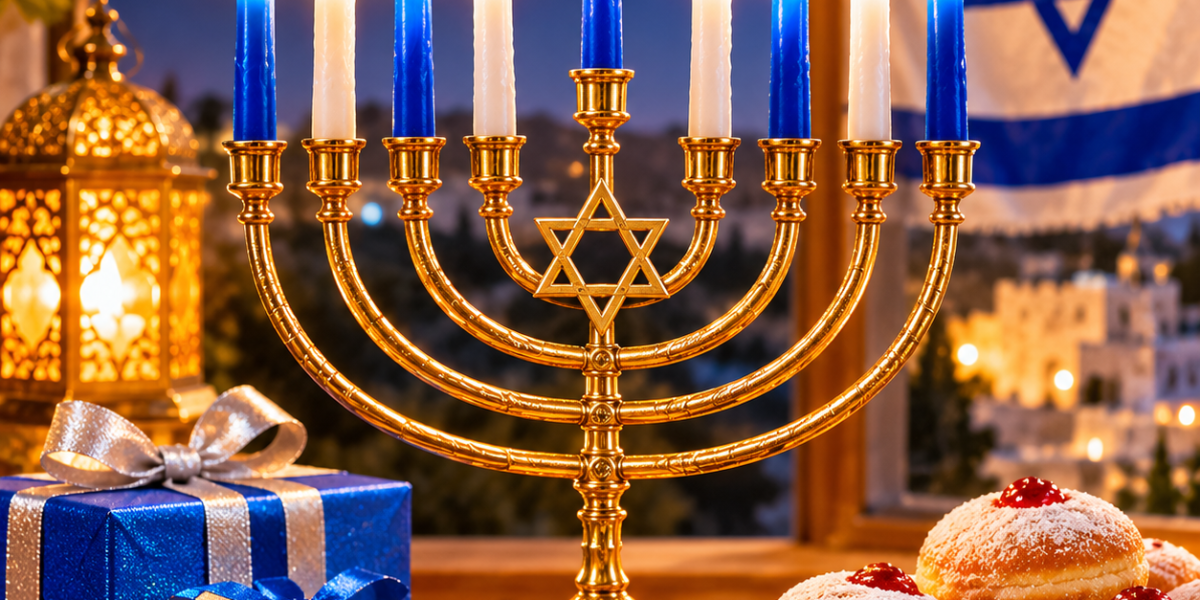
The central tradition of Hanukkah is lighting a special nine-branched candle holder called a hanukkiah, often referred to as a Hanukkah menorah.
It has eight branches for the eight nights of the festival and one additional candle called the shamash, or helper candle. The shamash is used to light the other candles.
One additional candle is lit each evening:
- First night: One Hanukkah candle
- Second night: Two Hanukkah candles
- Third night: Three Hanukkah candles
- Fourth night: Four Hanukkah candles
- Fifth night: Five Hanukkah candles
- Sixth night: Six Hanukkah candles
- Seventh night: Seven Hanukkah candles
- Eighth night: Eight Hanukkah candles
The shamash is used to kindle the lights and is not counted among the eight festival candles.
Families commonly place the hanukkiah in a visible location, such as a window or doorway, to share the message of the miracle with others. Special blessings are recited before lighting the candles.
Traditional Foods and Customs During Hanukkah
Food is an important part of Hanukkah celebrations. Many traditional dishes are prepared using oil, symbolising the miracle of the oil that lasted for eight days.
Some popular foods include:
- Latkes: Potato pancakes traditionally fried in oil.
- Sufganiyot: Jelly-filled doughnuts popular in Israel.
- Dairy dishes: Foods made with cheese and other dairy ingredients are enjoyed in some Jewish communities.
- Hanukkah gelt: Money or chocolate coins traditionally given to children during the festival.
Families also come together to sing traditional songs, exchange gifts in some communities, play the dreidel game and spend time with loved ones.
The Religious Significance of Hanukkah
Hanukkah is more than a festival of lights. It represents religious freedom, faith, courage and the preservation of cultural identity.
The story of the Maccabees is remembered as an example of a community standing up for its religious beliefs. The miracle of the oil symbolises hope and the power of faith even in difficult circumstances.
The lighting of candles each evening also carries a message of bringing light into darkness. It reminds people of the importance of resilience, devotion and keeping traditions alive across generations.
Hanukkah 2026: Important Dates to Remember
- December 4, Friday: First night of Hanukkah; first candle lit before Shabbat candles.
- December 5, Saturday: Second night; candles lit after Shabbat ends.
- December 6–10, Sunday to Thursday: Third to seventh nights.
- December 11, Friday: Eighth and final candle lit before Shabbat candles.
- December 12, Saturday: Hanukkah concludes at nightfall.
Exact candle-lighting times depend on the location and local sunset and Shabbat timings. People observing the festival should consult a reliable local Jewish calendar for their city.
Conclusion
Hanukkah 2026 offers a meaningful example of how religious calendars and traditions shape the way festivals are observed. Beginning on Friday evening, December 4, the Festival of Lights brings a special connection with Shabbat, requiring Hanukkah candles to be lit before the Shabbat candles.
From the story of the Maccabees and the miracle of the oil to the nightly lighting of the hanukkiah, Hanukkah celebrates faith, courage, religious freedom and hope. Its message of bringing light into darkness continues to hold significance for Jewish communities around the world.

Editorial Review Note
Written by Religion World — Bhavya Srivastava is the founder of Religion World and a veteran journalist with over 18 years of experience across broadcast, print, and digital media. A founding member of the International Association of Religion Journalists (IARJ), he has spent much of his career reporting on and producing content about religion, faith, and spirituality. View full profile →.
Religion World provides information on all religions and presents it impartially. You can send us information, news, updates, opinions, and suggestions at religionworldin@gmail.com. You can also follow us on X (Twitter), Facebook, and YouTube.