
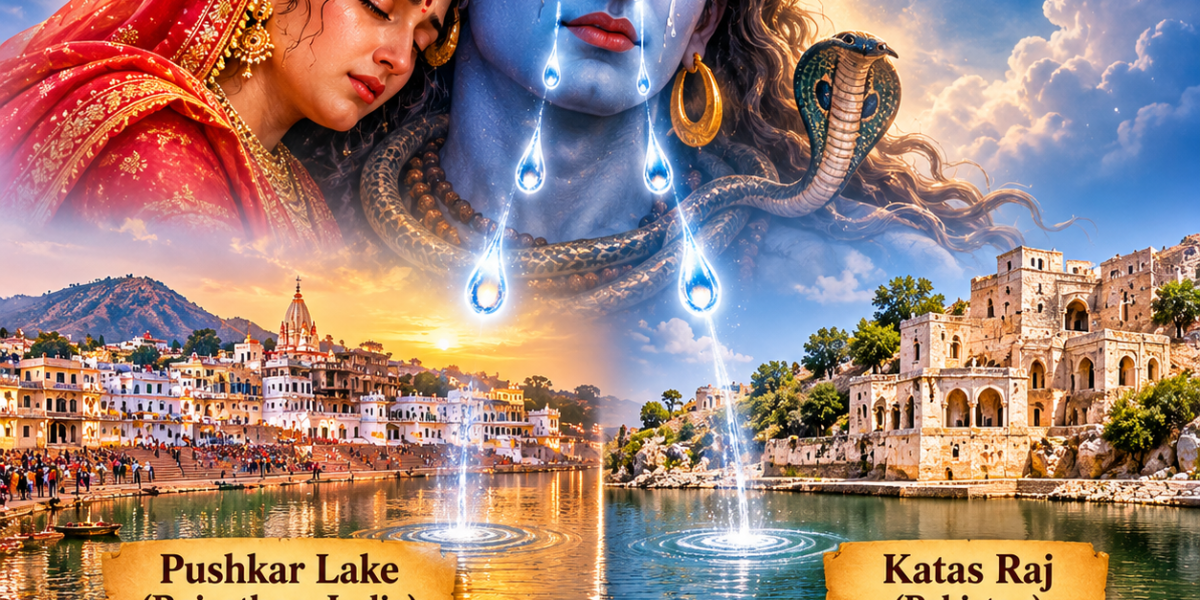
India is home to many sacred rivers, lakes and ponds associated with Hindu mythology. These water bodies are not only important pilgrimage destinations but also carry stories of devotion, faith and divine connection. Interestingly, a fascinating legend associated with Lord Shiva and Goddess Sati connects two sacred lakes located in two different countries — Pushkar Lake in Rajasthan, India, and the sacred pond at Katas Raj Temple in Pakistan.
According to a popular Hindu belief, after Goddess Sati’s death, Lord Shiva was overwhelmed with grief. His tears fell at two different places, creating two sacred water bodies. One is believed to be Pushkar Lake near Ajmer in Rajasthan, while the other is the holy pond at the Katas Raj Temple complex in Pakistan.
Both places hold religious and historical importance and continue to attract pilgrims and visitors interested in Hindu traditions.
The Legend of Lord Shiva’s Tears
According to Hindu mythology, Goddess Sati, the first consort of Lord Shiva, gave up her life after being deeply hurt by the disrespect shown towards Lord Shiva by her father, King Daksha.
Overcome with grief after losing Sati, Lord Shiva is believed to have shed tears of sorrow. According to a traditional legend, two drops of his tears fell at different locations and transformed into sacred water bodies.
One drop is believed to have formed Pushkar Lake in Rajasthan, while the other created the sacred pond at Katas Raj in Pakistan.
The story connects the two pilgrimage sites through a shared belief rooted in Lord Shiva’s love and grief for Goddess Sati.
Katas Raj Temple: The Sacred Pond in Pakistan
“Katas Raj Hindu temples sacred pond Chakwal Pakistan aerial view”
The “Katas Raj Temples” category=”Chakwal, Punjab, Pakistan are an ancient Hindu temple complex situated in the Salt Range hills of Pakistan’s Punjab province. The complex consists of several temples built around a sacred pond and is considered an important Hindu pilgrimage destination.
Most of the temples in the complex are believed to date between the 6th and 10th centuries, although local religious traditions connect the site with much older stories from Hindu mythology.
Why Is the Katas Raj Pond Sacred?
According to Hindu belief, the pond at Katas Raj was formed from one of the two tears shed by Lord Shiva after Goddess Sati’s death.
The name Katas is traditionally associated with the Sanskrit word Kataksha, which is interpreted in the legend as referring to tear-filled or sorrowful eyes.
The sacred pond is also known as a place of religious importance for Hindu devotees. The temple complex has long been associated with Shiva worship and pilgrimage.
Connection with the Mahabharata and the Pandavas
Katas Raj is also connected with stories from the Mahabharata.
According to local traditions, the Pandavas spent part of their exile at this place. Another belief associates the site with the famous Yaksha Prashna episode, in which Yaksha questioned Yudhishthira about life, duty, wisdom and righteousness.
Yudhishthira is believed to have answered the questions through his knowledge and wisdom. This story gives the temple complex an additional connection with the Mahabharata tradition.
Pushkar Lake: The Sacred Water Body in Rajasthan, India
The “Pushkar, Rajasthan, India” is among the most sacred pilgrimage sites in Hinduism. It is also known as Tirthraj, meaning the King of Pilgrimage Sites.
According to the legend of Lord Shiva’s tears, one of the two drops fell at Pushkar and created the sacred lake.
However, Pushkar Lake has another important mythological story associated with Lord Brahma.
The Story of Lord Brahma’s Lotus
According to a popular legend, Lord Brahma once dropped a lotus flower from his hand. Wherever its petals fell, water emerged from the earth, eventually forming the sacred water bodies of Pushkar.
This story is one reason Pushkar is closely associated with Lord Brahma. The town is also home to the famous Brahma Temple, which attracts devotees from different parts of India and abroad.
52 Ghats and Hundreds of Temples
Pushkar Lake is surrounded by approximately 52 bathing ghats. These ghats are used by pilgrims for religious bathing, prayers and rituals.
Some of the well-known ghats include:
- Varaha Ghat: Associated with Lord Vishnu’s Varaha incarnation.
- Brahma Ghat: Connected with Lord Brahma and Pushkar’s religious traditions.
- Gau Ghat: An important site for religious observances and rituals.
The area is also home to hundreds of small and large temples. During Kartik Purnima, thousands of devotees visit Pushkar to take a holy dip in the lake. The famous Pushkar Fair is also organised around this period.
According to Hindu belief, bathing in Pushkar Lake on Kartik Purnima is considered especially auspicious and is believed to bring spiritual merit.
What Makes These Two Sacred Lakes Special?
Although Pushkar Lake and the Katas Raj pond are located in different countries, they share a fascinating connection through the legend of Lord Shiva and Goddess Sati.
Their importance can be understood through several aspects:
- Shared mythology: Both water bodies are associated with the belief that Lord Shiva’s tears created sacred ponds after Goddess Sati’s death.
- Religious importance: Both are revered in Hindu traditions and are associated with pilgrimage and worship.
- Historical heritage: Katas Raj is an ancient temple complex, while Pushkar is an important historic pilgrimage town.
- Mahabharata connection: Katas Raj is linked with traditions about the Pandavas and the Yaksha Prashna story.
- Brahma connection: Pushkar is especially known for its association with Lord Brahma and his famous temple.
Conclusion
The stories of Pushkar Lake in India and the sacred pond at Katas Raj in Pakistan reveal how Hindu mythology connects places across geographical boundaries. According to a popular religious belief, both water bodies originated from the tears of Lord Shiva after the loss of Goddess Sati.
While Pushkar is celebrated as one of India’s most sacred pilgrimage destinations, Katas Raj remains an important symbol of Hindu heritage in Pakistan. Their legends, temples and spiritual traditions make both sites significant destinations for devotees and those interested in ancient history and mythology.
These stories continue to preserve the cultural and spiritual connections associated with Lord Shiva, Goddess Sati and the sacred waters.

Editorial Review Note
Written by Religion World — Bhavya Srivastava is the founder of Religion World and a veteran journalist with over 18 years of experience across broadcast, print, and digital media. A founding member of the International Association of Religion Journalists (IARJ), he has spent much of his career reporting on and producing content about religion, faith, and spirituality. View full profile →.
Religion World provides information on all religions and presents it impartially. You can send us information, news, updates, opinions, and suggestions at religionworldin@gmail.com. You can also follow us on X (Twitter), Facebook, and YouTube.