
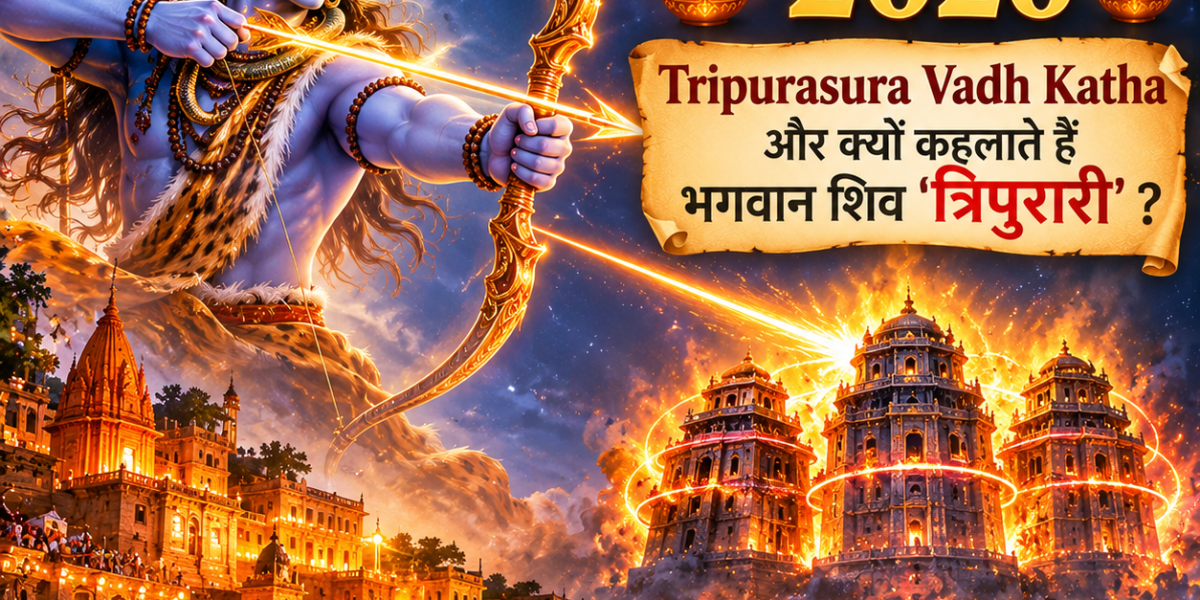
Dev Deepawali is one of the most beautiful and spiritually significant festivals in Hinduism. Celebrated on Kartik Purnima, the festival is associated with the victory of Lord Shiva over the powerful demon Tripurasura. According to Hindu religious beliefs, after Mahadev destroyed the three demonic cities, the gods celebrated his victory by lighting countless lamps in Kashi. This tradition is believed to be the origin of Dev Deepawali.
In 2026, Dev Deepawali will be celebrated on November 24, Tuesday. On this occasion, millions of diyas illuminate the ghats of Varanasi, while devotees offer prayers to Lord Shiva and participate in the traditional Ganga Deepdan.
But who was Tripurasura? Why did the gods seek Lord Shiva’s help? And how did Mahadev earn the name Tripurari? Here is the complete mythological story.
Dev Deepawali 2026: Date and Significance
Dev Deepawali is celebrated every year on Kartik Purnima, the full Moon day of the Hindu month of Kartik.
In 2026, the festival will fall on November 24, Tuesday.
According to the Panchang, Kartik Purnima Tithi will begin at 11:42 PM on November 23 and end at 8:23 PM on November 24.
The festival is particularly famous in Varanasi, where devotees gather along the banks of the Ganga to light earthen lamps. The ghats, temples and riverfront are decorated with thousands of diyas, creating a spectacular spiritual atmosphere.
Dev Deepawali is also known as Tripurari Purnima because of Lord Shiva’s victory over Tripurasura.
Who Was Tripurasura? The Story of Three Powerful Demon Brothers
According to Hindu mythology, Tarakasura was a powerful demon who was eventually killed by Lord Kartikeya, the son of Lord Shiva and Goddess Parvati.
After their father’s death, his three sons—Tarakaksha, Kamalaksha and Vidyunmali—decided to perform severe penance to obtain extraordinary powers and avenge his death.
Their intense meditation pleased Lord Brahma, who appeared before them and asked them to choose a boon.
Initially, the three brothers requested immortality. However, Brahma explained that complete immortality could not be granted to anyone born into the world.
The brothers then came up with another plan. They requested three enormous and powerful cities made of gold, silver and iron. They also sought a special condition: the three cities could be destroyed only when they aligned in a straight line and were struck by a single arrow.
Lord Brahma granted their wish, and the three cities were constructed by the architect of the demons, Maya Danava.
These three cities became known collectively as Tripura, and their rulers came to be associated with the name Tripurasura.
How Did Tripurasura Become a Threat to the Gods?
After receiving the powerful boon, the three brothers became increasingly arrogant. Protected by their nearly invincible cities, they began troubling the gods and creating chaos across the three worlds.
The gods found themselves unable to defeat the three demon brothers because of the special protection granted by Brahma.
With their suffering increasing, the gods first approached Lord Brahma and requested help. However, Brahma knew that the boon he had granted made the demons extremely difficult to defeat.
The gods eventually turned to Lord Shiva and prayed to him to protect the universe from the growing tyranny of Tripurasura.
How Did Lord Shiva Destroy the Three Cities with One Arrow?
Lord Shiva decided to end the threat posed by the three demon brothers. However, the conditions of Brahma’s boon made the task extremely challenging.
The three cities had to come into perfect alignment, and they could be destroyed only with a single arrow.
According to the mythological account, Lord Shiva prepared a divine chariot that represented the entire universe.
Its different parts were made from cosmic elements:
- Earth: Became the chariot.
- Sun and Moon: Became its wheels.
- Four Vedas: Became the horses.
- Lord Brahma: Became the charioteer.
- Mount Meru: Became the bow.
- Lord Vishnu: Took the form of the arrow.
Lord Shiva waited for the rare moment when all three cities would align in a straight line.
When that moment arrived, Mahadev placed the divine arrow on his bow and released it. With a single powerful strike, he destroyed all three cities and ended the reign of the demon brothers.
This victory became known as Tripura Samhara, or the destruction of Tripura.
The gods were finally freed from the terror of the demons, and peace was restored across the three worlds.
Why Is Lord Shiva Called Tripurari?
After destroying the three cities of Tripura, Lord Shiva came to be known as Tripurari.
The name has a special meaning:
- Tripura: Refers to the three cities of the demons.
- Ari: Means enemy or destroyer.
Therefore, Tripurari means the one who destroyed or defeated Tripura.
Lord Shiva is also worshipped as Tripurantaka, another name associated with his victory over the three cities.
The name represents Mahadev’s power to destroy evil, arrogance and forces that disturb the balance of the universe.
Why Do Gods Celebrate Dev Deepawali in Kashi?
According to religious beliefs, after Lord Shiva defeated Tripurasura, the gods celebrated his victory by lighting lamps in Kashi.
The divine celebration is believed to have taken place on Kartik Purnima. This is why the occasion came to be known as Dev Deepawali, meaning the Diwali of the gods.
The tradition continues today in Varanasi. On this day, devotees light countless diyas along the ghats of the Ganga, visit temples, offer prayers and participate in Ganga Aarti.
The illuminated riverfront is one of the most iconic sights associated with the festival.
Devotees also observe Ganga Snan, perform charity and offer lamps as part of their Kartik Purnima celebrations.
Dev Deepawali 2026: Religious Significance of Lighting Diyas
Lighting diyas is one of the most important traditions of Dev Deepawali. The lamps symbolise the victory of light over darkness and good over evil.
Devotees believe that offering lamps to Lord Shiva and lighting diyas near the Ganga on Kartik Purnima brings spiritual blessings.
The festival also reminds people that arrogance and misuse of power eventually lead to destruction, while righteousness and divine protection restore balance.
Conclusion
Dev Deepawali is not simply a festival of lamps; it commemorates the victory of Lord Shiva over the three powerful demon brothers—Tarakaksha, Kamalaksha and Vidyunmali.
Their three cities, collectively known as Tripura, were destroyed by Mahadev with a single divine arrow. This victory earned Lord Shiva the name Tripurari and became the mythological foundation of the Dev Deepawali celebration.
On November 24, 2026, devotees will once again celebrate this sacred occasion by worshipping Lord Shiva, taking holy dips, performing charity and lighting thousands of diyas along the Ganga in Kashi.

Editorial Review Note
Written by Religion World — Bhavya Srivastava is the founder of Religion World and a veteran journalist with over 18 years of experience across broadcast, print, and digital media. A founding member of the International Association of Religion Journalists (IARJ), he has spent much of his career reporting on and producing content about religion, faith, and spirituality. View full profile →.
Religion World provides information on all religions and presents it impartially. You can send us information, news, updates, opinions, and suggestions at religionworldin@gmail.com. You can also follow us on X (Twitter), Facebook, and YouTube.