
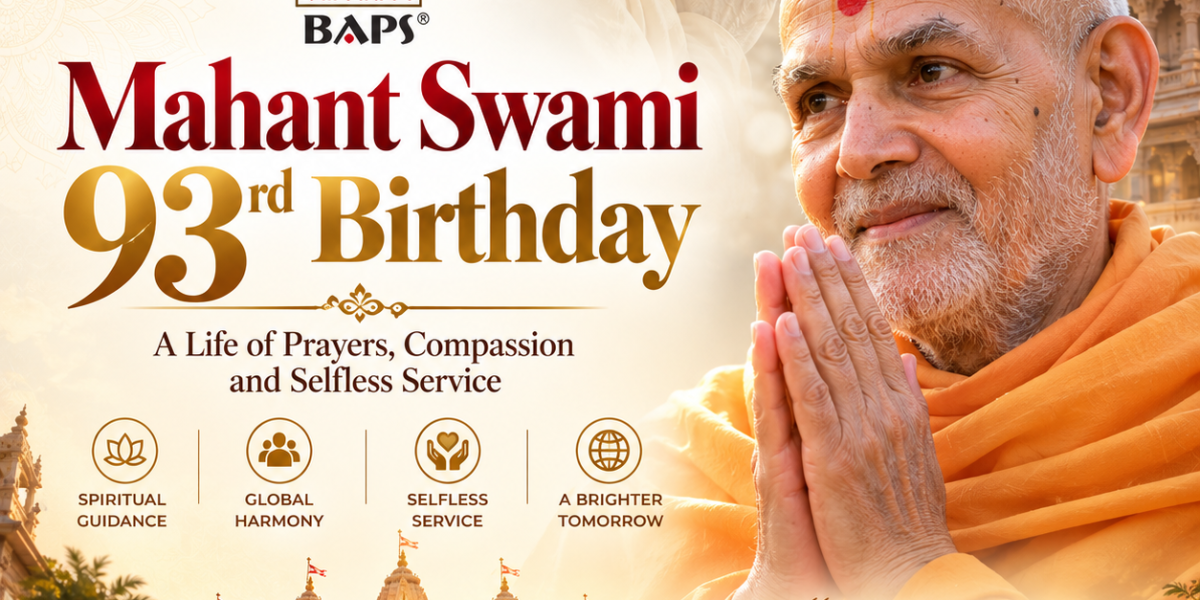
BAPS Mahant Swami Maharaj at 93: A Life of Humility, Devotion and Selfless Service
As His Holiness Mahant Swami Maharaj, the spiritual leader of BAPS Swaminarayan Sanstha, marks his 93rd birth anniversary, his journey offers a striking example of leadership rooted not in authority, but in humility, discipline, devotion and service.
At a time when leadership is often measured by visibility, influence and power, His Holiness Mahant Swami Maharaj represents a very different ideal.
As the spiritual head of BAPS Swaminarayan Sanstha, he guides a worldwide spiritual fellowship spanning temples, humanitarian initiatives, educational programmes, cultural institutions and thousands of volunteers. Yet the defining feature of his public and personal life has remained remarkable simplicity.
For devotees, Mahant Swami Maharaj is not merely an administrator of a global organisation. He is a guru whose life itself is regarded as his principal teaching.
His 93rd birthday therefore becomes more than the celebration of an individual. It is an occasion to revisit a spiritual journey that connects the traditional guru-shishya parampara of India with the realities of a rapidly changing global society.
From Jabalpur to a Life of Renunciation
Mahant Swami Maharaj was born as Vinu Patel on 13 September 1933 in Jabalpur, Madhya Pradesh, into a deeply religious family. His parents, Manibhai and Dahiben Patel, were devotees in the Swaminarayan tradition.
His life, however, did not begin in isolation from modern education.
As a young man, he pursued his studies and graduated from Anand Agricultural University. Those who look at his later life of complete renunciation may find this early background particularly significant: he understood both the world of formal education and the disciplined world of spiritual life.
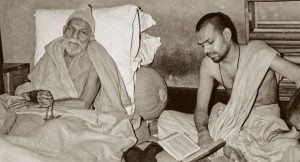
A decisive influence came through his association with Yogiji Maharaj, the fourth spiritual successor in the BAPS tradition.
In Yogiji Maharaj, the young Vinu Patel encountered something that would determine the direction of the rest of his life — a spirituality expressed through joy, humility, devotion and service.
Eventually, worldly ambitions gave way to a deeper calling.
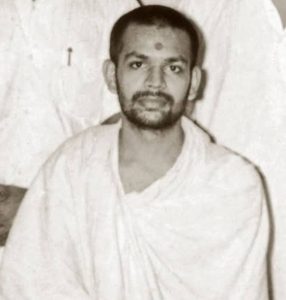
In 1961, he received initiation into the monastic order from Yogiji Maharaj and was given the name Sadhu Keshavjivandas.
This was not simply a change of name or clothing. It represented a radical reorientation of life: from personal aspiration towards spiritual discipline and service to others.
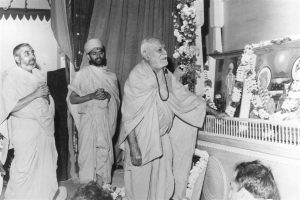
Why He Became Known as ‘Mahant Swami’
Soon after his initiation, Yogiji Maharaj entrusted him with responsibility for a group of newly initiated young sadhus.
He was appointed their mahant — their head or principal.
The title stayed.
Over time, Sadhu Keshavjivandas became affectionately known as Mahant Swami.
Yet there is an interesting paradox in that title. Although “Mahant” implies leadership, the quality devotees repeatedly associate with Mahant Swami Maharaj is precisely the absence of any desire to appear important.
His leadership developed around service rather than status.
He travelled, met devotees, counselled families, guided young people, participated in spiritual assemblies and quietly performed the duties entrusted to him.
This approach reflected one of the central principles of the BAPS tradition: spiritual authority becomes meaningful when it is accompanied by personal discipline and seva.
Three Gurus, One Spiritual Continuity
To understand Mahant Swami Maharaj, one must understand the lineage that shaped him.
His life has been deeply connected with three towering figures of modern BAPS history: Yogiji Maharaj, Pramukh Swami Maharaj and the Bhagwan Swaminarayan guru tradition they represented.
From Yogiji Maharaj, he absorbed an extraordinary emphasis on devotion, joy and seeing goodness in others.
After Yogiji Maharaj’s passing in 1971, Mahant Swami Maharaj devoted himself wholeheartedly to serving under Pramukh Swami Maharaj.
For approximately 45 years, he remained one of Pramukh Swami Maharaj’s most trusted senior sadhus.
These were transformative decades for BAPS.
The organisation expanded far beyond its traditional geographical base. Mandirs and cultural centres appeared across India and throughout the international diaspora. Large-scale humanitarian, educational, cultural and spiritual activities developed alongside them.
Mahant Swami Maharaj witnessed this expansion from very close quarters.
But importantly, he did so largely as a servant of the mission rather than someone attempting to establish a separate identity.
That long period of discipleship is essential to understanding his leadership today.
Before becoming guru, he spent decades learning how to follow.
The Legacy of Pramukh Swami Maharaj
Pramukh Swami Maharaj became internationally respected for a remarkably simple principle:
“In the joy of others lies our own.”
Under his leadership, BAPS developed into an international spiritual and humanitarian organisation, while major mandirs and cultural complexes became visible symbols of Hindu spirituality around the world.
Mahant Swami Maharaj accompanied and supported this mission through extensive travel and personal interaction with devotees.
Pramukh Swami Maharaj had publicly identified Mahant Swami Maharaj as his spiritual successor.
When Pramukh Swami Maharaj passed away in August 2016, Mahant Swami Maharaj became the sixth spiritual successor of Bhagwan Swaminarayan in the BAPS tradition and the spiritual leader of BAPS.
It was an enormous responsibility.
He inherited not simply an institution, but the spiritual trust of a worldwide community.
Leading BAPS in a New Era
The world Mahant Swami Maharaj began leading BAPS in was considerably different from the one in which he had entered monastic life.
Globalisation had transformed communities. Technology was changing human relationships. Younger generations of Hindus were growing up far from India. Questions of identity, mental well-being, family cohesion, faith and belonging had become increasingly complex.
His response has not been to abandon tradition in pursuit of modernity.
Instead, his leadership has sought to demonstrate how traditional spiritual principles can remain relevant within modern life.
His messages consistently return to deceptively simple values: faith in God, prayer, humility, family unity, purity of character, respect, self-discipline, service and seeing virtues in other people.
For Mahant Swami Maharaj, spirituality is not primarily intellectual speculation.
It must become behaviour.
How does a person speak to others?
How does someone react when insulted?
Can we celebrate another person’s success?
Can family members forgive one another?
Can religious devotion make someone more compassionate rather than more arrogant?
These everyday questions reveal the practical character of his spiritual teaching.
A Global Guru Who Remains Personally Accessible
One of the striking features of the BAPS guru tradition has been the importance given to personal contact.
Despite the enormous scale of the organisation, devotees frequently describe encounters with Mahant Swami Maharaj in intensely personal terms.
A glance, a blessing, a remembered detail, a short conversation or a handwritten response can acquire enormous emotional significance for a devotee.
This reflects an important dimension of Indian guru traditions.
The guru is not understood simply as a lecturer explaining philosophy. The guru represents an embodied spiritual relationship — someone whose conduct gives visible form to the values being taught.
Mahant Swami Maharaj’s highly disciplined daily routine, prayer, simplicity and personal austerity consequently carry as much significance for followers as his formal discourses.
His silence can sometimes communicate as powerfully as his words.
Temples as Places of Spiritual and Cultural Belonging
During Mahant Swami Maharaj’s leadership, the international presence of BAPS has continued to expand.
Perhaps the most visible recent symbol of this development is BAPS Hindu Mandir in Abu Dhabi, the first traditional Hindu stone temple of its scale in the Middle East.
Mahant Swami Maharaj presided over its historic consecration ceremonies in February 2024.
The significance of the temple goes beyond architecture.
In a region associated with several of the world’s major religious traditions, the mandir emerged as a powerful symbol of coexistence, dialogue and the ability of faith communities to build relationships across religious boundaries.
Similarly, BAPS Swaminarayan Akshardham in Robbinsville, New Jersey, has become an important spiritual and cultural landmark for Hindu communities in North America.
Such institutions serve several purposes simultaneously.
They are houses of worship, but they are also places where second- and third-generation families encounter Indian traditions, language, festivals, ethics, architecture and community life.
For Mahant Swami Maharaj, however, the ultimate purpose of a mandir is not architectural grandeur.
The physical temple must help build the inner temple of character.
The Quiet Power of Humility
Perhaps the most distinctive element of Mahant Swami Maharaj’s personality is humility.
Humility is easy to praise but extraordinarily difficult to practise once a person acquires authority.
Mahant Swami Maharaj occupies one of the most respected positions within a major global Hindu organisation. Thousands gather for his darshan. Major temples are consecrated in his presence. Political leaders, religious figures and prominent personalities meet him.
Yet his spiritual vocabulary continually redirects attention away from himself — towards Bhagwan Swaminarayan, Gunatitanand Swami, the guru parampara and the ideal of becoming a better devotee and human being.
This is what gives his leadership its unusual character.
His influence does not depend upon projecting power.
It depends upon reducing the importance of the self.
In an age built around personal branding, this almost appears countercultural.
His Message to Young People
The relationship between BAPS and younger generations is another important part of Mahant Swami Maharaj’s leadership.
Across the world, BAPS runs extensive activities for children and youth, involving spiritual education, volunteering, cultural learning and character development.
Mahant Swami Maharaj repeatedly encourages young people to combine education and professional excellence with ethical and spiritual discipline.
Success, in this understanding, cannot simply mean a better salary, greater social recognition or material achievement.
A successful person must also learn how to master anger, ego, jealousy, addiction and destructive habits.
This places spirituality within everyday decision-making.
The question becomes not merely, “What will I achieve?”
It becomes, “What kind of human being will I become while achieving it?”
That distinction may be one of his most relevant messages for the modern generation.
Beyond the Boundaries of One Community
Although deeply rooted in the Swaminarayan tradition, Mahant Swami Maharaj’s public message repeatedly emphasises harmony and respect.
BAPS institutions around the world have hosted interfaith leaders, civic representatives and people from diverse cultural backgrounds.
This approach carries particular importance today.
Religion can become a marker of division when identity becomes detached from compassion. But the same religious commitment can become a force for social trust when it teaches individuals to recognise dignity in others.
Mahant Swami Maharaj’s emphasis on harmony suggests that being deeply rooted in one’s own tradition need not require hostility towards another.
Spiritual confidence and respect for diversity can coexist.
93 Years — and a Much Larger Story
A 93rd birthday naturally invites attention to longevity.
But longevity alone does not explain why Mahant Swami Maharaj’s birthday carries significance for devotees around the world.
The larger story is about continuity.
A young man born in Jabalpur encountered a guru.
The disciple became a monk.
The monk became a servant.
The servant was given responsibility.
And after more than half a century of spiritual discipline, that servant became the guru of a worldwide spiritual fellowship.
There is something profoundly Indian about this trajectory.
Authority arrives only after discipleship.
Leadership follows service.
Teaching follows practice.
And recognition comes after decades spent trying not to seek it.
A Celebration That Points Beyond the Individual
For millions connected with BAPS, the 93rd birthday of His Holiness Mahant Swami Maharaj is therefore an opportunity for gratitude and reflection.
His journey raises a question larger than BAPS itself.
What does spiritual leadership look like in the 21st century?
Perhaps it does not always require louder voices, larger personalities or more complicated philosophies.
Mahant Swami Maharaj’s life proposes another possibility: that spiritual influence can emerge from disciplined living, consistency, compassion and an almost stubborn commitment to humility.
At 93, his life spans extraordinary transformations — from pre-independence India to the digital age; from local satsang communities to a global Hindu diaspora; from relatively modest mandirs to internationally recognised spiritual complexes.
Yet the essential message has remained remarkably unchanged:
Remember God. Serve others. Preserve unity. See the good in people. Live with humility.
Buildings may express a civilisation.
Institutions may preserve a tradition.
But ultimately, spirituality has to transform the human being.
And perhaps that is the most appropriate way to understand Mahant Swami Maharaj’s 93rd birthday — not simply as another milestone in the life of a revered guru, but as a celebration of a life devoted to showing that the greatest form of leadership may ultimately be service.
Religion World | Dharma • Spirituality • Wisdom

Editorial Review Note
Written by Religion World — Bhavya Srivastava is the founder of Religion World and a veteran journalist with over 18 years of experience across broadcast, print, and digital media. A founding member of the International Association of Religion Journalists (IARJ), he has spent much of his career reporting on and producing content about religion, faith, and spirituality. View full profile →.
Reviewed by Religion World Team on October 4, 2026.
Religion World provides information on all religions and presents it impartially. You can send us information, news, updates, opinions, and suggestions at religionworldin@gmail.com. You can also follow us on X (Twitter), Facebook, and YouTube.