
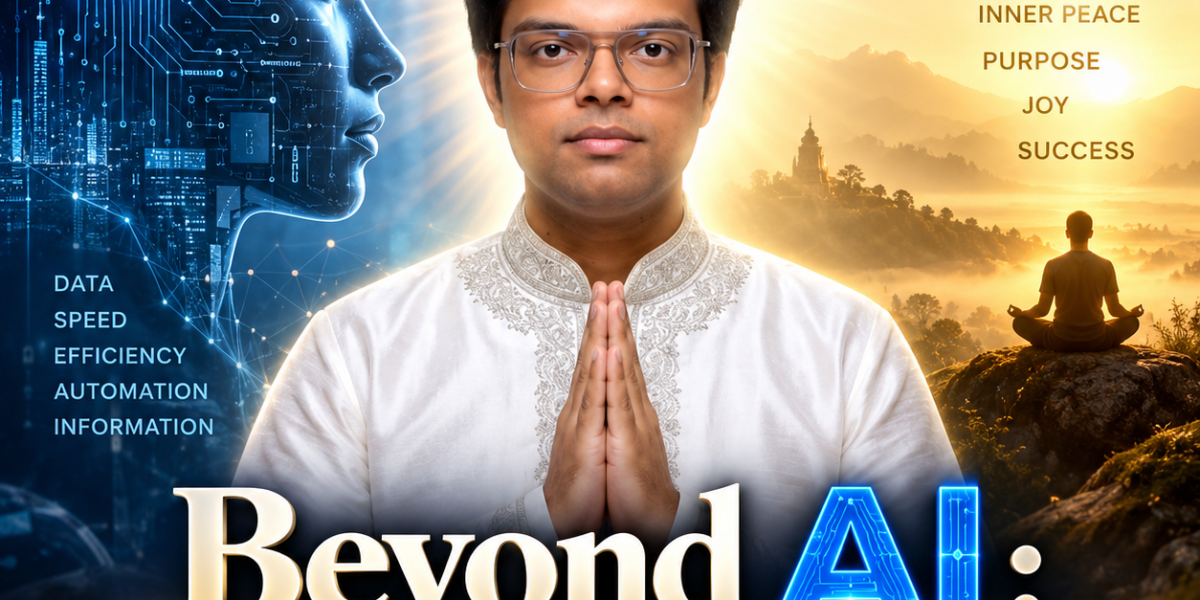
Divine Intelligence + Artificial Intelligence – a coding for success, peace, joy and happiness with inner alignment
- Devesh Purohit
In an era defined by the Fourth Industrial Revolution and Web 3.0, the global workforce is in a relentless race to upskill in Artificial Intelligence. LinkedIn feed urges us to upskill in AI from prompt engineering, machine learning to automation. And rightly so; AI is a powerful tool. But as a Reiki Grandmaster who has researched on energy, consciousness, and human transformation, I want to offer a counter-question: if AI is the operating system everyone is racing to install, who is upgrading the hardware, the human being running it?
AI can never replace Human Intelligence, and Human Intelligence can never replace Divine Intelligence. Artificial Intelligence is built by Human Intelligence. Human Intelligence, in turn, draws from something older and less measurable: Divine Intelligence, the intuitive, energetic, and consciousness-based wisdom that has guided seekers, sages, and healers for millennia. AI can process data. It cannot generate insight born of stillness, nor can it replicate the felt sense of alignment that arises when a person is spiritually attuned. No model has ever produced a genuine moment of grace. AI can amplify human intelligence, but Divine Intelligence (DI) can elevate human consciousness. AI improves performance, but DI gives performance a purpose. AI can process information; Divine Intelligence helps us understand what is worth pursuing. AI can predict behaviour; DI helps us respond with wisdom, compassion and discernment.And ultimately, the quality of our life depends not only on what we know, but on who we become.
Modern research validates what ancient wisdom has always known. A 2024 study of 240 students at the University of Delhi found that Spiritual Intelligence (SQ) and happiness are “positively and significantly related” at a 1% significance level, with SQ enhancing psychological well-being and adaptability . This confirms that developing our innate spiritual qualities directly correlates with success.
The World Economic Forum’s Future of Jobs Report 2025 makes an interesting point. While AI and big data are among the important skills of the future, employers rank analytical thinking, resilience, adaptability, leadership, creativity, motivation, self-awareness, empathy and active listening even higher. In other words, the future will not belong merely to people who know AI; it will belong to people who know themselves. This is where I introduce Divine Intelligence, the higher faculty of intuition, discernment, consciousness, compassion, purpose and inner wisdom. I see Reiki not merely as an energy-healing practice, but as one pathway toward cultivating inner awareness and a deeper relationship with consciousness.
Look closely at the people around you who are genuinely prosperous and at peace, not just financially successful but calm, magnetic, and resilient. Almost invariably, you will find a disciplined inner practice behind their outer achievement or a divine and spiritual support in mystic sense. Research in neurotheology shows that spiritual practices like energetic healing and meditation increase gray matter in the prefrontal cortex, lowering cortisol and dramatically improving high-stakes decision-making.
The timeless power of Divine Intelligence is woven through sacred Indian texts. Rigveda (10.190.1): Proclaims Rta, the cosmic order that governs the universe. Aligning personal intention with this universal truth yields effortless prosperity. Katha Upanishad (1.3.3–4) uses the metaphor of the chariot, where the Atman (Divine Self) is the passenger and the intellect is the charioteer. AI can assist the chariot, but only Divine Intelligence knows the destination. The Chāndogya Upanishad places intelligence at the centre of human functioning and then asks whether there is something beyond intelligence. The Taittirīya Upanishad describes Brahman as “satyam jñānam anantam”, truth, knowledge and infinity and associates the realization of the ultimate with limitless bliss.Shiv Puran details how Lord Shiva, as the ultimate embodiment of consciousness, governs the energy flow (prana) that sustains all creation, proving that inner mastery precedes outer reality. Vishnu Puran (1.9) illustrates through the Samudra Manthan (churning of the ocean) that true wealth (Laxmi) emerges only when the mind undergoes deep spiritual refinement.
The Rigveda speaks of the “seven-headed thought” (saptaguṃ dhiyam) and the revelation of Swar, the divine consciousness that opens doors to new states of existence. This is not mere poetry; it describes the awakening of higher consciousness through practices like Swar Vigyaan, the ancient science of breath and pranic rhythms that governs our mental and spiritual states. The Varaha Upanishad outlines seven stages of knowledge acquisition, from virtuous desire to learn (Subh-echchha) through to Turiya, or complete consciousness. This mirrors what we now call Neuro-Linguistic Programming (NLP) and Subconscious Reprogramming, replacing outdated mental programs with aligned, conscious beliefs.
The Taittirīya Upanishad presents Brahman as the source of joy, suggesting that lasting happiness is not entirely dependent on external acquisition. The Śvetāśvatara Upanishad links contemplation and yoga with freedom from illusion. The Vishnu Purana similarly describes the highest wisdom as self-illuminating, tranquil, fearless and pure. These are not instructions to reject the material world; they are reminders that external achievement without inner clarity can become another form of bondage.
Long before neuroscience mapped the brain, Indic wisdom traditions had already built sophisticated frameworks for self-mastery. Swar Vigyaan rooted in the Shiva Swarodaya, describes how breath alternates between the left nostril (Ida/Chandra Nadi, linked to calm, intuitive, right-brain states) and the right nostril (Pingala/Surya Nadi, linked to logic and dynamic action). This ancient breath-science parallels what modern physiology calls the nasal cycle, a well-documented ultradian rhythm in which nasal airflow dominance shifts, correlating with shifts in the autonomic nervous system. Rishis were reading the nervous system through breath centuries before polysomnography existed. Subconscious reprogramming, a cornerstone of modern NLP practice, echoes the Upanishadic insistence that the mind (manas) must be trained and transcended, not merely obeyed. The Chāndogya Upanishad’s teaching of “Tat Tvam Asi” , “That thou art” points to a Self beyond ego-conditioning, the very premise on which subconscious reprogramming rests: you are not your limiting patterns. NLP (Neuro-Linguistic Programming) reframes language and thought to change behaviour, a modern echo of the Vedic understanding that shabda (sound/word) shapes reality, seen in the Rigveda’s reverence for mantra as vibrational technology. The Vishnu Purana frames dharma (right action) and prosperity (artha) as inseparable from inner alignment. Success without inner coherence is described as hollow and unsustainable. The Shiv Purana places consciousness (Shiva) as prior to and greater than mind and matter a direct precursor to the DI-over-AI argument.
DI isn’t mystical escapism; it’s the missing curriculum. Reiki, breathwork, meditation, and subconscious reprogramming aren’t alternatives to ambition, they are its foundation. As you build your AI skillset, build your DI practice alongside it. The most future-proof leaders won’t just be AI-literate. They will be consciousness-literate. The technology will keep changing. The Source doesn’t.
Sources:
- https://www.academia.edu/124732346/Spiritual_Intelligence_happiness_and_success_of_students_in_select_higher_education_institutions_of_University_of_Delhi#1
- https://www.weforum.org/publications/the-future-of-jobs-report-2025/digest/
Author – Devesh Purohit

Editorial Review Note
Written by Religion World — Bhavya Srivastava is the founder of Religion World and a veteran journalist with over 18 years of experience across broadcast, print, and digital media. A founding member of the International Association of Religion Journalists (IARJ), he has spent much of his career reporting on and producing content about religion, faith, and spirituality. View full profile →.
Religion World provides information on all religions and presents it impartially. You can send us information, news, updates, opinions, and suggestions at religionworldin@gmail.com. You can also follow us on X (Twitter), Facebook, and YouTube.