
Last updated: August 2026 · Next Tholi Ekadashi: 14 July 2027
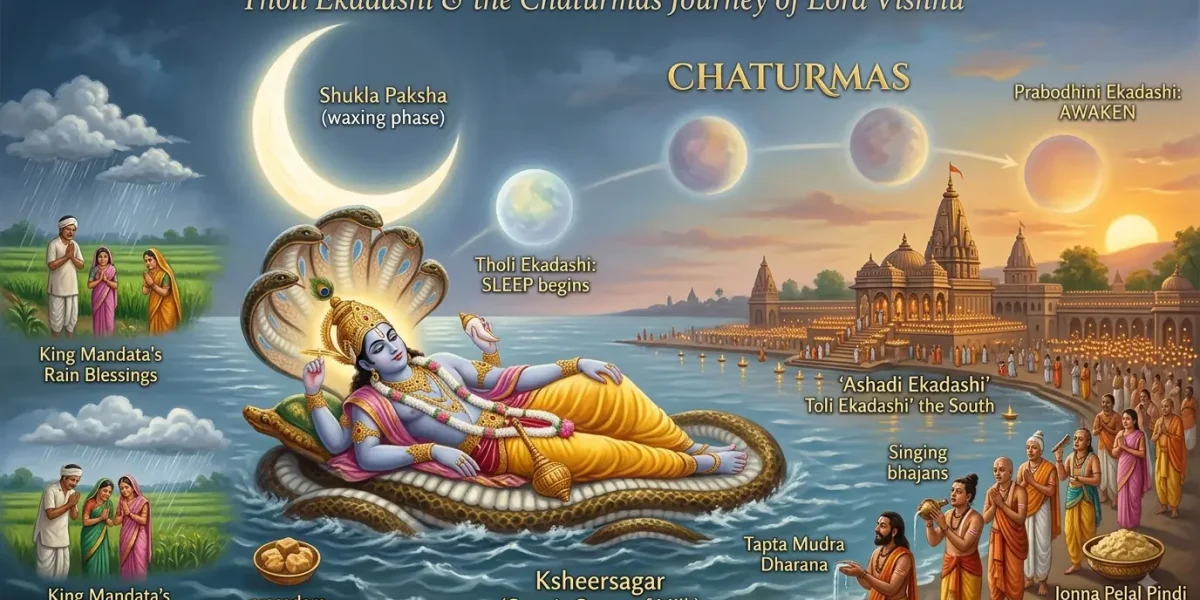
Tholi Ekadashi — also spelled Toli Ekadashi and known across India as Devshayani Ekadashi, Ashadi Ekadashi, or Shayani Ekadashi — is one of the most sacred days for followers of Lord Vishnu. It falls on the eleventh day (Ekadashi) of the waxing moon in the Hindu month of Ashadha (June–July) and marks the day Lord Vishnu begins his four-month cosmic sleep (Yoga Nidra) on Sheshanaga in the Ksheersagar, the ocean of milk. This same day begins Chaturmas, a holy four-month period. Below you will learn what Tholi Ekadashi means, why it has so many names, its exact date and timings, the legend behind it, the fasting rules, and how it is observed regionally.
Quick Facts
- What: The Ashadha Shukla Ekadashi marking Vishnu’s cosmic sleep
- Also called: Devshayani, Ashadi, Shayani, Padma, Hari Shayani Ekadashi
- Next date: 14 July 2027 (Tithi: 13 July 12:09 PM – 14 July 1:10 PM IST)
- Begins: Chaturmas (4-month period of Vishnu’s sleep)
- Ends on: Prabodhini / Dev Uthani Ekadashi (Kartik month, Oct–Nov)
- Deity: Lord Vishnu (with Mata Lakshmi)
Why does Tholi Ekadashi have so many names?
The spelling and naming confusion is the most common question searchers have — so let’s settle it first. Tholi Ekadashi, Toli Ekadashi, Devshayani, Ashadi, and Shayani Ekadashi are all the same day. The differences are regional and linguistic, not calendrical.
| Name | Where / why it’s used |
|---|---|
| Tholi / Toli Ekadashi | South India, especially Telugu-speaking regions (“Toli” means “first” — the first major Ekadashi of the Chaturmas) |
| Ashadi Ekadashi | Maharashtra — named after the Ashadha month; marks the end of the Pandharpur Wari pilgrimage |
| Devshayani Ekadashi | North India — “Dev-shayani” = “the god sleeps” |
| Hari Shayani / Shayani | Pan-Indian devotional usage |
| Padma Ekadashi | From the Puranic legend (see below) |
Spelling note: “Tholi,” “Toli,” and “Tholee” are all accepted transliterations of the Telugu term. There is no single “correct” English spelling — “Tholi Ekadashi” and “Toli Ekadashi” are the most common.
What is the significance of Tholi Ekadashi?
In Hindu cosmology, one day of the gods equals one human year: their six-month “day” is our Uttarayana, and their six-month “night” is our Dakshinayana. Tholi Ekadashi falls at the turn toward this cosmic night. From this day, daytime begins to shorten and nights lengthen — and symbolically, Lord Vishnu enters Yoga Nidra, a state of deep meditative rest, for four months.
This is why the day matters so deeply to Vaishnavas: it is considered the ideal moment to propitiate Vishnu and Mata Mahalakshmi before the Lord’s long rest. The Bhagavata Purana (Skandha IX) records the devotion of King Ambarisha, a model Ekadashi observer, anchoring the vrat in scriptural tradition.
When is Tholi Ekadashi? (Date & Tithi Timings)
Ekadashi Tithi begins: 13 July 2027, 12:09 PM IST
Ekadashi Tithi ends: 14 July 2027, 1:10 PM IST
Parana (fast-breaking): 15 July 2027, 5:54 AM – 8:33 AM IST
(Timings computed for Ujjain; they shift slightly by city. Always confirm with a local Panchang.)
Because Ekadashi is a lunar Tithi, the English calendar date changes every year. The Tithi can also straddle two days, which is why Panchang timings — not just the date — decide the correct fasting day.
The legend of King Mandata
The Bhavishyottara Purana records that Lord Krishna narrated this Ekadashi’s significance to Yudhishthira. The central story concerns King Mandata, whose kingdom suffered a three-year drought. Unable to find relief, the king approached the sage Angiras, who advised him to observe the vrat of Devshayani (Tholi) Ekadashi. The king did so — and by Vishnu’s grace, rain finally returned to his land. This is why the day is considered especially powerful for fulfilling sincere prayers.
What is Chaturmas, and what begins now?
Tholi Ekadashi opens Chaturmas (“four months”), the period of Vishnu’s sleep that coincides with the monsoon. It ends four months later on Prabodhini (Dev Uthani) Ekadashi in Kartik month, when the Lord “awakens.”
| During Chaturmas | Traditionally avoided |
|---|---|
| Fasting, prayer, charity, self-study, spiritual discipline | Marriages (vivah) |
| Reading Ramayana, Bhagavata, Mahabharata | Griha Pravesh (house-warming) |
| Observing the Chaturmas Vrata | Upanayana (thread ceremony), major yajnas |
The reasoning is both devotional and practical: with Vishnu at rest and the monsoon making travel and gathering difficult, tradition redirects energy from worldly celebration toward inner discipline.
Rituals and how Tholi Ekadashi is observedDevotees rise early, bathe, and worship an idol of Lord Vishnu with Shodashopachar puja (sixteen offerings). Through the day they chant Vishnu mantras — the Vishnu Sahasranama, the 108 and 1008 names, and Govinda namalu — and study sacred texts. Temples see large crowds seeking Vishnu’s blessings.
“Om Namo Bhagavate Vasudevaya”
In Vaishnavite mutts, initiates observe Tapta Mudra Dharana — the wearing of heated seals bearing Vishnu’s symbols. In South India, Jonna pelalu pindi (millet flour) with jaggery is offered as prasadam, valued traditionally for its monsoon-season health benefits.
Fasting (Vrat) rules
The ideal observance is a Nirjala fast (without water). Those unable to keep it may take liquids or fruit. Grains, rice, beans, and certain vegetables and spices are avoided. The fast is broken the next morning during Parana, which must fall within the Dwadashi Tithi and after Hari Vasara (the first quarter of Dwadashi) has passed. Pratahkal (early morning) is the preferred time; the Madhyahna (afternoon) window is avoided.
How many Ekadashis are there in a year?
A common misconception puts the number at 26. In fact, there are 24 Ekadashis in a normal year — two each lunar month, one in Shukla Paksha (waxing) and one in Krishna Paksha (waning). Only in an adhik-maas (leap month) year does the count rise to 26. Each Ekadashi is dedicated to Lord Vishnu and carries its own name and significance; Tholi Ekadashi is simply the most prominent of the Ashadha month.
तोली एकादशी, जिसे देवशयनी एकादशी और आषाढ़ी एकादशी भी कहा जाता है, आषाढ़ मास के शुक्ल पक्ष की ग्यारहवीं तिथि को मनाई जाती है। इसी दिन से भगवान विष्णु चार महीने के लिए क्षीरसागर में योगनिद्रा में लीन हो जाते हैं, जिसे चातुर्मास कहा जाता है। इस अवधि में विवाह और गृह प्रवेश जैसे शुभ कार्य नहीं किए जाते। भक्त इस दिन व्रत रखते हैं, भगवान विष्णु की पूजा करते हैं और “ॐ नमो भगवते वासुदेवाय” मंत्र का जाप करते हैं। चार महीने बाद प्रबोधिनी (देवउठनी) एकादशी पर भगवान जागते हैं और शुभ कार्य पुनः आरंभ होते हैं।
తొలి ఏకాదశి లేదా శయన ఏకాదశి
తొలి ఏకాదశి (దేవశయని ఏకాదశి) విష్ణువు ఆరాధకులకు అత్యంత పవిత్రమైన రోజు. ఆషాఢ మాసం శుక్ల పక్ష ఏకాదశి నాడు వచ్చే ఈ రోజున శ్రీమహావిష్ణువు క్షీరసాగరంలో శేషnాగుపై నాలుగు నెలల యోగనిద్రలోకి వెళతారు. దీనితో చాతుర్మాసం ప్రారంభమవుతుంది. భక్తులు ఉపవాసం ఉండి, విష్ణు సహస్రనామం పఠిస్తూ, “ఓం నమో భగవతే వాసుదేవాయ” మంత్రాన్ని జపిస్తారు. నాలుగు నెలల తర్వాత ప్రబోధిని ఏకాదశి నాడు స్వామి మేల్కొంటారు.
Frequently Asked Questions
What is Tholi Ekadashi?
Why is Tholi Ekadashi celebrated?
Is Tholi Ekadashi the same as Devshayani or Ashadi Ekadashi?
When is Tholi Ekadashi in 2027?
How many Ekadashis are there in a year?
What can and cannot be done during Chaturmas?
How do you break the Tholi Ekadashi fast?
Editorial Review Note
Reviewed by Bhavya Srivastava on August 13, 2026.
Sources: Bhavya Srivastava
Religion World provides information on all religions and presents it impartially. You can send us information, news, updates, opinions, and suggestions at religionworldin@gmail.com. You can also follow us on X (Twitter), Facebook, and YouTube.
Leave a Reply