
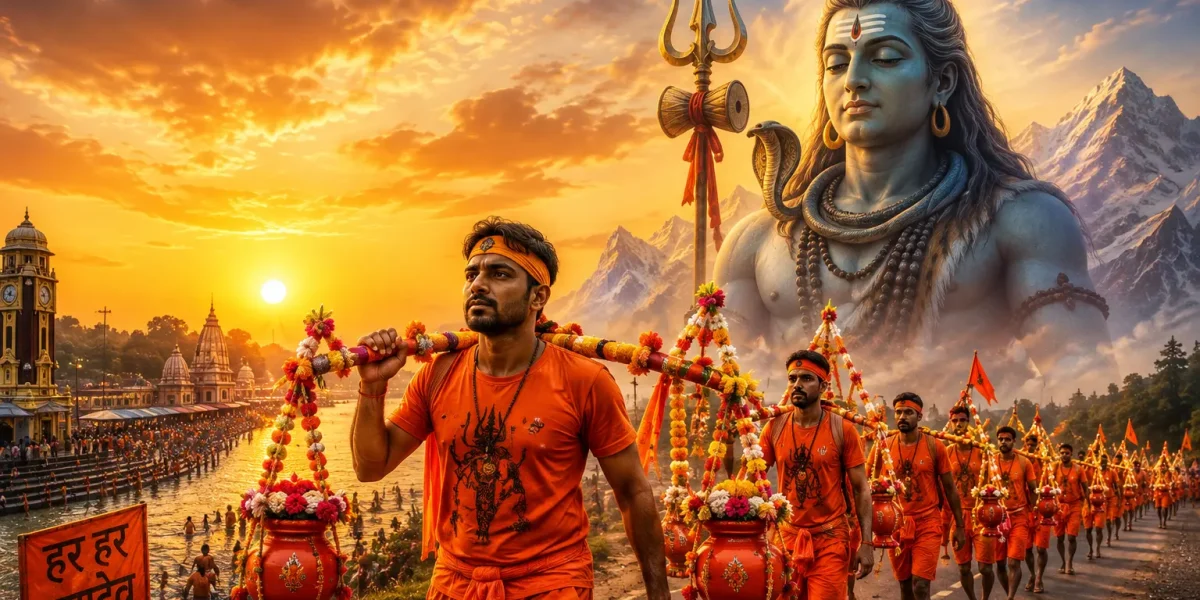
Kanwar Yatra has five main types — Dak, Khadi, Baithaki, Dandi and Sadharan — and each follows different rules, difficulty levels and vows. If you are planning to undertake the pilgrimage during Sawan 2026, knowing the types of Kanwar Yatra helps you choose the form that matches your faith, stamina and the strictness of vow (sankalp) you intend to keep. Below, you will learn what each type means, the exact rules that define it, which one is the hardest, and how a broken rule affects the yatra — plus a quick comparison table and FAQs.
Every year during the holy month of Shravan (Sawan), lakhs of Kanwariyas collect sacred Ganga water from Haridwar, Gaumukh, Gangotri and Sultanganj, then carry it back to offer to Lord Shiva. Kanwar Yatra 2026 begins on Thursday, 30 July 2026 and culminates on Sawan Shivratri, Tuesday, 11 August 2026, when most devotees perform jalabhishek. But not every Kanwariya carries the Kanwar the same way — the vow they take decides the type.
Why Are There Different Types of Kanwar Yatra?
The types are not arbitrary. They exist because devotees take a sankalp (a solemn vow) scaled to their physical capacity and spiritual intensity. A first-time pilgrim may keep a gentle vow; a seasoned devotee may take a vow so strict that a single lapse invalidates the entire journey. In this way, the same pilgrimage accommodates both a working householder and an ascetic-minded devotee. The stricter the type, the more it is understood as tapasya — austerity offered to Lord Shiva.
1. Dak Kanwar (Express / Relay Kanwar)
Dak Kanwar is the most physically demanding of the commonly undertaken forms. The word Dak means “post” or “express” — and the vow lives up to it. The Kanwariya runs continuously from the water-collection point to the temple, without stopping, and a relay team follows in vehicles (trucks or bikes): while one devotee runs, the others follow alongside, ready to keep the Kanwar moving.
The critical rule: Dak Kanwar is governed by an unbroken vow. If even a single rule is broken — a stop, a lapse in the relay, contact with the ground — the yatra is considered khandit (broken), and it is believed the devotee’s wish will not be fulfilled. Temples receiving Dak Kanwariyas often keep a dedicated path clear so the running devotee is never obstructed. This all-or-nothing intensity is exactly why Dak is regarded as supreme tapasya.
2. Khadi Kanwar (Standing Kanwar)
Khadi Kanwar introduces a strict rule: the Kanwar must never touch the ground, and it must not be hung either. When the devotee needs to rest, another person must physically hold the Kanwar upright, or it is placed on a specially designed wooden or metal Kanwar stand that keeps it elevated. Traditionally, keeping the Kanwar off the earth is believed to preserve the sanctity and purity of the Ganga water.
Mechanism / why it matters: Because the Kanwar can never rest on the ground, Khadi devotees usually travel in pairs or groups — one rests while the other holds the pole. This makes the vow a shared act of endurance, not a solo one.
3. Baithaki Kanwar (Seated / Rest-Allowed Kanwar)
In Baithaki (also called Baithi) Kanwar, devotees take planned, structured breaks during the journey and are permitted to place the Kanwar down while resting. It sits between Sadharan and the stricter forms — more disciplined than an ordinary walk, but without the no-rest intensity of Dak. It remains one of the most widely followed forms because it balances devotion with practicality.
4. Sadharan Kanwar (Ordinary Kanwar)
Sadharan Kanwar is the most common and flexible form. Devotees complete the journey on foot at their own pace, resting when needed while observing the core rules of the yatra — walking barefoot, following a satvik (pure vegetarian) diet, maintaining cleanliness, and chanting “Bol Bam.” The Kanwar can be set down on a clean, elevated surface during rest.
Best for: first-time pilgrims and families, because it keeps the spiritual discipline without the extreme physical demand.
5. Dandi Kanwar (Prostration Kanwar)
Dandi Kanwar is the rarest and hardest of all types. Instead of walking, the devotee measures the entire route with the length of their own body — lying flat (prostrating), marking the spot reached by the hands, then rising and starting again from that mark. Because the journey advances only one body-length at a time, a Dandi Kanwar can take several weeks to complete a route others walk in days. It is the most extreme form of physical austerity in the pilgrimage and is undertaken only by the most resolute devotees.
Which Type of Kanwar Yatra Is the Hardest?
By difficulty: Dandi is the hardest (body-length prostration over weeks), followed by Dak (continuous running with an all-or-nothing vow), then Khadi (no ground contact), then Baithaki, with Sadharan being the most accessible. Difficulty rises with the strictness of the vow — and, in tradition, so does the spiritual merit.
Why Is Kanwar Yatra Important?
The Kanwar Yatra is far more than a walk to a temple. Rooted in the Samudra Manthan legend — when Lord Shiva consumed the Halahala poison to save creation and was offered holy water to soothe it, earning the name Neelkanth — the yatra re-enacts an act of devotion and relief offered to Shiva. For the modern Kanwariya, the physical hardship is the point: it converts faith into discipline, endurance and surrender. Whether a devotee keeps a gentle Sadharan vow or the unforgiving Dak vow, the destination is the same — offering Gangajal to Lord Shiva and seeking his blessings during Shravan.
Frequently Asked Questions
How many types of Kanwar Yatra are there?
Which type of Kanwar Yatra is the hardest?
What is the difference between Dak and Khadi Kanwar?
What happens if a rule of Dak Kanwar is broken?
Why is the Kanwar not allowed to touch the ground in Khadi Kanwar?
Which type of Kanwar Yatra is best for beginners?

Editorial Review Note
Written by Religion World — Bhavya Srivastava is the founder of Religion World and a veteran journalist with over 18 years of experience across broadcast, print, and digital media. A founding member of the International Association of Religion Journalists (IARJ), he has spent much of his career reporting on and producing content about religion, faith, and spirituality. View full profile →.
Religion World provides information on all religions and presents it impartially. You can send us information, news, updates, opinions, and suggestions at religionworldin@gmail.com. You can also follow us on X (Twitter), Facebook, and YouTube.