
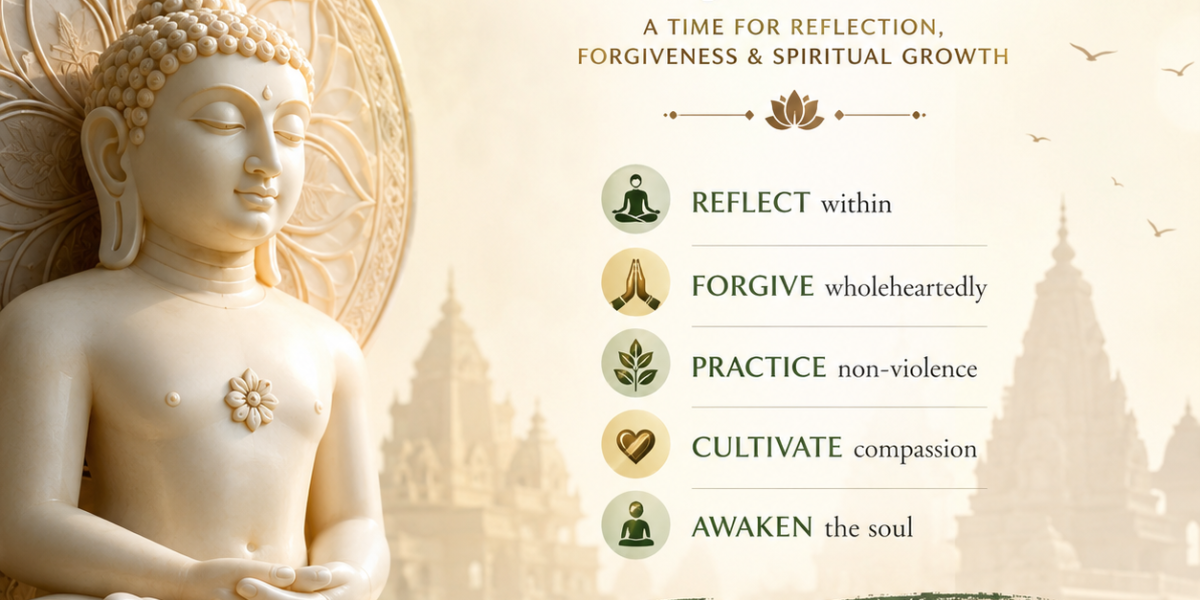
Paryushan: The Festival of Inner Awakening, Forgiveness, and Spiritual Renewal
Paryushan – The Soul’s Journey Towards Purity
In a world driven by speed, ambition, and constant distractions, there comes a sacred period that gently reminds humanity to pause, reflect, and reconnect with the soul. Paryushan, the most revered festival in Jainism, is not a celebration of external grandeur but an inward pilgrimage toward self-realization, compassion, and spiritual purification.
Unlike festivals centered around festivities and material celebrations, Paryushan invites individuals to embark on a journey of introspection, self-discipline, forgiveness, and universal friendship. It is a time when one consciously reduces worldly attachments and focuses on cleansing the mind, speech, and actions.
The word “Paryushan” is derived from the Sanskrit roots:
- Pari – around, complete, or all-encompassing
- Ushana (or Vas) – to stay, dwell, or come closer
Together, the word signifies “staying close to one’s true self” or “abiding in spiritual awareness.”
Historical and Spiritual Significance
Paryushan has been observed for thousands of years by the Jain community and holds profound importance in both the Śvetāmbara and Digambara traditions.
- The Śvetāmbara tradition observes Paryushan for eight days.
- The Digambara tradition observes a ten-day period known as Dashalakshana Parva, focusing on ten supreme virtues.
Although the duration differs, the spiritual objective remains the same—to purify karma, cultivate virtues, and progress toward liberation (Moksha).
According to Jain philosophy, every thought, word, and action leaves subtle karmic impressions on the soul. Paryushan provides an opportunity to consciously reduce these karmic bonds through repentance, self-control, meditation, scriptural study, and acts of compassion.
The Philosophy Behind Paryushan
Jainism teaches that every living being possesses an eternal soul capable of attaining infinite knowledge, bliss, and freedom. However, negative emotions such as anger, pride, deceit, greed, attachment, and hatred obscure the soul’s true nature.
Paryushan encourages practitioners to examine these tendencies honestly and replace them with:
- Compassion
- Forgiveness
- Humility
- Truthfulness
- Contentment
- Simplicity
- Self-restraint
- Non-violence (Ahimsa)
The festival serves as a spiritual reset, allowing individuals to reconnect with their highest values.
The Eight Pillars of Paryushan
1. Self-Reflection (Pratikraman)
One of the central practices of Paryushan is Pratikraman, a ritual of introspection.
Devotees review their thoughts and actions throughout the year and acknowledge mistakes committed knowingly or unknowingly.
Rather than blaming others, Pratikraman teaches personal responsibility and ethical awareness.
2. Forgiveness (Kshamapana)
Perhaps the most beautiful message of Paryushan is forgiveness.
At the conclusion of the festival, Jains seek forgiveness from everyone with the heartfelt words:
“Micchami Dukkadam.”
Its deeper meaning is:
“If I have caused you pain through my thoughts, words, or actions, knowingly or unknowingly, I sincerely seek your forgiveness.”
This practice transcends ritual and nurtures healing, humility, and harmony in relationships.
3. Fasting and Self-Control
Many devotees undertake different forms of fasting, including:
- Complete fasting
- Water-only fasting
- One meal a day
- Eating before sunset
- Avoiding root vegetables
- Simple, sattvic food
The objective is not punishment but mastery over desires and cultivation of inner discipline.
4. Meditation and Silence
Paryushan emphasizes reducing external noise and increasing inner awareness through:
- Meditation
- Chanting
- Silence (Maun)
- Breath awareness
- Contemplation
Silence helps conserve mental energy and encourages mindful living.
5. Study of Sacred Scriptures
Devotees dedicate time to studying Jain scriptures, including teachings of the Tirthankaras and ethical texts that guide moral living.
The emphasis is not merely on reading but on applying spiritual wisdom in daily life.
6. Ahimsa – Universal Non-Violence
Ahimsa lies at the heart of Jain philosophy.
During Paryushan, practitioners become especially mindful about avoiding harm to all forms of life—humans, animals, birds, insects, and even microscopic beings.
This extends beyond physical actions to include non-violent speech and compassionate thinking.
7. Charity and Compassion
Acts of generosity become an important part of the festival.
People support charitable causes by:
- Donating food
- Helping the needy
- Caring for animals
- Supporting educational initiatives
- Serving the community
True charity, according to Jain philosophy, is performed without expectation of recognition or reward.
8. Simplicity
Paryushan encourages reducing unnecessary consumption and embracing simplicity.
Less attachment to possessions creates greater space for gratitude and inner contentment.
Dashalakshana – The Ten Supreme Virtues
The Digambara tradition celebrates ten virtues that elevate human consciousness:
- Supreme Forgiveness (Kshama)
- Humility (Mardava)
- Straightforwardness (Arjava)
- Truthfulness (Satya)
- Purity (Shaucha)
- Self-restraint (Sanyam)
- Austerity (Tapas)
- Renunciation (Tyaga)
- Non-attachment (Akinchanya)
- Celibacy or Chastity (Brahmacharya)
These virtues serve as lifelong ideals for spiritual growth.
The Universal Message of Paryushan
Although rooted in Jain tradition, the teachings of Paryushan resonate universally.
Its principles are relevant to people of all backgrounds:
- Practice kindness.
- Speak truthfully.
- Forgive generously.
- Consume mindfully.
- Respect every form of life.
- Reduce anger.
- Cultivate gratitude.
- Live with integrity.
In today’s world, marked by conflict and environmental challenges, these values offer timeless guidance.
Environmental Wisdom
Jain philosophy has long advocated sustainable living.
The emphasis on minimal consumption, vegetarianism, compassion toward all living beings, and mindful use of resources aligns closely with modern environmental ethics.
Paryushan reminds us that caring for nature begins with caring for our intentions and actions.
Why Paryushan Matters Today
Modern life often leaves little time for reflection. Paryushan provides a sacred pause—a chance to evaluate not just achievements but character.
It asks meaningful questions:
- Have I become more compassionate?
- Have I reduced anger?
- Have I forgiven others?
- Have I lived truthfully?
- Have I contributed positively to society?
The answers guide personal transformation.
A Festival Beyond Religion
The wisdom of Paryushan transcends religious boundaries. It teaches that true spirituality is reflected not in rituals alone but in everyday conduct.
Its timeless lessons encourage humanity to replace judgment with understanding, greed with contentment, and resentment with forgiveness.
In an age seeking peace, sustainability, and ethical living, Paryushan stands as a profound reminder that lasting change begins within.
Conclusion
Paryushan is far more than an annual observance—it is an invitation to rediscover the purity of the soul. Through forgiveness, non-violence, humility, self-discipline, and compassion, it offers a path toward inner freedom and harmonious coexistence.
As devotees conclude the festival, they extend the heartfelt greeting:
“Micchami Dukkadam”
May all the harm caused knowingly or unknowingly be forgiven. May understanding replace division, compassion overcome conflict, and every soul move a step closer to peace and liberation.
This simple expression captures the essence of Paryushan: a celebration of humanity at its most humble, mindful, and compassionate.

Editorial Review Note
Written by Religion World — Bhavya Srivastava is the founder of Religion World and a veteran journalist with over 18 years of experience across broadcast, print, and digital media. A founding member of the International Association of Religion Journalists (IARJ), he has spent much of his career reporting on and producing content about religion, faith, and spirituality. View full profile →.
Reviewed by Religion World Team on July 23, 2026.
Sources: Aagam , Jain Literature
Religion World provides information on all religions and presents it impartially. You can send us information, news, updates, opinions, and suggestions at religionworldin@gmail.com. You can also follow us on X (Twitter), Facebook, and YouTube.