
Introduction
In today’s fast-paced and stress-filled world, meditation has become a popular practice for achieving inner peace, mental clarity, and emotional balance. People from different cultures and backgrounds practice meditation, often without associating it with any particular faith. This raises an important question: Is meditation connected to religion, or is it purely a mental and spiritual exercise? The answer lies in understanding the roots of meditation and its evolution across time.
Is Meditation Connected to Religion?
Meditation is the practice of focusing the mind to achieve a state of awareness, calmness, and inner stillness. It involves observing thoughts without judgment, controlling the breath, or concentrating on a mantra or object. At its core, meditation is about self-awareness and inner transformation. While modern meditation is often presented as a wellness tool, its origins are deeply connected to religious and spiritual traditions.
Meditation Connected to Religion in Ancient Traditions
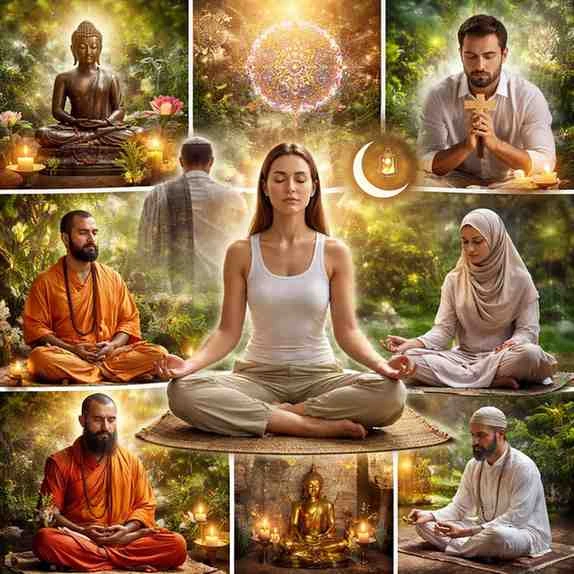
Historically, meditation has been an essential part of many religions. In Hinduism, meditation (Dhyana) is one of the eight limbs of Yoga described in ancient scriptures like the Yoga Sutras. It is seen as a path to self-realization and union with the divine.
In Buddhism, meditation is central to spiritual practice. Techniques such as Vipassana and Zen meditation are designed to develop mindfulness and insight, leading to liberation from suffering.
Christianity also includes meditative practices, such as contemplative prayer and silent reflection, where individuals connect with God through stillness. Similarly, in Islam, practices like Dhikr involve focused remembrance of God, which closely resembles meditative awareness.
Meditation Beyond Religious Boundaries
Although meditation originated within religious frameworks, it has gradually transcended religious boundaries. In the modern world, meditation is often practiced without any religious belief. People meditate to reduce stress, improve concentration, and enhance emotional well-being. Scientific research has shown that regular meditation can lower anxiety, improve brain function, and promote overall mental health. This universal applicability proves that meditation is not limited to any one religion.
Religion as a Spiritual Foundation
Religion often provides the philosophical and ethical foundation for meditation. Religious teachings give meaning, intention, and direction to meditative practices. When meditation is practiced within a religious context, it becomes a way to connect with God or a higher reality. Faith strengthens focus, devotion, and surrender, making meditation a deeply transformative experience. However, the absence of religion does not diminish the effectiveness of meditation.
Meditation as a Spiritual, Not Religious, Practice
It is important to differentiate between religion and spirituality. Religion is often structured, with rituals, doctrines, and community practices. Spirituality, on the other hand, is personal and inward. Meditation primarily belongs to the realm of spirituality. It helps individuals explore their inner world, understand their emotions, and experience inner peace. Whether practiced within or outside religion, meditation nurtures compassion, patience, and self-discipline.
Modern Perspective on Meditation
In contemporary society, meditation is widely accepted as a secular practice. Schools, hospitals, and corporate environments encourage meditation for mental wellness. Mindfulness programs are designed without religious symbolism, making meditation accessible to everyone. This modern approach highlights that meditation is a universal human practice rather than a religious obligation.
Can Meditation Exist Without Religion?
Yes, meditation can exist independently of religion. A person does not need to follow any religious belief to meditate. However, for those who are religious, meditation often deepens faith and spiritual understanding. Religion provides purpose, while meditation provides experience. Together, they create a balanced inner life, but one can exist without the other.
Conclusion
Meditation is deeply connected to religion through its origins, philosophy, and spiritual goals. However, it is not confined to religious practice alone. Over time, meditation has evolved into a universal tool for mental peace and self-awareness. Whether practiced as part of a religious path or as a personal wellness routine, meditation remains a powerful method for inner growth. Ultimately, meditation connects individuals not to religion, but to themselves—and that connection leads to peace.
Frequently Asked Questions
Is meditation connected to religion?
Yes, meditation is connected to religion through its origins in traditions such as Hinduism, Buddhism, Christianity, and Islam. However, in modern times it is also practiced as a personal and secular method for inner peace and mental wellness.
Can meditation be practiced without following a religion?
Yes, meditation can be practiced without following any religion. Many people meditate to reduce stress, improve concentration, and develop emotional balance without linking it to a specific faith.
Why is meditation important in religious traditions?
Meditation is important in religious traditions because it helps individuals develop self-awareness, discipline, devotion, and a deeper connection with God or a higher reality. It often supports spiritual growth and inner transformation.
Is meditation spiritual or religious?
Meditation is primarily spiritual because it focuses on inner awareness, calmness, and self-discovery. It can be religious when practiced within a faith tradition, but it can also be non-religious and personal.
How is meditation used in different religions?
In Hinduism, meditation is part of Yoga and self-realization. In Buddhism, it develops mindfulness and insight. In Christianity, it appears as contemplative prayer and silent reflection. In Islam, practices like Dhikr involve focused remembrance of God.
What are the benefits of meditation in modern life?
Meditation helps reduce stress, improve concentration, lower anxiety, support emotional balance, and promote overall mental well-being. This is why it is widely practiced in schools, workplaces, and health settings.
Can religion and meditation work together?
Yes, religion and meditation can work together. Religion can provide purpose, values, and direction, while meditation offers personal experience, inner peace, and spiritual depth.
Why is meditation considered universal?
Meditation is considered universal because people from different cultures, beliefs, and backgrounds can practice it. Its benefits for mental peace and self-awareness make it useful beyond religious boundaries.
~Religion World Bureau

Editorial Review Note
Written by Religion World — Bhavya Srivastava is the founder of Religion World and a veteran journalist with over 18 years of experience across broadcast, print, and digital media. A founding member of the International Association of Religion Journalists (IARJ), he has spent much of his career reporting on and producing content about religion, faith, and spirituality. View full profile →.
Religion World provides information on all religions and presents it impartially. You can send us information, news, updates, opinions, and suggestions at religionworldin@gmail.com. You can also follow us on X (Twitter), Facebook, and YouTube.