
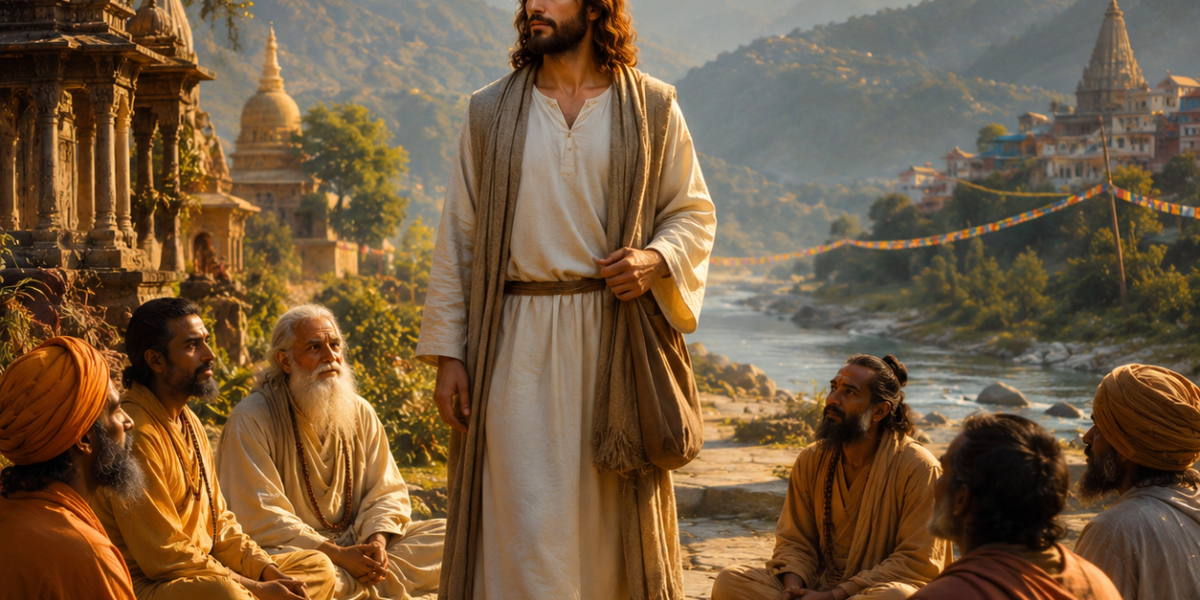
The life of Jesus Christ remains one of the most studied subjects in religious history. The Bible describes his birth, childhood, and later ministry, yet says almost nothing about the long stretch between his adolescence and the start of his public mission around the age of 30. This silence of nearly eighteen years is often called the Lost Years of Jesus, and it has inspired centuries of theories and debate — along with a long search for any historical evidence of Jesus during this missing period.
One of the most intriguing of these is the Christ of India theory, which asks a simple but striking question: did Jesus visit India during his missing years, studying Eastern spirituality before returning to the Middle East? Examining the historical evidence of Jesus and this claim reveals a story that has attracted wide interest, yet remains firmly debated among historians and religious scholars.
What Is the “Christ of India” Theory?
The theory proposes that Jesus journeyed through India, Tibet, and other parts of Asia during the years not covered in the New Testament. According to its supporters, he absorbed traditions of meditation, compassion, and inner transformation that later shaped his message of love and forgiveness. Advocates point to apparent parallels between Jesus’ teachings and Indian wisdom traditions as a possible bridge between Christianity and the spiritual heritage of the East.
The Mystery of Jesus’ Lost Years
The canonical Gospels mention Jesus as a child — most notably in the “Finding in the Temple” episode in Luke 2 — and then fall silent until he begins his ministry as an adult. This roughly eighteen-year gap is the foundation of every “Jesus in India” theory. Mainstream scholars generally believe Jesus spent these years in Galilee, likely working as a carpenter alongside his father Joseph. Alternative writers, however, have filled the silence with a far more adventurous journey eastward.
Notovitch and the “Unknown Life of Jesus”
The modern story begins in 1894 with the Russian traveller Nicolas Notovitch, who claimed to have discovered a manuscript at the Hemis Monastery in Ladakh describing the travels of “Saint Issa” — Jesus — through India. His book, The Unknown Life of Jesus Christ, became hugely popular and remains the starting point for almost every later version of the theory. It was Notovitch who first placed Jesus among the Brahmins of India and the monks of the Himalayas.
Connections to India and Kashmir
Later writers extended the theory well beyond the lost years. The German author Holger Kersten, in Jesus Lived in India, argued that Jesus survived the crucifixion and travelled east, eventually settling in Kashmir. Central to this claim is the figure of Yuz Asaf, a sage whose tomb — the Rozabal shrine in Srinagar — is identified by supporters as the final resting place of Jesus. The Ahmadiyya Movement in Islam has also long promoted a version of this belief, linking Jesus to Kashmir through its own theological tradition.
Similarities Between Jesus’ Teachings and Eastern Philosophy
Supporters of the India theory often highlight resemblances between Jesus’ message and ideas found in Hinduism and Buddhism:
- Compassion and non-violence
- Love for all humanity
- Inner spiritual transformation
- Detachment from material desires
- Meditation and self-discipline
Scholars caution, however, that similar moral and spiritual principles arise independently across many cultures. Shared values do not, by themselves, prove direct contact or influence.
What Does the Historical Evidence of Jesus Say?
Most historians and biblical scholars remain skeptical. The German Indologist Max Müller challenged Notovitch’s account soon after it appeared, noting that the monks of Hemis denied any record of a Western visitor or such a manuscript. Modern critics, including New Testament scholar Bart Ehrman, regard the supporting texts as relatively recent forgeries rather than ancient documents. The consensus is that there is no definitive archaeological or contemporary documentary evidence that Jesus travelled to India.
Why Does the Theory Remain Popular?
Despite the skepticism, the idea endures. It appeals because it builds a bridge between Eastern and Western spiritual traditions, offering a vision of universal wisdom that crosses cultural and religious lines. For some it suggests that spiritual truth can be found in every faith; for others it is simply one of history’s most captivating unsolved mysteries.
Conclusion
The Christ of India theory offers a captivating perspective on the life of Jesus and his possible link to Eastern spirituality. The historical evidence of Jesus travelling to India is inconclusive, and mainstream scholarship treats the claim as speculation rather than established fact. Yet whether read as history, legend, or a symbolic meeting of cultures, the question continues to fascinate spiritual seekers, historians, and the simply curious alike.
Frequently Asked Questions
What is the historical evidence of Jesus visiting India?
The main historical evidence offered for Jesus in India comes from later sources rather than contemporary records: Nicolas Notovitch’s 1894 manuscript claim, the Yuz Asaf tradition, and the Rozabal shrine in Kashmir. None is accepted as conclusive by mainstream historians, who note the absence of first-century documentary or archaeological proof.
Did Jesus visit India during his lost years?
Some alternative writers claim he did, travelling through India, Tibet, and Kashmir during the roughly eighteen years the Gospels do not describe. There is no mainstream historical or archaeological evidence confirming such a journey, so it remains a debated theory rather than established fact.
What are the “lost years” of Jesus?
The “lost years” refer to the gap of nearly eighteen years between Jesus as a child in the Temple (Luke 2) and the start of his public ministry around age 30. The New Testament gives no account of this period.
Who started the theory that Jesus went to India?
The modern theory traces to Russian traveller Nicolas Notovitch, whose 1894 book The Unknown Life of Jesus Christ claimed a Himalayan manuscript described Jesus travelling through India as “Saint Issa.”
What is the Rozabal tomb in Kashmir?
Rozabal is a shrine in Srinagar associated with a sage called Yuz Asaf. Supporters of the India theory, such as Holger Kersten, identify it as the burial place of Jesus, though this claim is not accepted by mainstream historians.
Do historians accept that Jesus visited India?
No. Most historians and biblical scholars reject the claim, citing a lack of contemporary evidence and the likelihood that the supporting manuscripts are modern forgeries. Indologist Max Müller was among the earliest to challenge it.

Editorial Review Note
Written by Religion World — Bhavya Srivastava is the founder of Religion World and a veteran journalist with over 18 years of experience across broadcast, print, and digital media. A founding member of the International Association of Religion Journalists (IARJ), he has spent much of his career reporting on and producing content about religion, faith, and spirituality. View full profile →.
Religion World provides information on all religions and presents it impartially. You can send us information, news, updates, opinions, and suggestions at religionworldin@gmail.com. You can also follow us on X (Twitter), Facebook, and YouTube.