
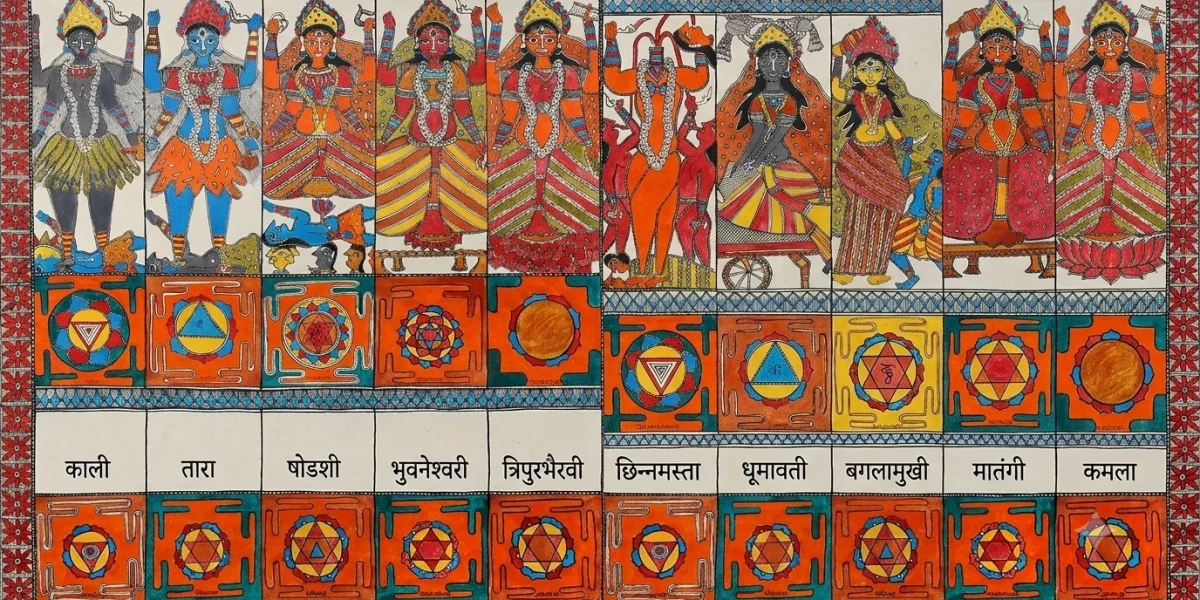
Das Mahavidya: Kali, Tara, Shodashi, Bhuvaneshvari, Bhairavi and Chhinnamasta
Das Mahavidya are the ten great Tantric goddesses of the Shakta tradition, each one a different face of the Divine Mother. This first part introduces six of them: Maa Kali, Tara, Shodashi, Bhuvaneshvari, Bhairavi and Chhinnamasta. Because Shardiya Navratri 2026 begins on 11 October, this is a good time to know who these goddesses are.
What Is Das Mahavidya?
The word Mahavidya means “Great Wisdom”. Das Mahavidya, also spelt Dasa Mahavidya, therefore means the ten great wisdoms of the Goddess. According to Wikipedia’s overview of the Mahavidyas, they are usually named in this order: Kali, Tara, Tripura Sundari, Bhuvaneshvari, Bhairavi, Chhinnamasta, Dhumavati, Bagalamukhi, Matangi and Kamala.
However, the order, names and even the number can vary between texts and traditions. Kali, nevertheless, is always included and is usually named first. Many devotees also see the ten as ten facets of one Truth, with each goddess teaching a different lesson about time, knowledge, beauty, desire, fear or liberation.
The Ten Mahavidyas at a Glance
- Kali (covered below)
- Tara (covered below)
- Tripura Sundari / Shodashi (covered below)
- Bhuvaneshvari (covered below)
- Bhairavi (covered below)
- Chhinnamasta (covered below)
- Dhumavati (Part 2)
- Bagalamukhi (Part 2)
- Matangi (Part 2)
- Kamala (Part 2)
Das Mahavidya: Maa Kali, the First Mahavidya
Maa Kali is the first of the Das Mahavidya and the fiercest aspect of Maa Durga. Kali is the Goddess of time and change. She presides over the time before the creation of the universe.
She is represented as the consort of Lord Shiva. Her abode is the cremation ground, and her weapons are the kripana (sword) and the trishul (trident).
As per the Devi Mahatmya, Devi Kali appeared out of Goddess Durga to defeat the demon Raktabija. Raktabija, whose name means “seed of blood”, could clone himself from every drop of blood that fell on the ground.
Das Mahavidya: Maa Tara, the Second Mahavidya
Maa Tara is the second of the ten Mahavidyas. Tara means “star”. Some interpretations see her as the unquenchable hunger, the burning drive, that propels life forward.
She is the Goddess who offers ultimate knowledge and grants salvation. In some traditional planetary associations, Tara is linked with Jupiter. She is also known as Neel Saraswati, the blue Saraswati. Her weapons include the sword and the scissors, and the scissors are the feature that most clearly distinguishes her from Kali in iconography.
Das Mahavidya: Maa Shodashi (Tripura Sundari), the Third Mahavidya
Maa Shodashi is the third Mahavidya, also known as Tripura Sundari. As the name suggests, she is described as the most beautiful in all three worlds. Within the Mahavidyas she represents Goddess Parvati, often called “Tantric Parvati”.
She is also known as Lalita and Rajarajeshwari. She is represented as a sixteen-year-old girl, and in some traditions she is said to embody sixteen aspects of desire. Likewise, her mantra has sixteen syllables. Tripura Sundari is also worshipped in the form of the Shri Yantra.
Das Mahavidya: Maa Bhuvaneshvari, the Fourth Mahavidya
Maa Bhuvaneshvari is the fourth of the ten Mahavidya goddesses. She is known as the World Mother and personifies the whole universe. As her name suggests, she is the queen of all the worlds. In many aspects she relates to Tripura Sundari.
Bhuvaneshvari is regarded as Adi Shakti, one of the earliest forms of Shakti. In her Saguna Rupa (form with attributes), she is known as Parvati. In appearance she resembles Tripura Sundari: she has the colour of the rising sun, with a crescent moon in her hair.
Das Mahavidya: Maa Bhairavi, the Fifth Mahavidya
Maa Bhairavi is the fifth of the ten Mahavidyas. She is a fierce and terrifying aspect of the Goddess and, in nature, is hardly distinguishable from Kali. She is the consort of Bhairava, the fierce manifestation of Lord Shiva associated with annihilation.
In some traditions Maa Bhairavi is identified with Chandi of the Durga Saptashati, who slays Chanda and Munda. She is portrayed with two strikingly different iconographies. In one she resembles Maa Kali, whereas in the other she resembles Maa Parvati.
Das Mahavidya: Maa Chhinnamasta, the Sixth Mahavidya
Maa Chhinnamasta is the sixth of the ten Mahavidyas, known as the self-decapitated Goddess. She is also called Prachanda Chandika. There are several legends about her origin, but most suggest that she beheaded herself to accomplish a greater and nobler cause.
Her iconography is fearsome and is meant to be read symbolically rather than literally. She holds her own severed head in one hand and a scimitar in the other. Three streams of blood rise from her neck and are drunk by her severed head and her two attendants, Dakini and Varnini. Traditional interpretations treat the image as a lesson about self-sacrifice and the conquest of ego and desire.
When Is Das Mahavidya Worshipped?
The Mahavidyas are worshipped most intensively during the two Gupt Navratris, in the months of Magh and Ashadha. They are also remembered during the regular Navratri festivals. For the nine-day cycle that starts on 11 October, see our guide to the significance of the 9 days and 9 colours of Navratri, and read why devotees light an Akhand Jyot during Navratri.
For pilgrims, the Kamakhya temple complex in Assam is special. According to the Kamakhya temple’s own website, it is the only site where temples of all ten Mahavidyas stand together.
Das Mahavidya Part 2: Coming Soon
The remaining four goddesses, Dhumavati, Bagalamukhi, Matangi and Kamala, will be added to this page soon. Please check back during Navratri.
Frequently Asked Questions About Das Mahavidya
What is Das Mahavidya?
Das Mahavidya are ten Tantric goddesses of the Shakta tradition, regarded as ten forms or aspects of the Divine Mother. The word Mahavidya means “great wisdom”.
Who is the first of the Das Mahavidya?
Maa Kali is the first Mahavidya. She is the goddess of time and change and is described as presiding over the time before the creation of the universe.
What are the names of the ten Mahavidyas?
They are usually listed as Kali, Tara, Tripura Sundari (Shodashi), Bhuvaneshvari, Bhairavi, Chhinnamasta, Dhumavati, Bagalamukhi, Matangi and Kamala. The order can vary slightly between texts.
Who is Neel Saraswati?
Neel Saraswati, the “blue Saraswati”, is a name and form of Maa Tara, the second Mahavidya, who is associated with knowledge and salvation.
Why is Shodashi called a sixteen-year-old goddess?
The name Shodashi means “sixteen”. She is depicted as an eternally sixteen-year-old girl, and her mantra is said to contain sixteen syllables. She is also known as Tripura Sundari, Lalita and Rajarajeshwari.
When are the Mahavidyas worshipped?
They are worshipped especially during the Gupt Navratris of Magh and Ashadha, and they are also remembered during Chaitra and Shardiya Navratri.
Disclaimer: This article is based on Hindu religious traditions and scriptures. Names, iconography, attributes and order of the Mahavidyas vary between texts, regions and lineages.

Editorial Review Note
Written by Religion World — Bhavya Srivastava is the founder of Religion World and a veteran journalist with over 18 years of experience across broadcast, print, and digital media. A founding member of the International Association of Religion Journalists (IARJ), he has spent much of his career reporting on and producing content about religion, faith, and spirituality. View full profile →.
Religion World provides information on all religions and presents it impartially. You can send us information, news, updates, opinions, and suggestions at religionworldin@gmail.com. You can also follow us on X (Twitter), Facebook, and YouTube.