
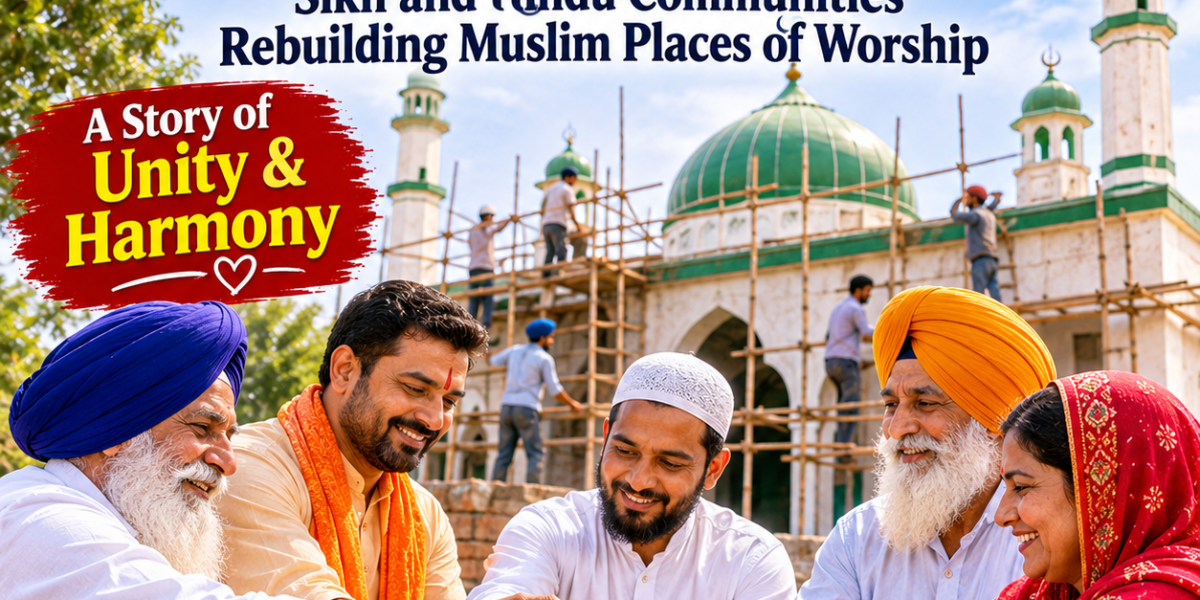
At a time when religious divisions often dominate headlines, villagers in Punjab are sharing a powerful message of humanity, brotherhood and communal harmony. Across the state, Sikh and Hindu communities have come together to help rebuild and restore mosques that were abandoned or damaged after the Partition of India in 1947.
According to a recent report by The Guardian, non-Muslim villagers have contributed to the construction or restoration of more than 165 mosques over the past nine years. Their efforts have included donating land, contributing money and providing construction materials so that Muslim families can once again have places to offer prayers.
These initiatives are not just about rebuilding religious structures. They are also helping revive relationships and traditions that were deeply affected by Partition.
Punjab: Where Villagers Are Rebuilding Mosques Together
During the Partition of India in 1947, Punjab witnessed widespread communal violence, migration and displacement. As millions of people crossed the newly created border, many Muslim families left villages in the Indian part of Punjab.
Hundreds of mosques were subsequently abandoned, damaged or used for other purposes, including as storage spaces and cattle sheds.
Over the years, however, several villages have taken steps to restore these places of worship. Sikh and Hindu residents have voluntarily supported the efforts, even in villages where only a small number of Muslim families live.
The initiative reflects the spirit of Punjabiyat, a shared cultural identity rooted in hospitality, mutual respect and community living.
An 87-Year-Old Man’s Hope to Hear the Azaan Again
One of the most moving stories comes from Jakhiwal village in Fatehgarh Sahib district.
Gajju Khan, an 87-year-old Muslim resident, is waiting for the completion of a mosque in his village. He hopes to hear the azaan, the Muslim call to prayer, once again in the place connected to his childhood memories.
During the violence of Partition in 1947, Khan and his two brothers were sent away by their parents to escape the bloodshed. His parents were killed, but Sikh neighbours sheltered the children and protected them from armed groups.
Nearly eight decades later, the same spirit of kindness is reflected in the construction of a mosque for the 18 Muslim families living in Jakhiwal.
A major contribution has come from 77-year-old Sikh woman Bibi Rajinder Kaur. She persuaded her grandson to donate a portion of their family’s agricultural land for the mosque.
She explained that every other religious community in the village had a place to gather, while Muslims had to travel around four kilometres to another village to offer prayers.
For Khan, the mosque represents much more than a building. It is a reminder of the kindness shown to his family during one of the darkest periods in the region’s history.
Hindu Family Donates Land to Build a Mosque in Punawal
Another inspiring example comes from Punawal village in Sangrur district.
Jaspal Sharma, 48, who belongs to a family of Hindu priests, donated a portion of his land for the construction of a mosque. The village has around 550 households, with only a small proportion of Muslim families.
The mosque was inaugurated in February 2026, and Sharma organised a community feast to celebrate the occasion.
The initiative was supported by residents from different religious backgrounds. While some contributed money, others donated bricks and cement for construction.
Sharma described the contribution as a responsibility towards his neighbours. He also expressed happiness that the mosque stands opposite his house and that the sound of prayers adds to the atmosphere of the village.
The example shows how people from different faiths can work together to ensure that everyone has the freedom and space to practise their religion.
Sikh Brothers Restore a Mosque in Umarpura
In Umarpura village near Malerkotla, Sikh brothers Sukhjinder Singh Pandher and his brother helped restore a local mosque.
Their contribution was also connected to their family’s history. Their grandfather had migrated from West Punjab to India during Partition.
For the brothers, helping restore the mosque was a way of honouring their family roots and strengthening relationships with their Muslim neighbours.
Pandher has spoken about how people in the village celebrate Eid and Gurpurab together. He believes that people should not be treated differently because of their religion.
The restored mosque has become another example of how shared community efforts can help preserve Punjab’s traditions of brotherhood.
More Than 165 Mosques Built or Restored in Nine Years
According to Punjab’s current Shahi Imam, Maulana Muhammad Usman Rehmani Ludhianvi, non-Muslim villagers have contributed to more than 165 mosques over the past nine years.
The initiative was inspired by his father, the former Shahi Imam, Maulana Habib-ur-Rehman Sani Ludhianvi.
The contributions have taken different forms. Some villagers have donated land, while others have provided construction materials or financial assistance. In several places, people have also helped reopen abandoned religious spaces so that Muslim residents and workers from nearby areas can offer prayers.
The efforts highlight the role of local communities in protecting religious heritage and ensuring that people have access to places of worship.
Punjabiyat: A Shared Tradition Beyond Religion
Punjab has a long history of cultural exchange and shared religious traditions. Its villages have often been shaped by relationships that go beyond religious identities.
The Golden Temple in Amritsar is also associated with a popular historical tradition that the Sufi saint Hazrat Mian Mir was invited to lay its foundation stone.
Such stories reflect the region’s long-standing connections between Sikh and Sufi traditions.
The restoration of mosques is another expression of this shared cultural heritage. For many villagers, helping a neighbour practise their faith is not a political statement but a natural responsibility.
As current Shahi Imam Maulana Muhammad Usman Rehmani Ludhianvi observed in the report, despite polarisation on the internet, ordinary people in villages continue to choose mutual support and protection.
Rebuilding More Than Places of Worship
The restoration of mosques in Punjab carries a significance that goes beyond bricks, cement and construction work. It represents an effort to heal memories of Partition, preserve shared heritage and strengthen relationships between communities.
For elderly residents like Gajju Khan, the return of the azaan is connected to childhood memories and the hope of seeing a place of worship restored in their village.
For Sikh and Hindu families donating land and resources, the effort reflects the belief that every community deserves the freedom to pray.
These stories remind us that humanity, compassion and respect for different faiths can bring people together even after generations of historical divisions.
In Punjab, villagers are showing that communal harmony is not just an idea to be discussed. It can also be built, brick by brick.

Editorial Review Note
Written by Religion World — Bhavya Srivastava is the founder of Religion World and a veteran journalist with over 18 years of experience across broadcast, print, and digital media. A founding member of the International Association of Religion Journalists (IARJ), he has spent much of his career reporting on and producing content about religion, faith, and spirituality. View full profile →.
Religion World provides information on all religions and presents it impartially. You can send us information, news, updates, opinions, and suggestions at religionworldin@gmail.com. You can also follow us on X (Twitter), Facebook, and YouTube.