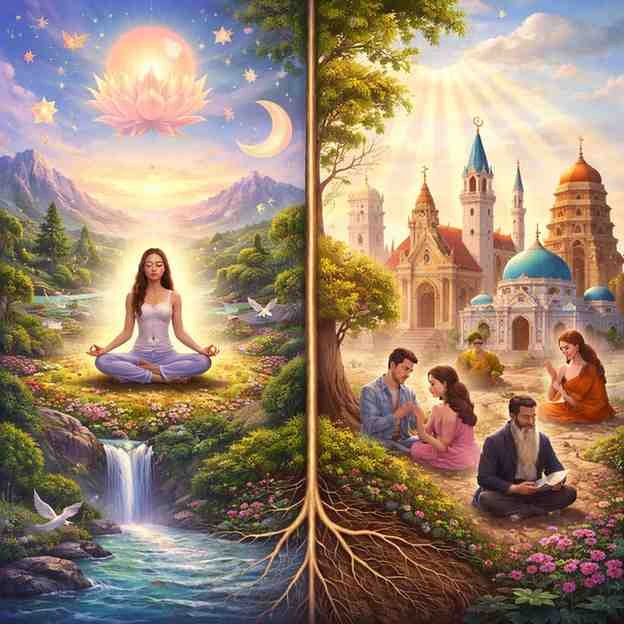
In modern discussions about faith, belief, and personal growth, the terms spirituality and religion are often used interchangeably. However, they are not the same. Many people today identify as “spiritual but not religious,” which raises an important question: what is the difference between spirituality and religion, and why does this distinction matter?
Understanding this difference helps individuals make sense of their beliefs and choose a path that truly resonates with their inner values.
Understanding Religion
Religion is a structured system of beliefs, practices, rituals, and moral guidelines centered around the idea of the sacred or divine. It usually involves institutions, scriptures, traditions, and a defined community of followers.
Religion provides a shared identity. It offers established teachings on how to live, what to believe, and how to worship. Rituals such as prayer, fasting, festivals, and ceremonies are integral parts of religious life. For many people, religion offers stability, discipline, and a sense of belonging.
However, because religion often emphasizes rules and traditions, some individuals may feel restricted if these practices are followed without understanding their deeper meaning.
Understanding Spirituality
Spirituality, on the other hand, is a deeply personal experience. It focuses on inner growth, self-awareness, and a personal connection with life, nature, or a higher reality. Unlike religion, spirituality does not necessarily require formal rituals, institutions, or scriptures.
Spirituality asks fundamental questions such as: Who am I? What is the purpose of my life? How can I live with peace and compassion? It emphasizes personal experience over collective doctrine and encourages exploration rather than obedience.
Because of its flexible nature, spirituality appeals strongly to people seeking freedom, authenticity, and emotional healing.
Key Differences Between Spirituality and Religion
1. Structure vs Freedom
Religion follows an organized structure with defined rules and practices. Spirituality is open-ended and allows individuals to define their own path.
2. Community vs Individual Experience
Religion is often practiced within a community, promoting shared beliefs and traditions. Spirituality is more individual, focusing on personal understanding and inner connection.
3. Rituals vs Awareness
Religion relies on rituals as a means of worship. Spirituality emphasizes awareness, mindfulness, and conscious living.
4. Authority vs Inquiry
Religion often depends on religious authorities and sacred texts. Spirituality encourages questioning, reflection, and self-discovery.
Can Religion and Spirituality Coexist?
Yes, they can—and often do. Religion can serve as a foundation for spiritual growth, while spirituality can bring depth and meaning to religious practices. When rituals are performed with awareness and understanding, they become spiritual acts rather than mechanical habits.
Problems arise only when religion loses its spiritual essence or when spirituality completely rejects ethical responsibility. Balance is key.
Why the Difference Matters Today
In today’s fast-changing world, many people feel disconnected from traditional institutions but still long for meaning and peace. Recognizing the difference between spirituality and religion allows individuals to choose consciously rather than feel pressured or confused.
For some, religion offers moral guidance and social connection. For others, spirituality provides healing and inner clarity. Neither path is superior; both aim to help humans live meaningful lives.
Misconceptions About Spirituality and Religion
A common misconception is that religion is outdated and spirituality is modern. In reality, both have existed throughout human history. Another misunderstanding is that spirituality lacks discipline, while religion lacks freedom. In truth, both can offer discipline and freedom when practiced sincerely.
Conclusion
So, what is the difference between spirituality and religion? Religion is an organized path that connects individuals through shared beliefs and practices. Spirituality is a personal journey toward self-awareness, peace, and purpose. Both seek truth, compassion, and harmony. Whether one chooses religion, spirituality, or a blend of both, what matters most is living with integrity, empathy, and conscious awareness.
~Religion World Bureau