
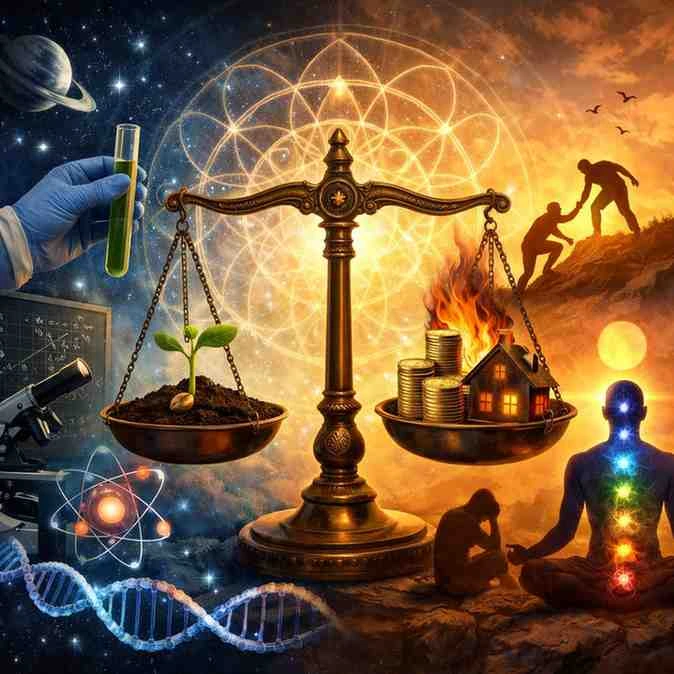
Introduction
The idea that every action has a consequence is deeply rooted in Indian philosophy and spiritual traditions. Commonly expressed as “karma and its result,” this principle suggests that good actions lead to positive outcomes, while negative actions bring suffering. But in a modern, evidence-driven world, an important question arises: How scientific is the theory of karma and result? Can this ancient belief be explained or supported through logic, psychology, and science, or does it remain purely a matter of faith?
Understanding the Theory of Karma and Result
The word karma literally means “action.” In philosophical terms, it refers not only to physical deeds but also to thoughts, intentions, and decisions. The “result” or phala is the outcome that eventually follows these actions. Unlike instant cause-and-effect reactions, karma is often believed to operate over long periods, sometimes even across lifetimes.
From a traditional perspective, karma functions as a moral law of the universe, ensuring balance and justice. However, science does not accept metaphysical explanations unless they can be tested or observed. This creates a natural tension between spiritual belief and scientific reasoning.
Cause and Effect: A Scientific Parallel
At its core, the theory of karma resembles the scientific principle of cause and effect. In physics, every action produces a reaction. In biology, lifestyle choices affect health outcomes. In psychology, thoughts and behaviors shape personality and mental well-being.
Seen this way, karma can be interpreted as an ethical and behavioral extension of cause and effect rather than a supernatural force.
For example, consistent honesty builds trust, while repeated dishonesty damages relationships. These results are not mystical; they are predictable consequences of behavior.
Psychological and Behavioral Evidence
Modern psychology strongly supports the idea that actions influence outcomes. Habits formed through repeated behavior directly affect success, failure, happiness, and stress levels. Positive actions such as discipline, empathy, and perseverance tend to improve quality of life. Negative behaviors like aggression, laziness, or addiction often lead to long-term harm.
Cognitive psychology also explains how belief in karma can shape behavior. When individuals believe their actions matter, they are more likely to act responsibly. This belief system promotes self-control, ethical decision-making, and long-term thinking—traits scientifically linked to better life outcomes.
Sociology and Social Consequences
From a social science perspective, karma operates at a collective level. Societies that reward honesty, cooperation, and fairness tend to be more stable and prosperous. Individuals who violate social norms often face legal, social, or professional consequences.
In this sense, karma functions as a social feedback mechanism rather than a cosmic one.
Where Science Draws the Line
Despite these parallels, science does not support certain aspects of traditional karma theory—particularly the idea of results carrying over into future lives. Concepts like rebirth and cosmic moral accounting remain beyond empirical verification. Science relies on measurable data, and experiences beyond one lifetime cannot be tested or observed with current methods.
Therefore, while the ethical and psychological dimensions of karma align with scientific understanding, its metaphysical claims remain unproven.
Karma as a Practical Life Model
Instead of viewing karma as destiny or divine punishment, many modern thinkers interpret it as a practical life model. Actions influence mindset, habits shape character, and character determines life direction. This interpretation fits well within scientific frameworks and removes the fear-based aspects often associated with karma.
Conclusion
So, how scientific is the theory of karma and result? It is not scientific in the strict experimental sense, especially regarding metaphysical claims. However, when understood as a principle of cause and effect in human behavior, psychology, and society, it aligns closely with scientific logic. Karma may not be a measurable force, but its practical implications are real, observable, and impactful. Ultimately, the theory serves as a powerful ethical framework that encourages responsibility, awareness, and conscious living.
~Religion World Bureau