
Can Religion and Science Walk the Same Path?
Religion and science are often seen as two separate worlds standing in opposite directions. Science is based on logic, evidence, and experimentation, while religion relies on faith, experience, and spiritual understanding. But is it truly correct to say that the two cannot coexist? Or is it possible that both are essential in their own ways and complement one another in understanding life? In today’s modern world—where technology is advancing rapidly, yet people continue to seek spiritual peace—this question becomes even more significant.
The primary purpose of religion is to give meaning to human life. Religion attempts to answer questions like: Who are we? Why are we here? What is the ultimate purpose of life? It guides people toward morality, compassion, coexistence, and inner peace. Religious teachings inspire individuals to practice self-control, kindness, gratitude, and the pursuit of truth. Science, on the other hand, works to unlock the mysteries of the natural world. It seeks to understand how the universe was formed, how nature works, and how life evolved. Science provides rational answers within the boundaries of observable facts.
Historically, there have been moments when religion and science appeared to clash—for example, on topics like the shape of the Earth, the heliocentric model, or biological evolution. But these conflicts were not permanent. Over time, many religious thoughts adapted to scientific discoveries, and science also began to acknowledge that some questions cannot be answered by experiments alone. What is the true meaning of life? What happens after death? What is the nature of consciousness, emotions, love, and the soul? These are questions that lie beyond scientific measurement and enter the spiritual domain, where religion offers guidance.
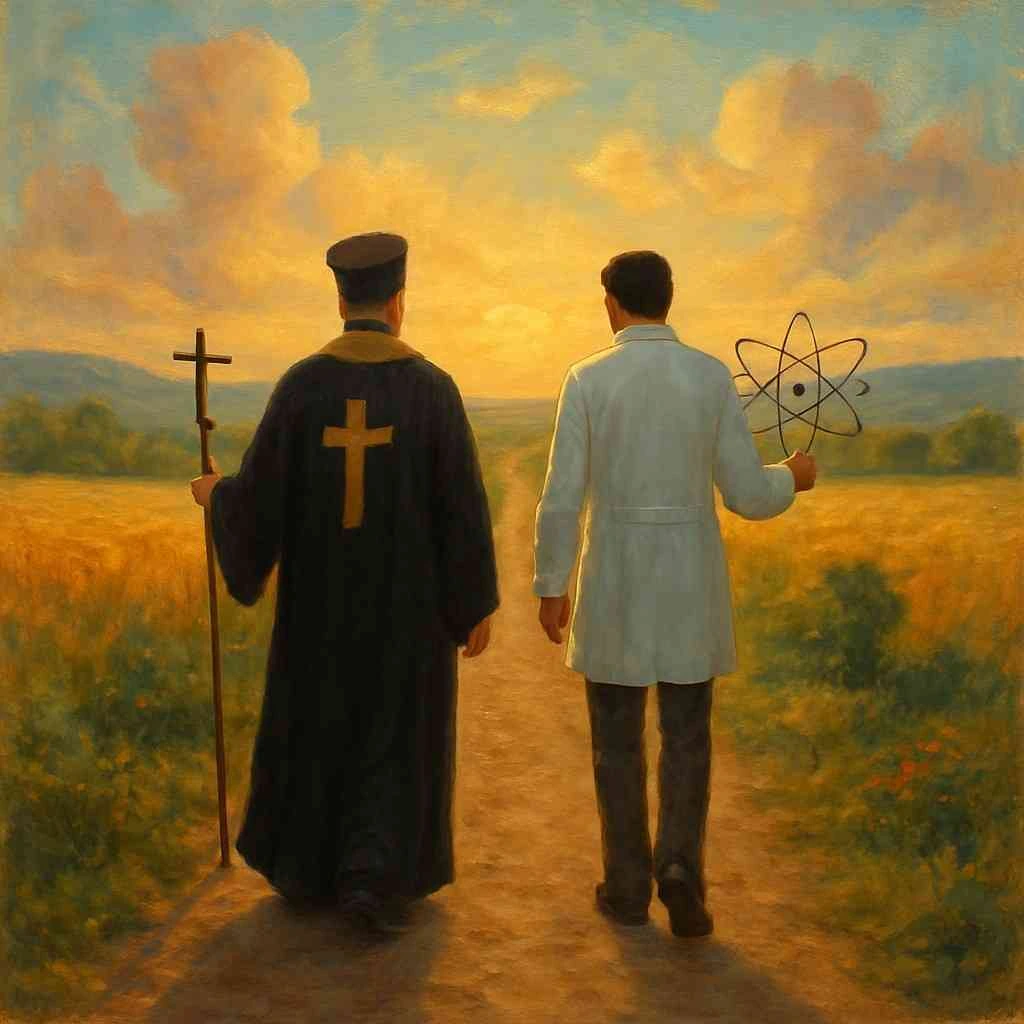
The most important point of harmony is that both science and religion are seekers of truth—only their approaches differ. Science explores the external world, while religion guides us inward. Science studies matter and the body, whereas religion focuses on the mind and the spirit. If science explains how things work, religion attempts to explain why. In this way, they are not enemies but complementary forms of knowledge.
In today’s age, many scientists openly appreciate spirituality. They recognize that the universe is incredibly complex, nature is beautifully balanced, and consciousness is a deep mystery that cannot be fully described by scientific formulas. Similarly, many religious scholars respect scientific discoveries and view them as a reflection of divine order. For them, the laws of nature represent a higher intelligence at work.
Finding the balance between science and religion is essential for a progressive society. Science brings technology, health, comfort, and development. Religion brings morality, compassion, humanity, and peace of mind. A world with only science could become mechanical and emotionless, while a world with only religion might struggle to progress. When both walk together, they create a harmonious world where external progress and inner growth can coexist.
Ultimately, religion and science are two different languages attempting to understand the same universe. When we stop seeing them as competitors and start viewing them as two complementary ways of exploring truth, life becomes more complete and meaningful. Therefore, it is absolutely possible to say that religion and science can walk the same path—they simply walk it in different ways.
~Religion World Bureau