Near-Death Experiences — Religious Interpretations
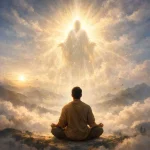
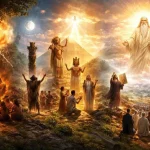
Near-death experiences, often called NDEs, have fascinated humanity for centuries. These are moments when a person comes extremely close to death, loses consciousness, or experiences a clinical state that appears lifeless, yet later returns to describe powerful visions or sensations. Such experiences often include tunnels of light, a feeling of leaving the body, meeting unknown beings or ancestors, panoramic memory, deep peace, or a sense of returning from another realm. While science tries to interpret NDEs through brain activity and neurochemical responses, religion looks at them through an entirely different lens—one that connects these moments with the soul, the afterlife, and the deeper mysteries of human existence. Because of this, near-death experiences have become one of the most discussed phenomena where spirituality, psychology, and faith intersect.
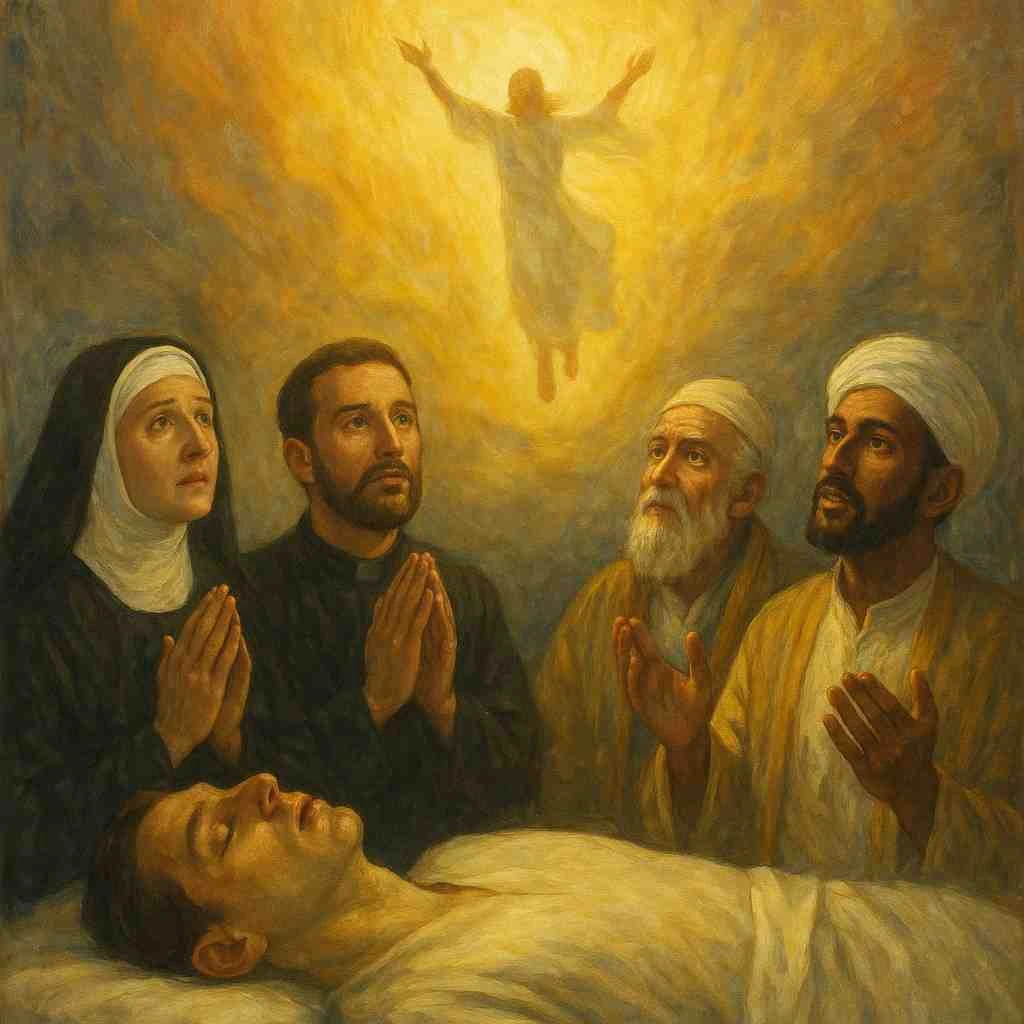
Throughout history, almost every major religion has interpreted NDEs in its own way. In many traditions, such experiences are seen as a glimpse of the afterlife or a proof that human consciousness continues even after physical death. In Christianity, NDEs are often associated with meeting angels, deceased loved ones, or seeing a brilliant divine light that believers interpret as the presence of God or Christ. Many Christians describe their experience as peaceful, reassuring, and full of unconditional love, which strengthens their faith in heaven and the afterlife. Some people even interpret NDEs as a divine reminder to live with compassion, forgiveness, and purpose.
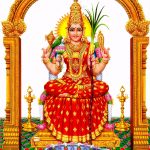
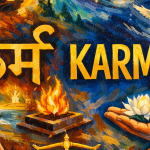
In Hinduism, near-death experiences are often linked to the journey of the soul through different planes of existence. Many Hindu interpretations view NDEs as a temporary separation of the subtle body from the physical body, similar to what ancient scriptures describe in the concept of “preta yoni” or the transitional state of the soul. One may encounter ancestors, divine beings, or a symbolic vision of Karma. Some Hindus interpret NDEs as the soul reaching the threshold of Yamlok, where the messengers of Yama review one’s deeds. People returning from such experiences often speak of understanding their life’s purpose more deeply, believing they were sent back because their “time had not yet come.”
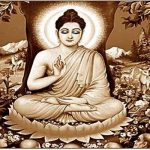
Buddhism also offers a distinct perspective. It understands near-death experiences through the idea of consciousness transitioning between states. Tibetan Buddhist traditions describe the “bardo,” an intermediate realm that the mind experiences after death. Many NDE accounts—bright lights, feelings of detachment, visions of peaceful landscapes—mirror these descriptions closely. For Buddhists, such experiences are less about divine judgment and more about the nature of the mind. They see NDEs as a reflection of one’s mental state, karmic impressions, and inner clarity. Instead of a heaven or hell revealed by an external force, the experience is seen as a mirror of one’s own consciousness.
In Islam, near-death experiences are often interpreted as early glimpses of the afterlife described in the Quran and Hadith. Some Muslims report visions of angels, feeling of being questioned, or a journey through a tunnel toward a bright presence. The experience is sometimes understood as a temporary passage where the soul begins to detach from the body before returning. Islamic teachings emphasize that actual judgment happens only after real death, but NDEs may be considered a reminder of the spiritual truth about accountability, faith, and the eternal world that lies ahead.
Despite these varied interpretations, one thing remains common across religions: near-death experiences are not dismissed as imagination but seen as meaningful and transformative. Most people who undergo NDEs report coming back with a changed perspective on life. They often lose the fear of death, feel more connected to spirituality, grow kinder, and focus more on relationships and inner growth instead of material pursuits. This emotional transformation itself becomes evidence, for many believers, that the experience was not hallucination but something sacred and real.
However, the question remains whether NDEs are universal spiritual truths or shaped by cultural beliefs. Some researchers argue that people see what their faith or upbringing expects them to see—Christians see Jesus, Hindus see Yama, Buddhists feel the bardo, and Muslims experience angels. Others say the similarities across cultures—like tunnels, peace, light, and out-of-body moments—prove that consciousness operates beyond the brain. Religion does not see this as contradiction; rather, most traditions agree that the soul expresses itself in familiar symbols when close to death.
Near-death experiences continue to bridge gaps between science and spirituality. They remind humanity that life is more than physical existence, and the boundary between this world and the next may be thinner than we imagine. Whether interpreted as divine messages, karmic insights, psychological phenomena, or glimpses of another dimension, NDEs remain one of the most powerful experiences that shape belief, faith, and our understanding of what lies beyond death.
~Religion World Bureau