Is Mental Peace Possible Without Medication? What Does Meditation Say?
In today’s fast-paced and stressful world, mental health challenges such as anxiety, restlessness, and emotional exhaustion have become increasingly common. Many people immediately turn to medication in search of relief. But an important question arises: Is mental peace possible without medication? Ancient wisdom and modern research both point toward meditation as a powerful, natural path to inner calm. This article explores what meditation says about mental peace and whether true tranquility can be achieved without relying on medicines.
Understanding Mental Peace
Mental peace does not mean the absence of problems; it means the ability to remain calm and balanced despite challenges. A peaceful mind is less reactive, more aware, and emotionally stable. While medication can help manage symptoms, it often addresses the surface rather than the root cause. Meditation, on the other hand, works at a deeper level—transforming how the mind responds to thoughts and emotions.
What Meditation Really Is
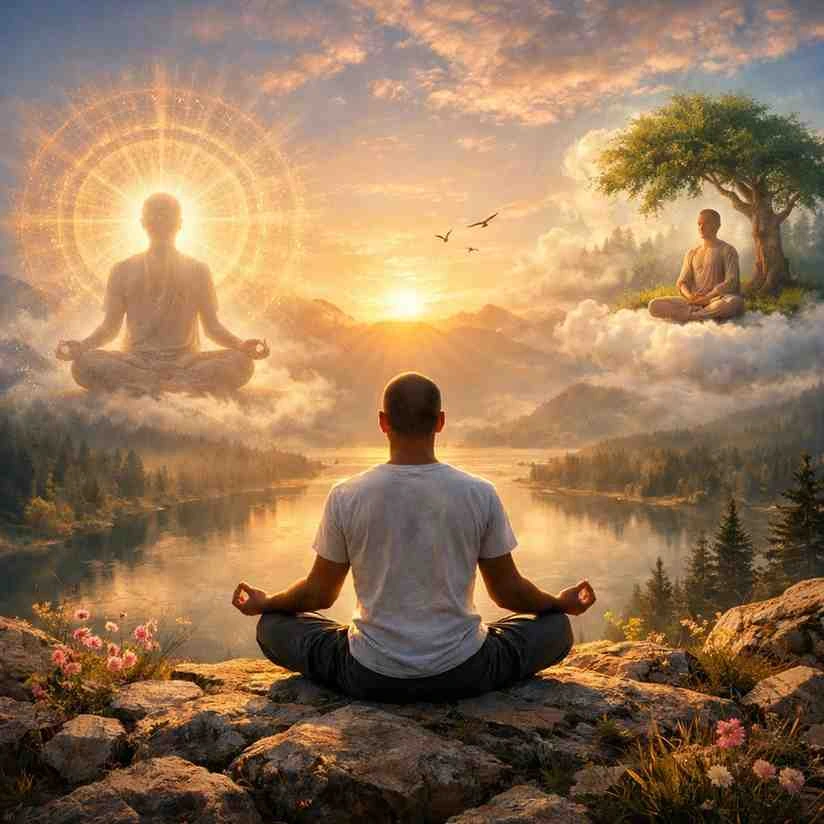
Meditation is not about stopping thoughts or escaping reality. It is the practice of observing the mind with awareness. By focusing on the breath, a mantra, or simple awareness, meditation trains the mind to slow down and detach from unnecessary mental noise.
Ancient traditions like Buddhism, Yoga, and Vedanta have emphasized meditation as a direct path to mental clarity and peace. Today, even modern psychology recognizes meditation as a powerful tool for mental well-being.
How Meditation Creates Mental Peace
Meditation helps mental peace in several important ways:
1. Reduces Overthinking
Most mental distress comes from constant overthinking—worrying about the past or future. Meditation gently brings the mind into the present moment, where peace naturally exists.
2. Calms the Nervous System
Scientific studies show that meditation activates the parasympathetic nervous system, which slows the heart rate and relaxes the body. This reduces stress hormones like cortisol, creating a sense of calm without medication.
3. Builds Emotional Awareness
Instead of suppressing emotions, meditation teaches us to observe them without judgment. This awareness prevents emotions like anger, fear, and anxiety from controlling the mind.
Meditation vs Medication
Medication can be helpful in severe cases and should never be judged or avoided when necessary. However, it often works as a support, not a permanent solution. Meditation addresses the cause of mental unrest by changing mental patterns.
Key differences include:
Medication manages symptoms; meditation transforms habits
Medication depends on dosage; meditation depends on practice
Medication works externally; meditation works internally
Many people find that regular meditation reduces their dependence on medication under professional guidance.
Ancient Wisdom and Modern Science
Meditation is not merely spiritual belief—it is increasingly supported by science. Brain scans of long-term meditators show:
Reduced activity in stress-related brain areas
Improved focus and emotional regulation
Increased feelings of compassion and contentment
This confirms what ancient sages taught thousands of years ago: peace is a natural state of the mind, not something to be artificially created.
Can Everyone Experience Mental Peace Through Meditation?
Yes, but consistency matters. Meditation is not an instant cure. Just as physical fitness requires regular exercise, mental peace requires daily inner practice.
Even 10–15 minutes of meditation a day can:
Improve sleep quality
Reduce anxiety
Increase self-confidence
Create emotional balance
Mental peace grows gradually, becoming stable and long-lasting.
A Balanced Approach
Meditation does not reject medical help; it complements it. The ideal approach to mental health combines self-awareness, healthy lifestyle choices, professional support, and inner practices like meditation. Many people discover that meditation empowers them to take charge of their mental well-being naturally.
So, is mental peace possible without medication? Meditation clearly suggests that it is. While medication may be necessary in certain situations, true and lasting peace arises from understanding and training the mind. Meditation offers a gentle, natural, and sustainable path to inner calm—one that does not suppress thoughts, but transforms the way we relate to them. Mental peace is not something to be found outside; it is something to be rediscovered within.
~Religion World Bureau