
Introduction
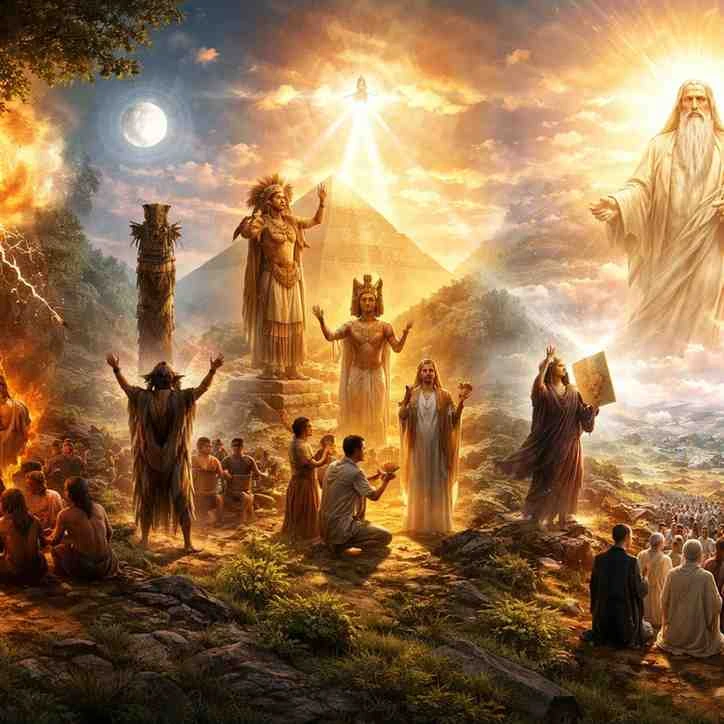
The Evolution of the concept of God has been one of the most profound and enduring ideas in human history. Across civilisations, cultures, and time periods, human beings have sought to understand forces greater than themselves. The development of the concept of God is one of the most profound journeys in human history, shaped by nature, morality, philosophy, and hope. The idea of God did not emerge suddenly; rather, it evolved gradually as humans tried to explain nature, life, suffering, and purpose. Understanding how the concept of God developed helps us understand humanity itself—its fears, hopes, and search for meaning.
Evolution of the concept of God in Early Human Beliefs
In early human societies, survival depended heavily on nature. The sun, rain, wind, fire, and animals directly influenced human life. Early humans began attributing divine power to natural elements, believing them to be controlled by unseen forces. This led to nature worship, where the sun became a god, rain was seen as a divine blessing, and storms were feared as expressions of anger. These early beliefs were humanity’s first attempt to connect with the unknown.
Evolution of the concept of God: From Spirits to Many Gods
As societies became more organised, belief systems evolved from simple nature worship to animism – the belief that spirits inhabited objects, trees, rivers, and mountains. Over time, these spirits were personified into gods with specific roles. Polytheistic systems emerged, where different gods governed different aspects of life such as fertility, war, wisdom, and justice. Ancient civilizations like Egypt, Greece, Mesopotamia, and India developed rich mythologies reflecting their social structures and values.
Evolution of the concept of God and the Rise of Monotheism
With the growth of social order and ethical awareness, the idea of God began to change. God was no longer seen only as a controller of natural forces but also as a moral authority. People began believing that divine power rewarded good behavior and punished wrongdoing. This shift helped societies maintain order and encouraged ethical living. God became more personal- someone who listened, guided, and protected.
The Emergence of Monotheism
One of the most significant developments in religious thought was monotheism—the belief in one supreme God. This idea emerged in various traditions, emphasizing a single, all-powerful, all-knowing creator. Monotheism simplified religious understanding and introduced the concept of a universal moral law. God was no longer limited to one community or region, but seen as universal.
Philosophical Interpretations of God
As human intellect advanced, philosophers began exploring God beyond rituals and myths. Thinkers questioned whether God was a form, a force, or pure consciousness. In many philosophical traditions, God became an abstract reality—eternal, formless, and beyond human understanding. This marked a shift from external worship to internal realization, where knowing God meant understanding truth, self, and existence.
God as Love, Compassion, and Hope
Over time, the emotional relationship between humans and God deepened. God came to be seen not just as a ruler or judge, but as a source of love, mercy, and hope. In times of suffering, faith in God provided comfort and strength. Prayer, devotion, and surrender became ways to cope with pain and uncertainty. The concept of God evolved into a deeply personal experience rather than a distant authority.
Modern Perspectives on the Evolution of the concept of God
In the modern world, scientific discoveries have changed how people view the universe, but the idea of God has not disappeared. Instead, it has adapted. Many people now view God as a universal intelligence, cosmic energy, or inner consciousness. Others see God as a symbol of moral values and human unity. Even those who question traditional beliefs often seek meaning, purpose, and connection—elements historically associated with God.
Stanford Encyclopedia of Philosophy page on Concept of God
Why the Evolution of the concept of God Continues to Exist
The concept of God continues because it addresses fundamental human needs: the need for meaning, security, hope, and moral guidance. Whether viewed religiously, philosophically, or spiritually, God represents humanity’s desire to understand life beyond the visible world. The evolution of this concept reflects humanity’s intellectual and emotional growth.
What is Spirituality?
Conclusion
The concept of God developed alongside human civilization, shaped by fear, curiosity, morality, philosophy, and compassion. From nature worship to abstract philosophy, God has taken many forms, yet the core purpose remains the same—to help humans understand existence and their place within it. Ultimately, the idea of God is not just about belief, but about humanity’s endless quest for truth, meaning, and inner peace.
~Religion World Bureau