Bak Full Moon Poya falls on the full moon day in April and is regarded as one of the most significant sacred days in Sri Lanka’s Buddhist calendar. The month of Bak itself holds national importance, making this Poya day especially meaningful for devotees.
This holy day commemorates the second visit of the Buddha to Sri Lanka, which is said to have taken place in the fifth year after His Supreme Enlightenment. According to Buddhist tradition, the Buddha visited Sri Lanka to settle a serious dispute between two Naga chiefs, Mahodara and Chulodara, who were uncle and nephew. Their conflict had escalated over a magnificent jeweled throne, and the disagreement was moving toward open hostility.
The spiritual theme associated with Bak Full Moon Poya is Right Understanding (Samma Ditthi), one of the key principles in Buddhist teaching.
Why Bak Full Moon Poya Is Celebrated
The importance of the Full Moon Poya is deeply connected to the Buddha’s role as a bringer of peace and harmony. Tradition states that Mahodara, a Naga king with miraculous powers, ruled a kingdom in the ocean. His younger sister was married to the Naga king of Kannavaddhamana Mountain, and their son was Chulodara.
A jeweled throne had been given to Chulodara’s mother by her father. After the death of the Naga king, a dispute arose over ownership of that throne. This disagreement soon turned into a threatening conflict between Mahodara and Chulodara, while other Nagas, also possessing miraculous powers, prepared for battle.
Buddha’s Second Visit to Sri Lanka
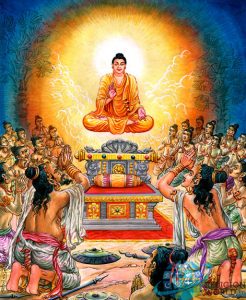
According to the Mahavamsa, the Buddha came to Sri Lanka accompanied by a deity. His purpose was to prevent war and restore peace among the Nagas. As the story is told, the Buddha appeared above the battlefield in mid-air and first created darkness, causing fear among the Nagas. He then dispelled the darkness and spread light once again.
Seeing the Blessed One, the Nagas were filled with devotion and bowed at His feet. The Buddha then preached the doctrine of peace, unity and concord. Moved by His teaching, both Mahodara and Chulodara gave up their claim to the throne and ended their dispute.
Spiritual Meaning of Full Moon Poya
The message of Bak Full Moon Poya goes beyond a historical or legendary event. It reminds devotees of the value of wisdom, understanding and reconciliation. The day highlights how conflict can be resolved not through violence, but through compassion and right thinking.
For Buddhists, this sacred day is an opportunity to reflect on Samma Ditthi, or Right Understanding, and to strengthen faith in the teachings of the Buddha. It is also a time to practice generosity, observe religious activities and focus on inner peace.
Conclusion
Full Moon Poya is a deeply revered day that marks the Buddha’s second visit to Sri Lanka and His intervention in a conflict that could have led to destruction. The day stands as a powerful symbol of peace, wisdom and harmony. Its message remains relevant even today, encouraging people to choose understanding over division and peace over conflict.
FAQ
1. What is Bak Full Moon Poya?
Bak Full Moon Poya is a sacred Buddhist observance held on the full moon day of April, commemorating the Buddha’s second visit to Sri Lanka.
2. Why is Bak Full Moon Poya important?
It is important because it marks the occasion when the Buddha reconciled two Naga chiefs, Mahodara and Chulodara, preventing conflict.
3. What is the main theme of Bak Full Moon Poya?
The theme of the day is Right Understanding, also known as Samma Ditthi.
4. Who were Mahodara and Chulodara?
Mahodara and Chulodara were Naga chiefs, uncle and nephew, who were in conflict over a jeweled throne.
5. What does Bak Full Moon Poya teach us?
It teaches the importance of peace, wisdom, harmony and resolving disputes through understanding.
Courtesy: http://sridaladamaligawa.lk

Editorial Review Note
Written by Religion World — Bhavya Srivastava is the founder of Religion World and a veteran journalist with over 18 years of experience across broadcast, print, and digital media. A founding member of the International Association of Religion Journalists (IARJ), he has spent much of his career reporting on and producing content about religion, faith, and spirituality. View full profile →.
Religion World provides information on all religions and presents it impartially. You can send us information, news, updates, opinions, and suggestions at religionworldin@gmail.com. You can also follow us on X (Twitter), Facebook, and YouTube.
Leave a Reply