
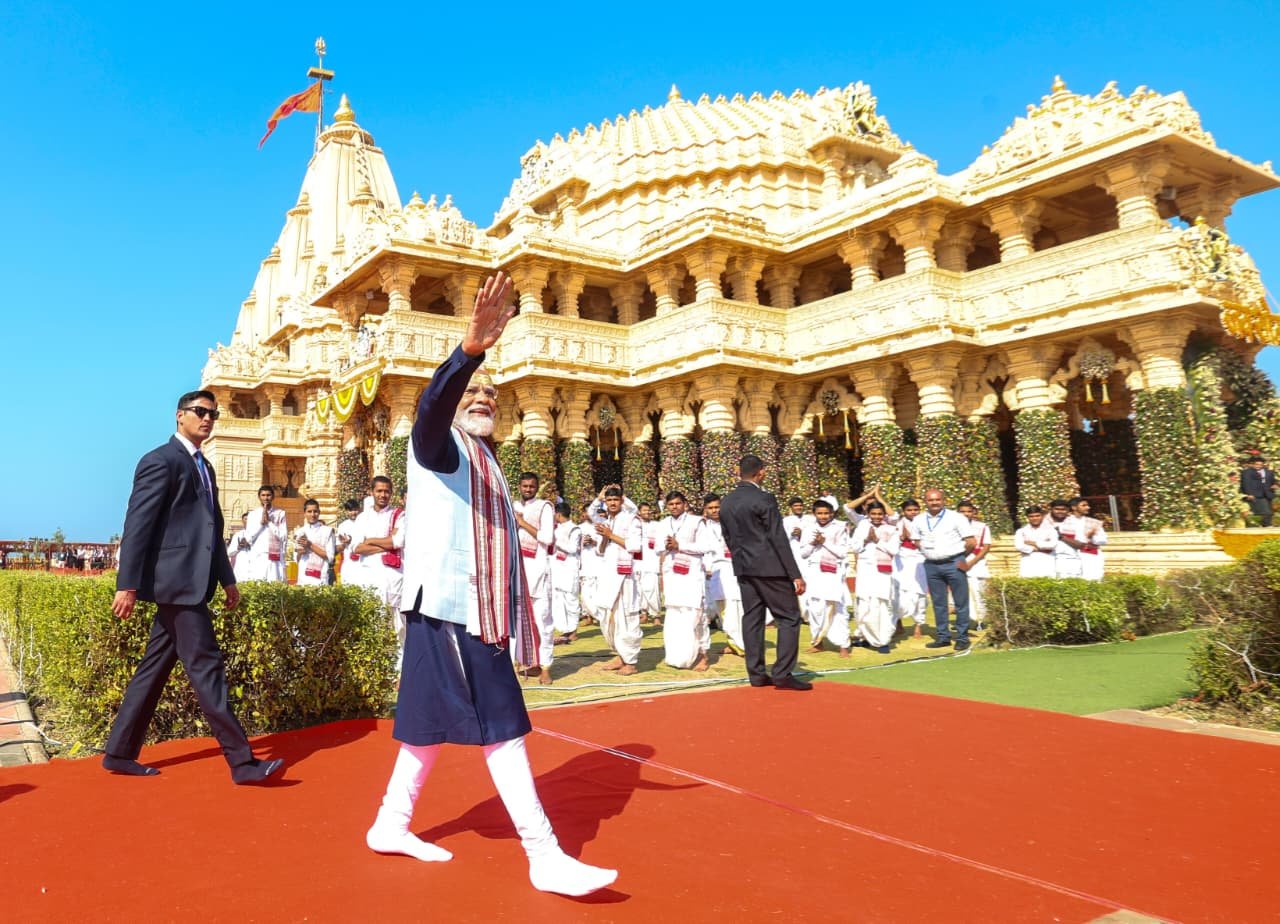
Somnath 1000-Year Mahotsav: A Millennium of Faith, Resilience and National Consciousness
Somnath (Gujarat):The historic coastal town of Somnath witnessed an extraordinary convergence of faith, history, and national sentiment as the Somnath Swabhiman Parv, marking 1,000 years of the temple’s civilizational journey, concluded with grand rituals and high-level participation. The multi-day Mahotsav commemorated one millennium since the first recorded attack on the Somnath Temple in 1026 CE, while also celebrating 75 years of the temple’s reconstruction in independent India.
The event emerged not merely as a religious gathering, but as a symbolic reaffirmation of India’s cultural continuity and collective memory, drawing saints, scholars, devotees, and national leadership to one of Hinduism’s most revered Jyotirlingas.

Prime Minister Narendra Modi’s Participation
Prime Minister Narendra Modi played a central role in the Mahotsav, underscoring the national significance of the occasion. His presence at Somnath was widely seen as both spiritual participation and cultural leadership, reinforcing the narrative of heritage preservation and civilizational pride.

The Prime Minister offered traditional prayers and rituals at the Somnath Jyotirlinga, performing puja in accordance with established temple customs. He also participated in the Omkar Mantra Anushthan, a continuous collective chanting of the sacred syllable Om, symbolizing unity, cosmic order, and spiritual resilience.
Addressing the gathering, PM Modi described the Somnath Mahotsav as “a celebration of India’s existence, faith, and self-respect”, stating that Somnath stands as a living testimony to the nation’s ability to rebuild, renew, and rise despite centuries of adversity.
Key Rituals and Religious Observances
The Mahotsav featured a carefully curated sequence of Vedic and Shaiva rituals, maintaining traditional sanctity while accommodating large-scale participation.
Major Ritual Highlights
-
Jyotirlinga Abhishek and Puja: Performed by temple priests following ancient Shaiva traditions
-
Continuous Omkar Chanting: A 72-hour collective spiritual practice involving saints and devotees
-
Deepotsav and Aarti: Evening aartis illuminated the temple complex and the Arabian Sea coastline
-
Shaurya Yatra: A symbolic procession honouring historical defenders of Dharma, featuring 108 horses, representing courage, continuity, and remembrance
-
Commemorative Sankalpa: Collective prayers dedicated to peace, harmony, and national unity
The rituals reflected a conscious effort to preserve orthodoxy while expanding inclusivity, allowing thousands of devotees to participate without diluting religious discipline.
Cultural and Technological Elements
In a notable blend of tradition and modernity, the Mahotsav incorporated technology-enabled storytelling to narrate Somnath’s history.
A large-scale drone and light show depicted key moments from the temple’s past—its ancient glory, periods of destruction, and eventual reconstruction—projected against the night sky. The presentation aimed to engage younger generations and international audiences while reinforcing historical awareness.
Cultural programmes featuring classical music, devotional compositions, and thematic narrations complemented the religious proceedings, transforming the Mahotsav into a holistic civilizational event rather than a single-point religious ceremony.
Historical Context: Why the 1000-Year Milestone Matters
The Somnath Temple has occupied a unique place in Indian history. First mentioned in ancient texts and travel accounts, it has faced repeated destruction over centuries, beginning with the 1026 CE invasion. Each time, it was rebuilt by devotees and rulers, making it a symbol of unbroken faith and collective resolve.
After India’s independence, the temple’s reconstruction was spearheaded under the leadership of Sardar Vallabhbhai Patel, culminating in its re-inauguration in 1951. The present Mahotsav thus bridged three timelines:
-
A millennium since the first recorded attack
-
Centuries of repeated destruction and revival
-
75 years of post-independence restoration
This layered historical context gave the celebration depth beyond ritual observance.
Public Participation and National Response
Thousands of devotees from across India attended the Mahotsav in person, while parallel observances were held in temples and spiritual centres nationwide. Special prayers, lamp-lighting ceremonies, and discourses were organized in multiple cities, extending the Mahotsav’s impact beyond Somnath.
Security arrangements and crowd management were handled through coordinated efforts between temple authorities and the state administration, ensuring smooth conduct of events.
Broader Significance
Observers noted that the Somnath 1000-Year Mahotsav marked a shift in how religious heritage events are positioned—from isolated temple celebrations to national cultural milestones. The integration of ritual, historical narrative, leadership participation, and modern presentation created a template for future heritage commemorations.
The Mahotsav reinforced Somnath’s identity not only as a sacred site, but as a civilizational anchor, representing India’s enduring relationship with faith, memory, and renewal.
Conclusion
As the chants faded and lamps dimmed, the Somnath Swabhiman Parv left behind a resonant message: faith may be challenged, but it is never erased. The 1,000-year commemoration stood as a reminder that Somnath is not merely a monument of stone, but a living embodiment of India’s spiritual resilience and historical consciousness.
In that sense, the Mahotsav was less about looking back—and more about reaffirming continuity in the present, with confidence for the future.
- Religion World Bureau

Editorial Review Note
Written by Religion World — Bhavya Srivastava is the founder of Religion World and a veteran journalist with over 18 years of experience across broadcast, print, and digital media. A founding member of the International Association of Religion Journalists (IARJ), he has spent much of his career reporting on and producing content about religion, faith, and spirituality. View full profile →.
Religion World provides information on all religions and presents it impartially. You can send us information, news, updates, opinions, and suggestions at religionworldin@gmail.com. You can also follow us on X (Twitter), Facebook, and YouTube.