The evolution of the concept of God is one of the most profound and enduring developments in human history. Across civilizations, cultures, and ages, human beings have tried to understand powers greater than themselves. The concept of God did not appear suddenly. Instead, it developed gradually as people tried to explain nature, suffering, morality, life, death, and the purpose of existence.
Understanding the evolution of the concept of God helps us understand humanity itself—its fears, hopes, imagination, and constant search for meaning. From nature worship and spirits to monotheism, philosophy, and modern spirituality, the idea of God has changed over time while continuing to remain central to human life.
Early Human Beliefs and the Evolution of the Concept of God
In early human societies, life depended almost entirely on nature. The sun, rain, wind, fire, rivers, animals, and changing seasons directly affected survival. Because early humans could not scientifically explain these forces, they often believed they were controlled by unseen powers.
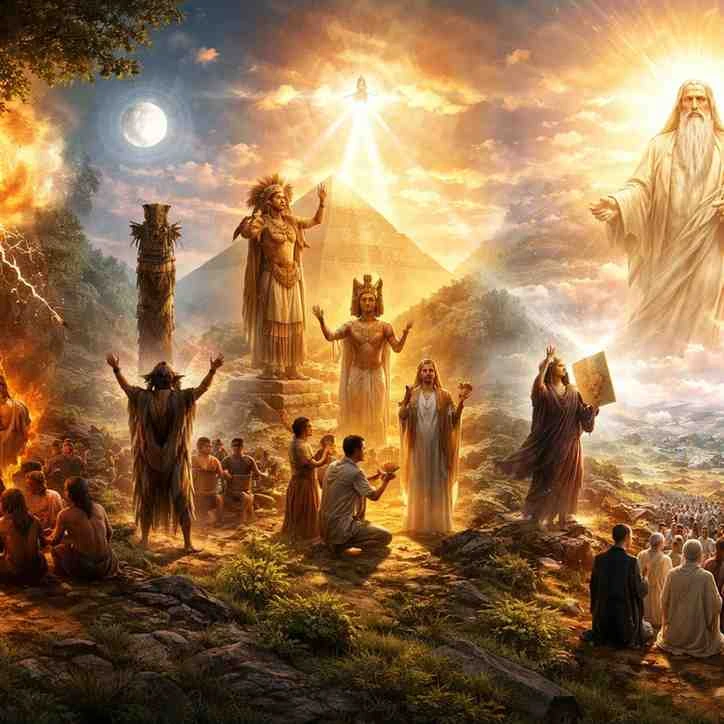
This was one of the earliest stages in the evolution of the concept of God. Natural forces were treated as sacred, powerful, and divine. The sun was seen as a life-giving power, rain as a blessing, and storms as signs of divine anger. This gave rise to nature worship, one of humanity’s first spiritual responses to the unknown.
From Nature Worship to Spirits and Animism
As human thought became more organized, belief systems also developed further. People began to believe that not only natural forces, but also trees, rivers, mountains, rocks, and animals had spirits within them. This belief is known as animism.
Animism played an important role in the evolution of the concept of God because it marked a shift from worshipping visible natural elements to believing in invisible spiritual presence. Humans started seeing the world as alive with sacred energy. This made religion more personal and symbolic, as people tried to communicate with these spirits through rituals, offerings, and prayers.
Evolution of the Concept of God in Polytheistic Traditions
As ancient civilizations became more complex, religious beliefs also became more structured. Different divine powers were given specific names, forms, personalities, and responsibilities. This led to polytheism, the belief in many gods.
In polytheistic traditions, different gods ruled over different areas of life, such as fertility, war, wisdom, death, justice, and prosperity. Ancient civilizations such as Egypt, Mesopotamia, Greece, Rome, and India developed rich mythologies and temple traditions around these divine figures.
This stage in the evolution of the concept of God reflected the social and cultural complexity of growing civilizations. Gods were often seen as protectors of kingdoms, moral enforcers, and cosmic powers connected to everyday life.
The Rise of Moral and Personal Understandings of God
Over time, the concept of God began to move beyond nature and ritual. As societies developed moral codes and systems of justice, divine power was increasingly understood as a source of ethical order. God was not only seen as a force controlling the world, but also as one who rewarded good actions and punished wrongdoing.
This was a major turning point in the evolution of the concept of God. The divine became more personal and moral. People believed that God listened to prayers, guided human behavior, protected the righteous, and cared about justice. Religion was no longer only about survival and fear; it also became about morality, duty, and inner responsibility.
The Emergence of Monotheism
One of the most significant stages in the evolution of the concept of God was the rise of monotheism, the belief in one supreme God. Unlike polytheism, monotheism emphasized a single, all-powerful, all-knowing, and universal creator.
This development changed religious thought in a major way. God was no longer seen as limited to one place, tribe, or function. Instead, God became the creator and ruler of the entire universe. Monotheism also strengthened the idea of universal moral law, where all human beings were accountable to one divine authority.
The emergence of monotheism simplified many religious ideas while deepening others. It introduced a more unified view of creation, morality, and human purpose.
Philosophical Interpretations in the Evolution of the Concept of God
As human reasoning advanced, philosophers and spiritual thinkers began to interpret God in more abstract and intellectual ways. Rather than focusing only on rituals, stories, or images, they asked deeper questions: Is God a person, a force, pure consciousness, or the ultimate truth behind existence?
This phase of the evolution of the concept of God moved religion toward philosophy. In many traditions, God came to be understood as eternal, formless, infinite, and beyond ordinary human description. God was no longer seen only as an external being to be worshipped, but also as a deeper truth to be realized within.
In philosophical and mystical traditions, knowing God became connected with self-knowledge, truth, consciousness, and liberation.
God as Love, Compassion, and Hope
Another important stage in the evolution of the concept of God was the emotional and devotional relationship that developed between human beings and the divine. Over time, God came to be seen not only as powerful and just, but also as loving, merciful, compassionate, and forgiving.
This transformed religion into a deeply personal experience. In times of suffering, uncertainty, loss, and fear, faith in God offered comfort and strength. Prayer, surrender, devotion, and trust became ways through which people connected with the divine.
In this sense, the evolution of the concept of God was not only intellectual or social, but also emotional and spiritual. God became a source of peace, healing, and hope.
Modern Perspectives on the Evolution of the Concept of God
In the modern age, science, philosophy, psychology, and global cultural exchange have changed how many people think about God. However, the idea of God has not disappeared. Instead, it has adapted in new ways.
Today, some people continue to follow traditional religious beliefs, while others understand God as a universal intelligence, cosmic energy, divine consciousness, or symbol of moral truth. Some approach God spiritually rather than religiously. Others question the traditional concept of God but still seek meaning, purpose, and connection.
These modern perspectives show that the evolution of the concept of God is still continuing. The language may change, but the human search for transcendence, truth, and inner peace remains alive.
Why the Evolution of the Concept of God Still Matters
The evolution of the concept of God continues to matter because it reflects humanity’s deepest questions. Human beings want to know why they exist, how the universe began, what is right and wrong, and what gives life meaning.
The idea of God has endured because it addresses fundamental human needs:
- the need for meaning
- the need for hope
- the need for moral guidance
- the need for security
- the need for spiritual connection
Whether understood religiously, philosophically, or spiritually, God remains one of humanity’s most powerful ideas. The continued development of this concept reflects both intellectual growth and emotional depth.
Conclusion
The evolution of the concept of God is closely connected with the evolution of human civilization itself. From nature worship and animism to polytheism, monotheism, philosophy, and modern spiritual thought, the concept of God has changed with human understanding.
Yet despite these changes, the deeper purpose has remained the same: to help human beings make sense of existence, morality, suffering, hope, and their place in the universe. The concept of God is not just a religious idea. It is also a reflection of humanity’s endless search for truth, meaning, and inner peace.
Frequently Asked Questions
What is the evolution of the concept of God?
The evolution of the concept of God refers to the gradual development of human beliefs about divine power, moving from nature worship and animism to polytheism, monotheism, philosophy, and modern spiritual thought.
How did the concept of God develop in early societies?
In early societies, people depended on natural forces such as the sun, rain, fire, and wind for survival. They began to see these forces as sacred or divine, which led to nature worship and early religious beliefs.
What role did polytheism play in the evolution of the concept of God?
Polytheism introduced the idea of many gods with different powers and responsibilities, such as fertility, war, wisdom, and justice. It reflected the growing complexity of ancient civilizations and their cultural values.
Why is monotheism important in the evolution of the concept of God?
Monotheism marked a major shift by presenting God as one supreme, universal creator. It strengthened the ideas of divine unity, moral law, and a single spiritual authority for all humanity.
How is the concept of God viewed in modern times?
In modern times, some people continue to follow traditional religious beliefs, while others understand God as universal intelligence, cosmic energy, moral truth, or inner consciousness. The idea of God continues to adapt to changing human thought.
~Religion World Bureau

Editorial Review Note
Written by Religion World — Bhavya Srivastava is the founder of Religion World and a veteran journalist with over 18 years of experience across broadcast, print, and digital media. A founding member of the International Association of Religion Journalists (IARJ), he has spent much of his career reporting on and producing content about religion, faith, and spirituality. View full profile →.
Religion World provides information on all religions and presents it impartially. You can send us information, news, updates, opinions, and suggestions at religionworldin@gmail.com. You can also follow us on X (Twitter), Facebook, and YouTube.