
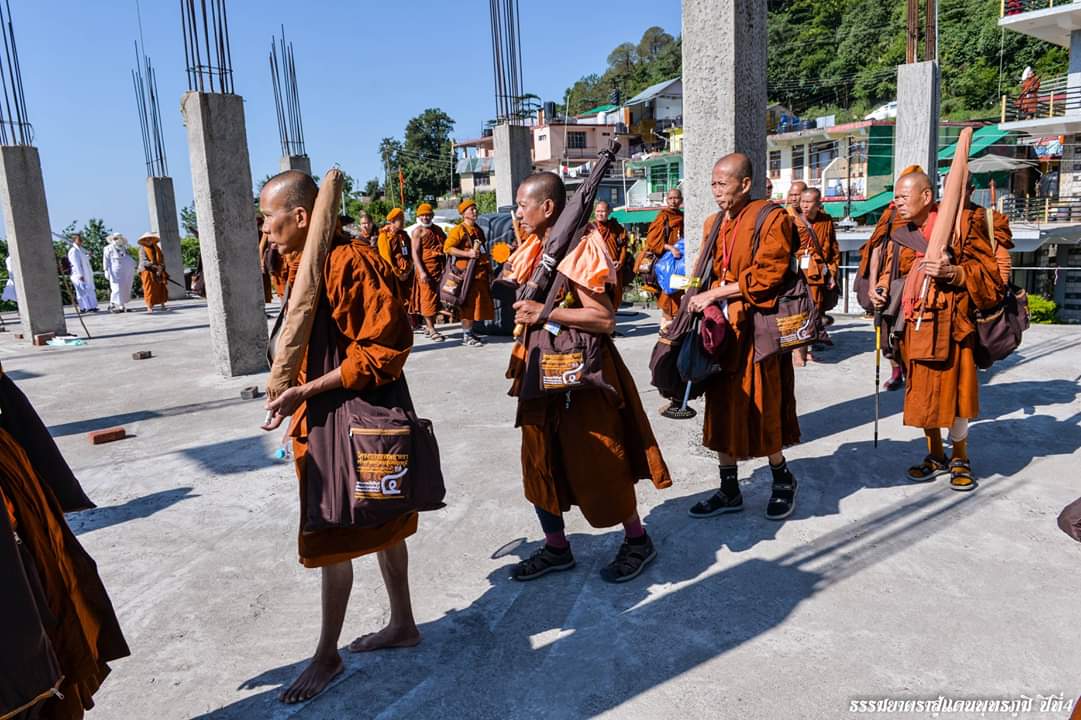
India, the land of Lord Buddha (Buddhist Walking Pilgrimage), has long attracted millions of Buddhists from across the world. Monks, pilgrims, researchers and travellers from every continent visit this sacred land to experience the places associated with Gautam Buddha, whose teachings of wisdom and self-realisation continue to inspire humanity. From Bodhgaya to Sarnath, these holy sites remain deeply revered by devotees, much like other great spiritual destinations of the world.
Inspired by this spiritual connection, a group of Thailand-based monks began a unique journey four years ago. Their vision was to come to India and walk on foot to important Buddhist destinations connected with Buddha’s life and teachings. This journey was not just a pilgrimage, but also a test of devotion, discipline and endurance, as the monks chose to travel by foot while managing all basic arrangements along the way.
In its fourth consecutive year, nearly 200 monks and nuns from Thailand undertook a month-long Buddhist Walking Pilgrimage or Pad Yatra through the Himalayas. Every day, the pilgrims walked several kilometres, prepared their meals, prayed, meditated and rested for a few hours before continuing their spiritual path. This sacred journey was dedicated to the message of peace and the protection of the Himalayas.
The significance of this Walking Pilgrimages initiative grew further through its collaboration with the Ladakh-based Mahabodhi International Meditation Centre (MIMC), founded by spiritual leader Bhikkhu Sanghasena. He invited the monks and nuns to his ashram in Ladakh, where the journey was scheduled to culminate on June 25-26, 2019.
This spiritual yatra holds great value not only for the participants but also for Buddhist communities worldwide. His Holiness the Dalai Lama has warmly welcomed the group during their journeys, inviting them to Dharamshala and arranging meals and other support. During the 2019 pilgrimage, the monks met His Holiness on May 23 and 24, 2019.
Despite its noble purpose, the padyatra comes with many challenges. Arranging food, shelter and medical support for such a large group is demanding, especially in weather and terrain very different from Thailand. Climatic conditions in the Himalayas can also be difficult. However, with proper coordination and support, the pilgrimage continued smoothly without any major obstacles.
The journey also highlighted larger global concerns. A three-day international conference on world peace and the protection of Himalayan heritage was planned at MIMC, Ladakh. Speaking on the occasion, Bhikkhu Sanghasena stressed the urgency of peace in today’s world. He noted that terrorism, war and violence are affecting societies in many forms, and humanity cannot remain a silent spectator.
These Walking Pilgrimages are more than a religious journey. They represent compassion, discipline, peace and a deep commitment to preserving both spiritual heritage and nature. In a world facing conflict and environmental threats, such pilgrimages send a powerful message of harmony, mindfulness and responsibility.
FAQ
1. What are Walking Pilgrimages?
Walking Pilgrimages refer to a spiritual Pad Yatra undertaken by monks and nuns on foot to Buddhist sacred places in India.
2. How many monks took part in this pilgrimage?
Nearly 200 monks and nuns from Thailand participated in the month-long pilgrimage.
3. What was the purpose of the Walking Pilgrimages?
The journey was dedicated to peace, spiritual devotion and the protection of the Himalayas.
4. Who supported the pilgrimage in Ladakh?
The Mahabodhi International Meditation Centre in Ladakh, founded by Bhikkhu Sanghasena, supported the pilgrimage.
5. Did the monks meet the Dalai Lama?
Yes, the monks met His Holiness the Dalai Lama on May 23 and 24, 2019, during their pilgrimage.
Agenda of the Conference: conference-agenda

Editorial Review Note
Written by Religion World — Bhavya Srivastava is the founder of Religion World and a veteran journalist with over 18 years of experience across broadcast, print, and digital media. A founding member of the International Association of Religion Journalists (IARJ), he has spent much of his career reporting on and producing content about religion, faith, and spirituality. View full profile →.
Religion World provides information on all religions and presents it impartially. You can send us information, news, updates, opinions, and suggestions at religionworldin@gmail.com. You can also follow us on X (Twitter), Facebook, and YouTube.